
Prompt Engineering vs Context Engineering: Why Smart Businesses Need More Than Better Prompts
Member-only insight for SME owners, consultants, trainers, and decision makers who want AI outputs that are not just faster, but actually useful.
Many business owners think their AI problem is simple: “We need better prompts.”
On the surface, that sounds reasonable. If the output is weak, surely the instruction was weak too.
But in real business use, that is only part of the story.
The bigger issue is often not the wording of the prompt. It is the lack of business context behind it.
That is why one team gets generic, fluffy answers from AI, while another gets something that actually helps them close deals, write better proposals, or support customers with more confidence.
This matters because AI in business is no longer just about asking interesting questions. It is about building a reliable thinking environment around the task.
A familiar business scene
Imagine a business owner in Kuala Lumpur running a growing HR outsourcing firm.
The team is busy. Sales enquiries are coming in. Prospects ask about payroll outsourcing, onboarding support, compliance concerns, and whether the firm can support multi-branch operations.
So the manager opens ChatGPT and types:
“Write a proposal for HR outsourcing services.”
The AI responds quickly. The writing looks polished. The English sounds professional.
But something feels off.
The proposal sounds like it could belong to almost any company. It does not reflect the firm’s actual service scope. It does not address the client’s real concerns. It misses the proof points that matter. It sounds acceptable, but not convincing.
That is where many businesses get misled. They think the answer is to keep tweaking the prompt.
In reality, the problem is deeper.
What is really going wrong
The visible problem is poor output.
The hidden problem is thin context.
Most teams are asking AI to perform like a senior strategist while feeding it like a stranger.
They give the task, but not the business reality behind the task.
They ask for a proposal without sharing the offer structure. They ask for a follow-up email without sharing the discovery notes. They ask for sales messaging without sharing the buyer fears, proof points, or stage of conversation.
It is like asking a tailor to make a suit without giving measurements, occasion, or budget. You may still get a suit. But it will not fit the person, the moment, or the purpose.
That is why this matters in business. Generic output creates hidden costs: weak positioning, slower sales cycles, inconsistent communication, and teams that start doubting the value of AI.
The strategic shift: from asking better to briefing better
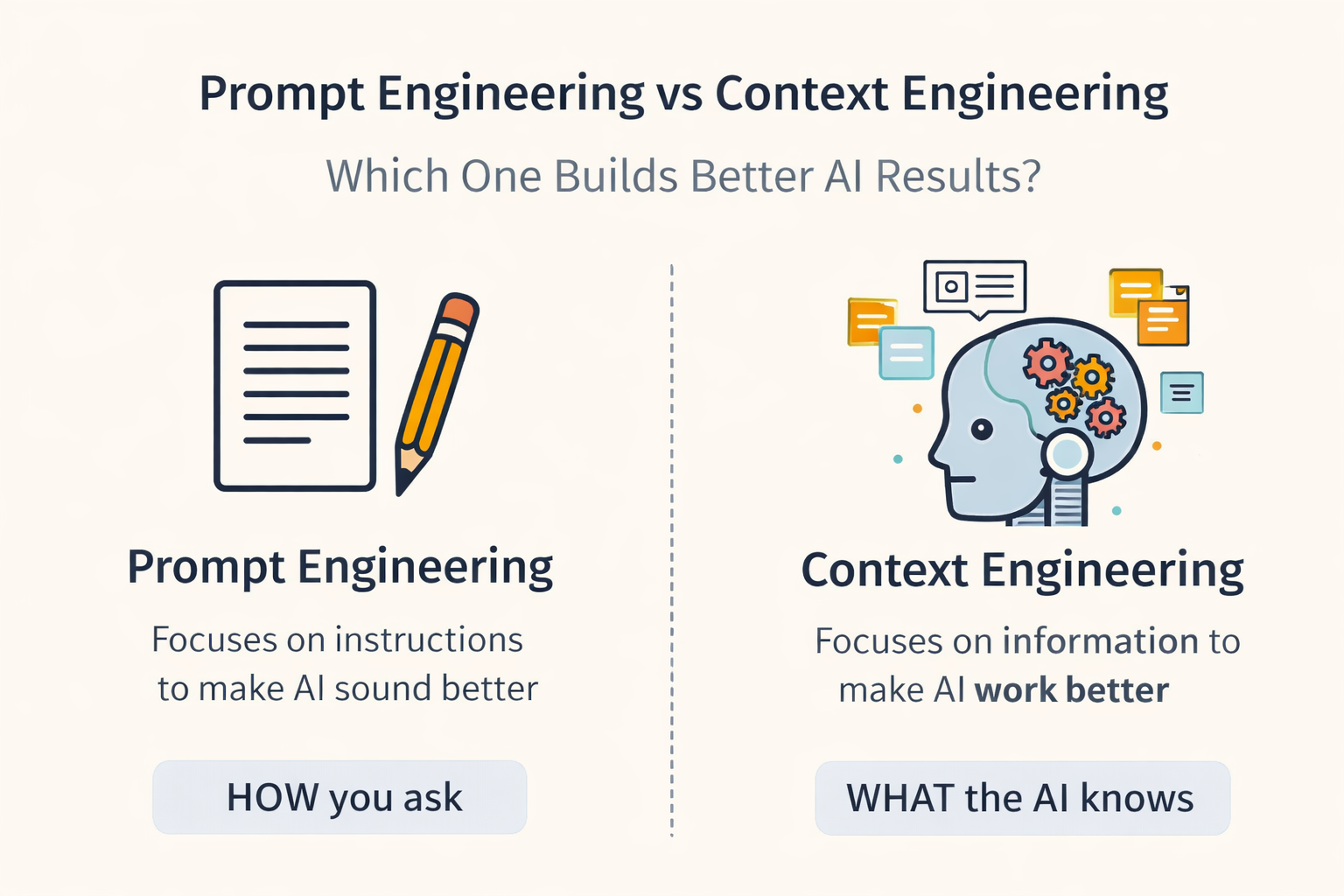
Prompt engineering focuses on how you ask.
Context engineering focuses on what the AI knows before it answers.
That difference may sound small, but commercially it is huge.
If prompt engineering is about wording the request well, context engineering is about designing the working environment around the request.
In plain language:
Prompt engineering helps AI sound better.
Context engineering helps AI work better.
This is the shift many businesses need to make. Not because prompts no longer matter, but because prompts alone are too thin for real decision-making, customer communication, and revenue work.
A practical framework: The 4C Context Stack
Before your team asks AI to write, analyse, recommend, or reply, make sure four layers are clear.
1. Company Context
What does your business actually do? What do you sell, to whom, in what way, and with what positioning?
This matters because AI cannot reflect your value if it does not understand your business model.
2. Customer Context
Who is the customer? What are they trying to solve? What are they worried about? What language do they use when describing the problem?
This matters because customers do not buy based on your service list. They buy based on their pain, urgency, risk, and desired outcome.
3. Conversion Context
What stage is this task for? First enquiry? Proposal stage? Follow-up after a meeting? Renewal conversation?
This matters because the right message depends on timing. A discovery email should not sound like a final proposal. A proposal should not sound like a brochure.
4. Constraint Context
What should the AI avoid assuming? What boundaries, pricing rules, tone rules, legal limits, or service limits must it respect?
This matters because useful AI is not just creative. It is commercially safe and aligned.
When these four layers are present, your AI output usually becomes more specific, more credible, and more reusable.
Side-by-side: prompt only vs context-led prompting
| Prompt Only | Context-Led Prompt |
|---|---|
|
Request Likely content |
Request Likely content |
|
Request Likely content |
Request Likely content |
Real-world walkthrough: how a service business would apply this
Let us stay with the HR outsourcing firm.
A prospect from a mid-sized retail chain reaches out. They have multiple branches, frequent staff turnover, messy onboarding, and recurring payroll corrections. On the surface, they are asking for HR support.
But beneath that request are deeper business concerns.
Their likely pains: too much manual work, inconsistent process across branches, payroll errors, and internal staff stretched too thin.
Their likely fears: compliance mistakes, service disruption during handover, poor response time, and getting locked into a service that does not fit.
Their proof needs: evidence of rollout capability, clarity on scope, confidence that branch operations will not be disrupted, and signs that your team understands retail complexity.
Now notice what happens.
If your AI only receives the task — write a proposal — it will produce language.
If your AI receives the business reality behind the task, it can produce decision support.
That is the commercial difference.
Using the 4C Context Stack, the team would brief AI like this:
- Company Context: We provide payroll, onboarding, and HR admin outsourcing for Malaysian SMEs with multi-branch operations.
- Customer Context: Retail client with 4 branches, high staff turnover, recurring payroll errors, onboarding inconsistency.
- Conversion Context: Proposal stage after a discovery call.
- Constraint Context: Do not mention recruitment, training, or legal advisory. Keep the tone practical and risk-aware.
With this, AI can now help the team build a proposal, email, FAQ response, or internal call summary that feels far more usable.
This matters because businesses do not need more AI content. They need more commercially accurate communication.
Prompt pack for members
Use these as working prompts. Adapt them to your own business. Notice that each one contains both instruction and context.
1. Diagnose missing context before you write
Use this when your team keeps getting generic output.
Act as a business communication strategist. I want to use AI for a customer-facing task, but I do not want a generic answer. Review this task: [insert task]. Tell me what context is missing under these four categories: Company Context, Customer Context, Conversion Context, and Constraint Context. Then show me the minimum information I should provide before asking AI to generate the final output.
2. Turn a weak prompt into a context-ready prompt
Use this when you already have a rough instruction.
Act as an AI workflow advisor for SMEs. Here is my original prompt: [insert weak prompt]. Rewrite it into a stronger, context-led prompt that will produce a more specific and commercially useful result. Keep the prompt practical, not overly long, and make sure it includes business context, buyer situation, stage of communication, and key constraints.
3. Build a proposal brief from discovery notes
Use this after a sales call.
Act as a B2B proposal strategist. Based on these discovery notes, create a concise proposal brief before writing the full proposal. Include: client situation, likely pains, likely objections, proof needed, decision risks, offer angle, suggested structure, and next-step CTA. Discovery notes: [paste notes]. Our business offers: [paste services]. Keep the brief grounded in what the client actually cares about.
4. Create a better follow-up message based on buyer reality
Use this when follow-up emails feel too general.
Act as a consultative sales writer. Write a follow-up email after a first meeting using the information below. Reflect the buyer’s actual pain points, acknowledge their concerns, and guide them to the next step without sounding pushy. Include a subject line and keep the email warm, clear, and commercially relevant. Buyer details: [insert details]. Main concerns: [insert concerns]. Our offer: [insert offer]. Desired next step: [insert next step].
What members should do this week
Do not start by collecting more prompts.
Start by choosing one real business workflow that matters. A proposal. A follow-up email. A sales reply. A customer onboarding message. A discovery summary.
Then do this simple exercise:
- Take the prompt your team is currently using.
- Check whether it includes the 4C Context Stack.
- Rewrite it with missing context added in.
- Compare the output quality side by side.
That is how you move from experimenting with AI to building dependable business use.
Member CTA: Pick one customer-facing workflow this week and upgrade one weak prompt into a context-led brief using the 4C Context Stack. Save both versions, compare the outputs, and bring the difference into your next team discussion.
Because the real advantage is not having access to AI.
The real advantage is knowing how to feed it the business reality it needs to do useful work.