
Member Asset • Customer Clarity → Revenue Growth
The Customer Signal Engine: Turn Feedback into Revenue Clarity
Many SMEs are not short of customer feedback. They are short of a way to turn that feedback into decisions.
Comments sit in WhatsApp chats, sales calls, emails, onboarding notes, and service conversations. Everyone hears something.
Very few teams can see the full pattern.
This member workflow shows you how to turn scattered customer voice into clarity signals your business can act on:
pain points, urgency, buying triggers, trust blockers, and the places where revenue is quietly leaking.
When good feedback still doesn’t create steady growth
Imagine a boutique HR consultancy serving growing SMEs. The founder knows the work is valuable. Clients often say the programmes are practical, timely, and useful. Yet growth still feels uneven.
Prospects ask similar questions before buying. New clients get stuck at similar points during onboarding. Existing customers sometimes go quiet before renewal. Feedback exists everywhere — but it is trapped in different places, owned by different people, and rarely reviewed as one picture.
This is more common than most business owners realise. The business is hearing the customer. It just is not translating what it hears into action fast enough.
At first, it looks like a sales problem
Most SMEs diagnose this the usual way. They assume they need more leads, more promotion, faster follow-up, or better messaging. So the team does more.
The business gets busier, but not necessarily clearer.
The real gap is not data. It is visibility.
The issue is rarely that customer feedback does not exist. The issue is that nobody can see the patterns clearly enough to respond with confidence.
Customers are already telling you what feels confusing, risky, urgent, frustrating, or hard to trust. But when those signals remain buried in notes and conversations, they stay as noise.
That is why visibility matters. Once customer voice becomes structured and visible, leaders stop reacting to isolated comments and start seeing which issues deserve action.
From scattered comments to one decision system
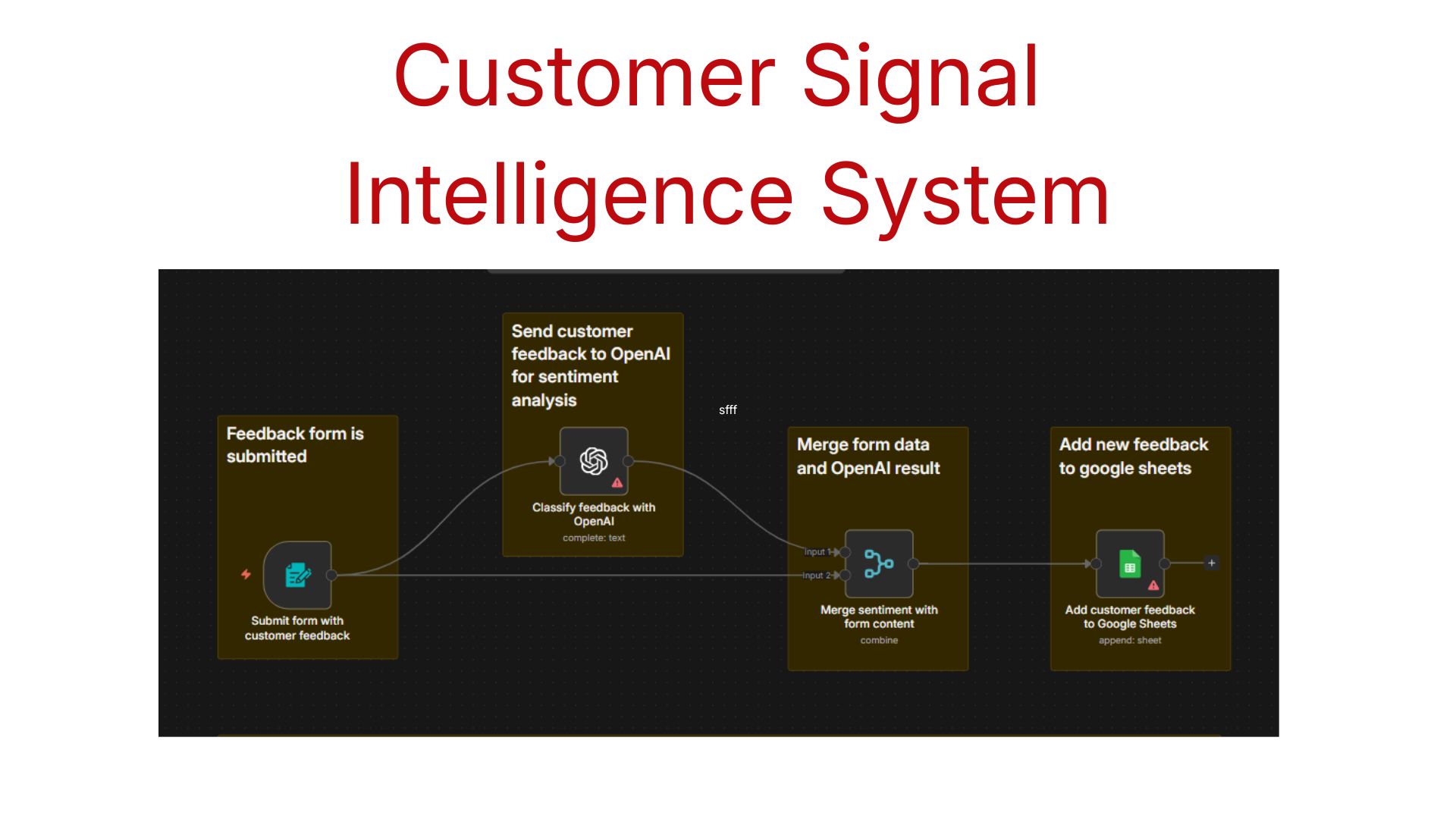
Think of this as a simple Customer Signal Engine. It gives your business a repeatable way to collect feedback, extract what matters, and turn it into owned action.
Capture feedback where it happens
Use AI to extract pain, urgency, blockers, and leak stage
Append everything into one shared Sheet
Assign owner, status, and next action
Where clarity starts compounding
This is the commercial logic behind the system. It is not just a workflow. It is a way of connecting customer reality to revenue action.
That is where the real value sits. Customer voice stops being background noise and starts becoming part of how the business runs.
What this looks like inside a real SME
Back to the HR consultancy. Once the founder starts reviewing feedback in one place, a pattern emerges: many “pricing objections” are not really about price. They are about uncertainty.
Clients are not fully sure what happens after they say yes. They want more clarity around onboarding, timelines, support, and outcomes. That insight changes the response completely.
Instead of discounting, the consultancy improves proposal clarity, onboarding visibility, and proof assets. That is a smarter move because it fixes the real blocker, not the assumed one.
The few fields that make the data useful
The Sheet should not become a passive log. It should help the team decide what matters, what to do next, and who owns it.
| Column | Why it matters |
|---|---|
| Sentiment + Urgency | Shows where trust or churn risk is highest and where response speed matters most. |
| Primary issue | Reveals which pain themes are repeating and deserve leadership attention. |
| Leak stage | Maps the issue to Lead → Sales → Onboarding → Delivery → Support → Renewal. |
| Owner + Status | Turns insight into execution instead of passive reporting. |
| Revenue impact (Low/Med/High) | Keeps focus on fixes that influence conversion, retention, and referrals. |
Start with the lean version
You do not need a perfect system on day one. You need one simple loop that creates visibility.
-
Create one feedback capture point
Use an n8n form, Google Form, Typeform, or a website form. Keep it simple enough that people will actually use it. -
Run AI extraction
Use AI to pull out the commercial signal: sentiment, urgency, primary issue, leak stage, and suggested action. -
Append everything into one Google Sheet
One shared source of truth is what makes recurring patterns visible. -
Add a decision layer
Assign owner, status, and follow-up date. Without this, the workflow creates insight but not change.
Prompt template
If you want the output to be useful inside a workflow, keep it structured. JSON makes it easier to log, sort, and review.
You are a revenue-focused customer insight analyst.

Given customer feedback text, extract these fields:
- sentiment: Positive / Neutral / Negative
- urgency: Low / Medium / High
- primary_issue: one short phrase
- leak_stage: Lead / Sales / Onboarding / Delivery / Support / Renewal
- buying_trigger_or_blocker: one short phrase
- suggested_next_action: one short sentence

Return ONLY valid JSON:
{"sentiment":"...","urgency":"...","primary_issue":"...","leak_stage":"...","buying_trigger_or_blocker":"...","suggested_next_action":"..."}

Feedback:
{{ feedback_text }}
Put each JSON field into its own Sheet column. That is what makes the trends visible.
The cadence that makes this work
A workflow only matters if it changes behaviour. This is the operating rhythm that turns customer clarity into revenue discipline.
Once the basics work, scale carefully
Once the core loop is stable, you can upgrade the system in sensible steps. The goal is not complexity. The goal is faster visibility and clearer ownership.
FAQ
Is this only for customer complaints?
No. It is just as useful for hesitation, confusion, objections, and quiet signals that block revenue long before a formal complaint appears.
Do I need technical skills?
Not for the first version. A simple form → AI extraction → Google Sheet setup is enough to start. Alerts, routing, and dashboards can come later.
What’s the fastest win?
Create one rule: any Negative + High urgency signal must be reviewed and responded to within 24 hours. That one standard protects retention and trust immediately.
Need help implementing this workflow?
Contact our AI Consultant
Get guidance on setup, prompts, routing, alerts, and turning customer signals into revenue actions.