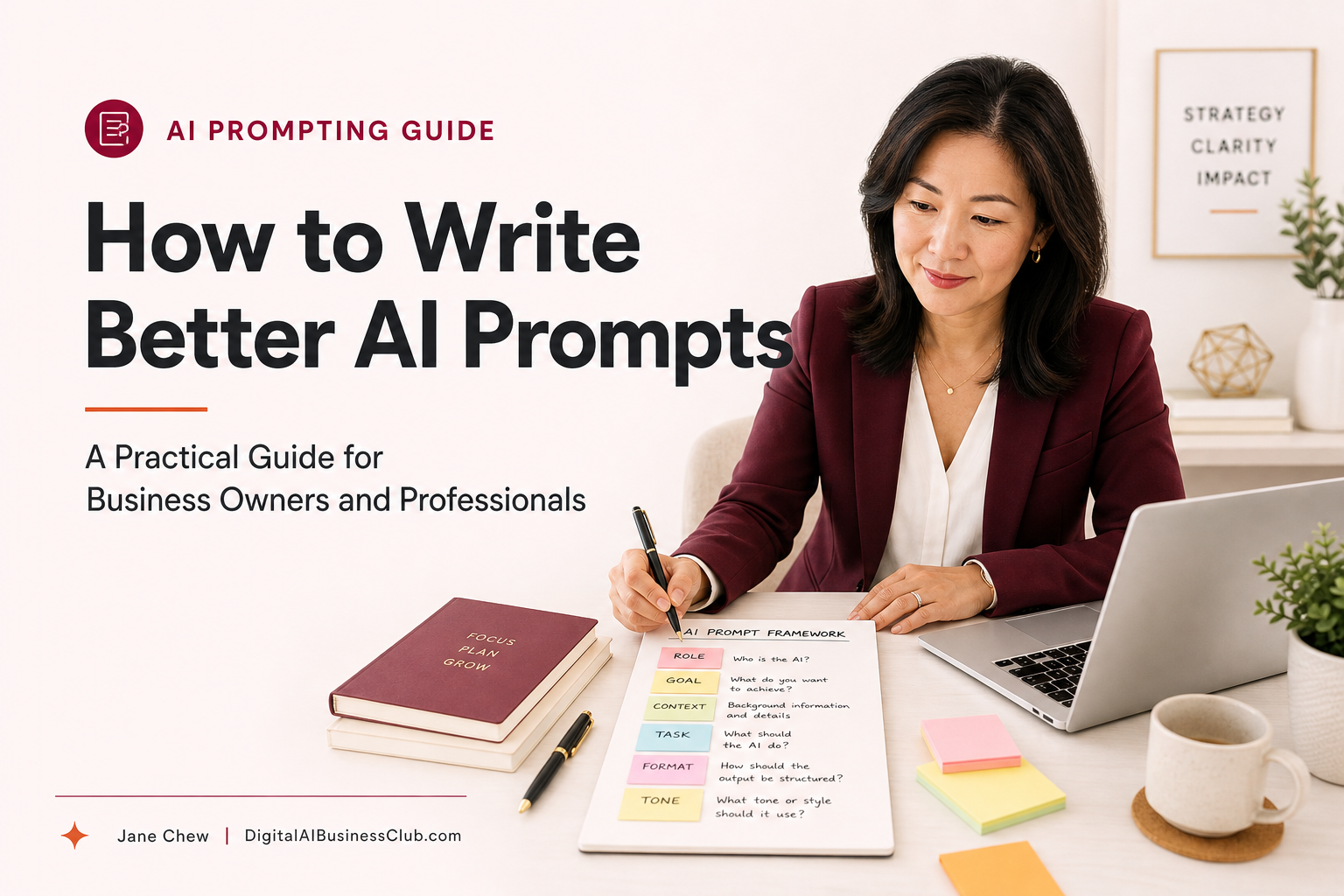
How to Write Better AI Prompts: A Practical Guide for Business Owners and Professionals
Most people think better AI results come from using a better tool. In reality, better AI results usually come from giving better instructions.
AI is powerful, but it is not magic. It works best when you know what outcome you want, what context matters, what role the AI should play, and how you will evaluate the output.
This guide shows you how to move from casual prompting to structured prompting, so AI becomes a practical work assistant instead of a random answer generator.
Quick answer: A good AI prompt should include five core elements: role, task, context, steps, and constraints. For more complex work, you can improve the output further by using examples, prompt chaining, structured formats, and clear evaluation criteria.
1. Why Prompting Matters for Business
The goal of prompting is simple: to communicate your intent clearly to AI so it can produce useful, relevant, high-quality work.
For business owners, leaders, consultants, trainers, and professionals, prompting is no longer just a technical skill. It is a delegation skill.
When you write a clear prompt, you are not just asking AI a question. You are briefing a digital assistant.
Think of AI Prompting as Delegation
When you delegate to a staff member, you would not simply say, “Do marketing.” You would explain the goal, audience, message, deadline, format, and expected quality.
The same applies to AI. A vague prompt creates vague output. A structured prompt creates a more useful first draft.
2. The Biggest Prompting Mistake: Starting Before You Define the Task
Many people open ChatGPT, Claude, Gemini, or another AI tool and immediately start typing. The problem is not the tool. The problem is that the task is unclear.
Before writing a prompt, ask yourself:
- What exactly do I want AI to help me produce?
- Who is the output for?
- What decision, action, or outcome should this support?
- What information does AI need before it can help me properly?
- How will I judge whether the output is good?
This is where many AI users go wrong. They ask AI to create content, strategy, emails, proposals, or training materials without first defining the business purpose.
Business-first reminder
Do not start with “What can AI do?” Start with “What business outcome do I want to improve?”
3. The 5-Part Prompt Structure
A strong prompt usually includes five parts:
| Prompt Element | What It Means | Business Example |
|---|---|---|
| Role | Tell AI what expert lens to use. | You are a business strategist helping SME owners improve customer conversion. |
| Task | Tell AI exactly what to do. | Create a 14-day content calendar to attract service-based SME owners. |
| Context | Give background information so the answer fits your situation. | My business helps SMEs identify revenue leaks across Lead → Trust → Close → Onboard. |
| Steps | Tell AI the thinking or working sequence to follow. | First identify the customer mindset, then map content topics, then create CTAs. |
| Constraints | Set boundaries for tone, length, style, format, and quality. | Use a calm, strategic, non-hype tone. Avoid technical jargon. Format as a table. |
This structure helps AI understand not only what you want, but how you want it to work.
4. Use Examples to Improve Output
One powerful way to improve AI output is to provide examples. This is often called few-shot prompting.
In simple terms, you show AI a few samples of the style, structure, or pattern you want. Then you ask it to create a new output following the same pattern.
Example
This works well when you want AI to follow your tone, writing style, or output pattern. It is especially useful for social posts, email openings, captions, headlines, proposal summaries, and training examples.
5. Use Prompt Chaining for Complex Work
Prompt chaining means breaking a bigger task into smaller steps. Instead of asking AI to complete everything in one prompt, you guide it through a sequence.
This is useful because complex business work usually requires thinking in stages.
Example: Creating an Email Campaign
- Prompt 1: Identify the main goal of the email campaign.
- Prompt 2: Outline the key value propositions for the target audience.
- Prompt 3: Generate subject line options based on the value propositions.
- Prompt 4: Draft the email body with a clear call-to-action.
- Prompt 5: Review the email for clarity, persuasion, and alignment with the brand tone.
This approach creates better results because each step builds on the previous one. It also allows you to review and correct the direction before AI goes too far.
For business owners, this is important. AI should not replace strategic review. AI should support the workflow while you remain the decision-maker.
6. Test and Improve Your Prompts
A prompt is not always perfect on the first attempt. Like a business process, it improves through testing.
When reviewing AI output, ask:
- Is the answer aligned with the business objective?
- Is the message clear to the target customer?
- Is the tone consistent with my brand?
- Are there any unsupported claims?
- Is the output practical enough to use?
- What should be removed, clarified, or strengthened?
Important
AI output still needs human judgement. Always review, fact-check, edit, and refine before using AI-generated content in public, client-facing, legal, financial, medical, or strategic contexts.
7. Business Use Cases: Where Better Prompting Creates Real Value
Prompting becomes valuable when it improves real business work. Here are practical areas where structured prompts can help.
| Business Area | Prompting Use Case | Possible Output |
|---|---|---|
| Marketing | Turn customer pain points into content ideas. | 14-day content calendar, hooks, captions, FAQs. |
| Sales | Prepare for discovery calls. | Buyer questions, objection handling, proposal angles. |
| Customer Service | Standardise responses to common enquiries. | FAQ bank, WhatsApp replies, support scripts. |
| Training | Convert expertise into workshop materials. | Course outline, exercises, slides, facilitator notes. |
| Strategy | Clarify business problems and root causes. | Problem statement, diagnostic questions, action priorities. |
| Operations | Document repeatable workflows. | SOPs, checklists, process maps, role responsibilities. |
The goal is not to use AI for the sake of using AI. The goal is to reduce friction, improve clarity, and help your business move faster with better decisions.
8. A Master Prompt Template You Can Reuse
Use this template whenever you want AI to help you create business content, plans, frameworks, or communication assets.
This template works because it gives AI the same kind of briefing you would give to a capable assistant, consultant, or team member.
9. The Strategic Shift: From Chatting with AI to Building AI Workflows
Basic prompting helps you get answers. Better prompting helps you get useful outputs. But the real business value comes when you turn repeatable prompts into workflows.
For example:
- A content prompt becomes a monthly content engine.
- A sales prompt becomes a discovery call preparation system.
- A customer service prompt becomes a support response library.
- A training prompt becomes a workshop development process.
- A strategy prompt becomes a business diagnostic tool.
This is where AI becomes more than a chatbot. It becomes part of how your business thinks, communicates, sells, serves, and scales.
Want to Use AI More Strategically in Your Business?
Join DigitalAI Business Club and learn how to turn AI from random tools into practical business systems for strategy, marketing, customer journey, productivity, and growth.
Explore DigitalAI Business ClubFAQ: AI Prompting for Business
What is AI prompting?
AI prompting is the way you give instructions to an AI tool so it can produce the output you want. A good prompt communicates the role, task, context, steps, and constraints clearly.
Why do my AI results feel generic?
AI results often feel generic when the prompt lacks context, audience details, examples, or clear instructions. The more specific your briefing, the more relevant the output becomes.
What is few-shot prompting?
Few-shot prompting means giving AI a few examples of the input and output pattern you want. This helps AI understand your preferred style, structure, and direction.
What is prompt chaining?
Prompt chaining means breaking a larger AI task into smaller steps. The output from one prompt becomes the input for the next prompt. This is useful for complex work such as campaigns, proposals, training design, and strategic planning.
Should I trust AI output immediately?
No. AI output should be reviewed, edited, and fact-checked. AI can help you think and produce faster, but human judgement is still needed for accuracy, strategy, and accountability.
What is the best prompt structure for business use?
A practical structure is: Role, Task, Context, Steps, and Constraints. This helps AI understand who it should act as, what it should produce, what background matters, how to approach the task, and what boundaries to follow.