
AI and Jobs: What Malaysian Business Leaders Need to Know
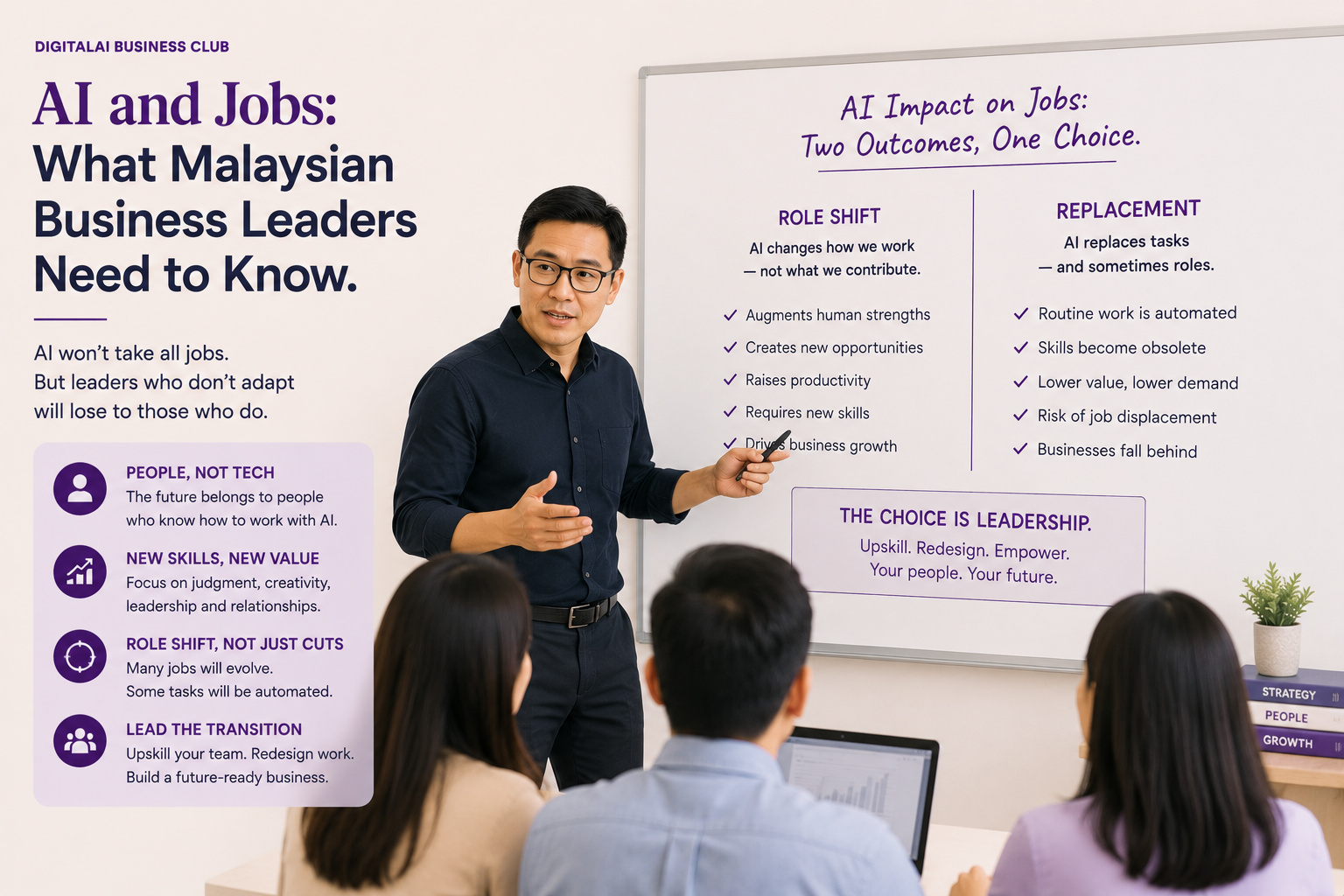
The question isn’t whether AI will change jobs. It’s whether your business is preparing for it. The global data says change is already underway. The more useful question for a business leader isn’t whether that’s true — it’s what to do about it inside your own team, starting this quarter.
Best Answer
AI is expected to displace a significant number of jobs globally over the next five years while creating even more new ones — a net gain, according to the World Economic Forum’s Future of Jobs Report 2025, though the transition will be uneven across sectors and roles. In Malaysia, government labour data shows both real displacement risk and strong ongoing hiring demand at the same time. For most businesses, the accurate framing isn’t “jobs disappearing” — it’s role shift: the tasks inside a job changing, while judgement, relationships, and decisions stay human. The leaders preparing well are mapping that shift inside their own teams now, not waiting for it to arrive.
At a recent SME roundtable, a business owner asked me directly: “Should I be worried about AI taking my staff’s jobs?” The honest answer wasn’t reassurance or alarm — it was a redirection. The businesses that come out ahead of this shift aren’t the ones with the most confident prediction. They’re the ones who’ve actually looked at which tasks in their business are changing, and started preparing their people for it.
This article opens the AI Strategic View series — what the global data actually shows, what’s happening specifically in Malaysia right now, and a practical action plan for business leaders who want to prepare rather than predict.
The Real Question Isn’t Whether AI Changes Jobs
Most conversations about AI and employment get stuck at the wrong question. “Will AI take jobs?” invites a yes-or-no answer, and yes-or-no answers don’t help a business leader plan anything. The data itself doesn’t resolve to a simple answer either — displacement and creation are both happening, at the same time, often in the same industries.
The more useful question is narrower and more actionable: which specific tasks inside your business are already shifting, and is your team ready for that shift when it reaches them? That question has a concrete answer. The first one doesn’t.
Waiting for certainty about AI and jobs is itself a decision — and usually the more expensive one.
What the Global Data Actually Shows
The most cited global reference point is the World Economic Forum’s Future of Jobs Report 2025, based on a survey of over 1,000 major employers across 55 economies. It paints a picture that’s more nuanced than either the optimistic or alarmist headlines suggest.
| Finding | What It Means |
|---|---|
| 170 million jobs projected to be created, 92 million displaced by 2030 | A net global gain of roughly 78 million roles — but displacement is real and concentrated in specific task types, not evenly spread. |
| ~86% of employers expect AI to transform their business by 2030 | This isn’t a fringe prediction — it’s close to a consensus view among large employers globally. |
| ~39% of core job skills expected to change by 2030 | Even roles that survive will look different — the skill mix inside them is shifting, not staying static. |
| 41% of employers plan to reduce workforce where AI can automate tasks, while 85% plan to prioritise reskilling | Both are happening simultaneously — reduction in some areas, reinvestment in people in others. The difference is which side of that split your business ends up on. |
None of this is a Malaysia-specific forecast — it’s the global backdrop. What it tells a business leader is that the shift is broad-based enough to plan around, not a fringe scenario to dismiss.
What’s Happening in Malaysia Right Now
Malaysia’s own labour data adds a more immediate, local layer to the global picture — and it shows two things happening at once, which is easy to miss if you only read the headline.
| Signal | What’s Happening |
|---|---|
| Displacement risk is real | Malaysia’s Human Resources Ministry has flagged that a substantial number of jobs are at risk without upskilling — a direct warning, not background noise. |
| But labour demand remains strong | Government job portal data shows far more active vacancies than active jobseekers nationally — this isn’t a story of an economy running out of jobs. |
| The government is investing heavily in AI capability | Budget 2026 allocated billions of ringgit toward AI and digital infrastructure, including a Sovereign AI Cloud, under the National AI Action Plan running through 2030. |
| Reskilling pathways already exist | Programmes coordinated through HRDC and national skills platforms are actively certifying workers in AI-related skills, with training capacity scaling through 2026. |
Put together, this isn’t a story about Malaysia falling behind or being overrun by AI job losses. It’s a story about a labour market in active transition — with real risk for businesses and workers who don’t prepare, and real support available for those who do.
Is Your Business Actually Ready for This Shift?
Most leaders assume readiness. Few have actually mapped it. The DigitalAI Readiness Assessment takes 10 minutes and shows you where your business stands on AI adoption, workforce readiness, and the customer journey — before the shift catches up with you.
Take the Free Readiness Assessment Join the Free WhatsApp CommunityRole Shift vs Replacement: The Distinction That Matters
Almost every anxious conversation about AI and jobs collapses two very different scenarios into one. Separating them changes how a leader should actually respond.
| Role Shift | Role Replacement | |
|---|---|---|
| What changes | The tasks inside a role — some are AI-supported, others stay fully human | The role itself no longer exists in its current form |
| How common it is | The majority of roles affected by AI today | A smaller subset, concentrated in highly repetitive, rule-based work |
| What the business needs | Reskilling — help the person do the changed version of their job well | Redeployment or restructuring — a harder, more deliberate decision |
| What leaders often get wrong | Treating every shift as a threat to the whole job, causing unnecessary anxiety | Assuming shift when it’s actually replacement, delaying a decision that needed to happen sooner |
Most SME teams are living through role shift far more often than outright replacement. Naming that distinction clearly to your team — rather than leaving it vague — does more to reduce anxiety than any reassurance without evidence behind it.
The Leader Action Plan
None of the data above matters unless it becomes a plan. Here’s where to start.
| Step | Action |
|---|---|
| 1. Map task-level exposure | For each role in your business, list which specific tasks are repetitive and rule-based versus which require judgement, relationships, or context only a human has. |
| 2. Separate shift from replacement | Use the table above to classify each role honestly — most will be shift, a smaller number may genuinely be heading toward replacement. |
| 3. Name the two or three skills that matter most next | Don’t try to reskill for everything — identify the specific capabilities your team will need most in the next 24 months. |
| 4. Build a reskilling plan before a crisis forces one | HRDC-claimable training exists specifically to make this affordable for Malaysian SMEs — use it proactively, not reactively. |
| 5. Communicate the plan, not just the anxiety | Teams cope better with a named plan, even an imperfect one, than with silence and speculation. |
Frequently Asked Questions
Will AI replace most jobs in Malaysia?
Most credible projections, including the World Economic Forum’s Future of Jobs Report 2025, point to net job growth globally rather than mass replacement — new roles are expected to outnumber displaced ones. The more accurate picture for most businesses is role shift: tasks within a job changing, not the job disappearing outright. Malaysia’s own labour ministry has flagged a significant number of roles at risk without upskilling, which makes preparation the deciding factor, not the technology itself.
What does the WEF Future of Jobs Report 2025 say about AI and employment?
The report projects that by 2030, roughly 170 million new jobs will be created globally against 92 million displaced, for a net gain of about 78 million roles. It also finds that around 86% of employers expect AI to transform their business by 2030, and that roughly 39% of core job skills are expected to change in that period.
What is the difference between role shift and job replacement?
Job replacement means a role disappears entirely. Role shift means the tasks that make up a role change — some tasks are taken over by AI, while the human focus moves toward judgement, relationships, and decisions AI can’t make alone. Most roles affected by AI today are experiencing role shift, not outright replacement.
How is Malaysia responding to AI’s impact on jobs?
Malaysia’s government has been actively investing in AI readiness through Budget 2026 allocations for AI and digital infrastructure, a National AI Action Plan running to 2030, and reskilling programmes through agencies including the Human Resources Development Corporation. Malaysia’s Human Resources Ministry has also flagged that a substantial number of jobs are at risk without upskilling, underlining the urgency for both workers and employers.
What should a business leader do now to prepare for AI’s impact on their team?
Start by mapping which roles in your business face task-level change versus roles that are largely unaffected, identify the two or three skills your team will need most in the next two years, and build a reskilling plan before a crisis forces a reactive one. Waiting for certainty before acting usually means acting too late.
Is HRDC training available to help Malaysian companies prepare their workforce for AI?
Yes. Malaysian companies can access HRDC SBL-Khas claimable training to build practical AI capability across their teams, including through DigitalAI Business Club’s Claude AI for Business Training programme.
Find Out Where Your Business Actually Stands
Before you build a workforce readiness plan, know your starting point. The DigitalAI Readiness Assessment maps your business against AI adoption, customer journey, and team readiness — the same lens this article uses, applied to your own business.
Take the Free Readiness Assessment