
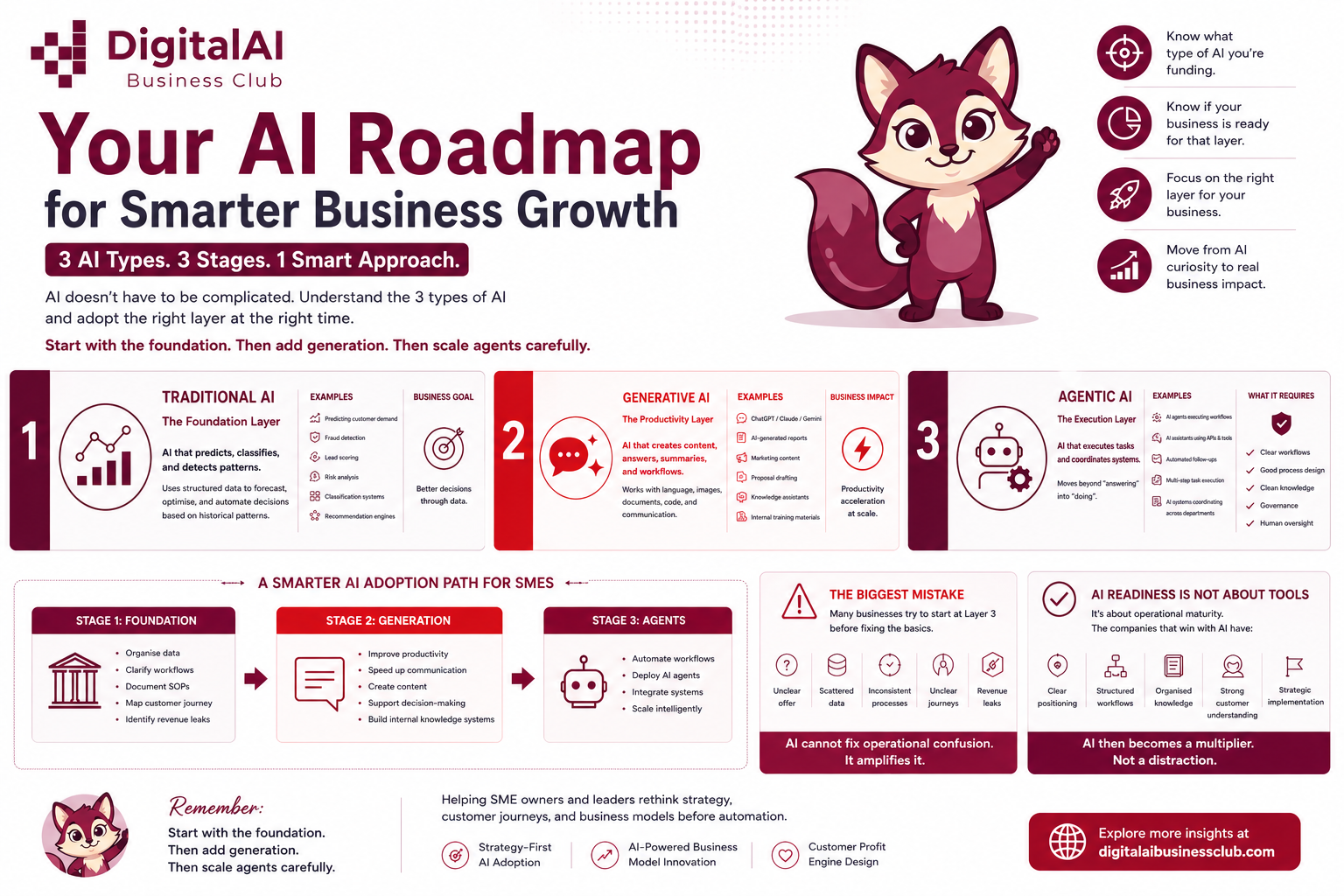
Why Business Leaders Need a Simple AI Map
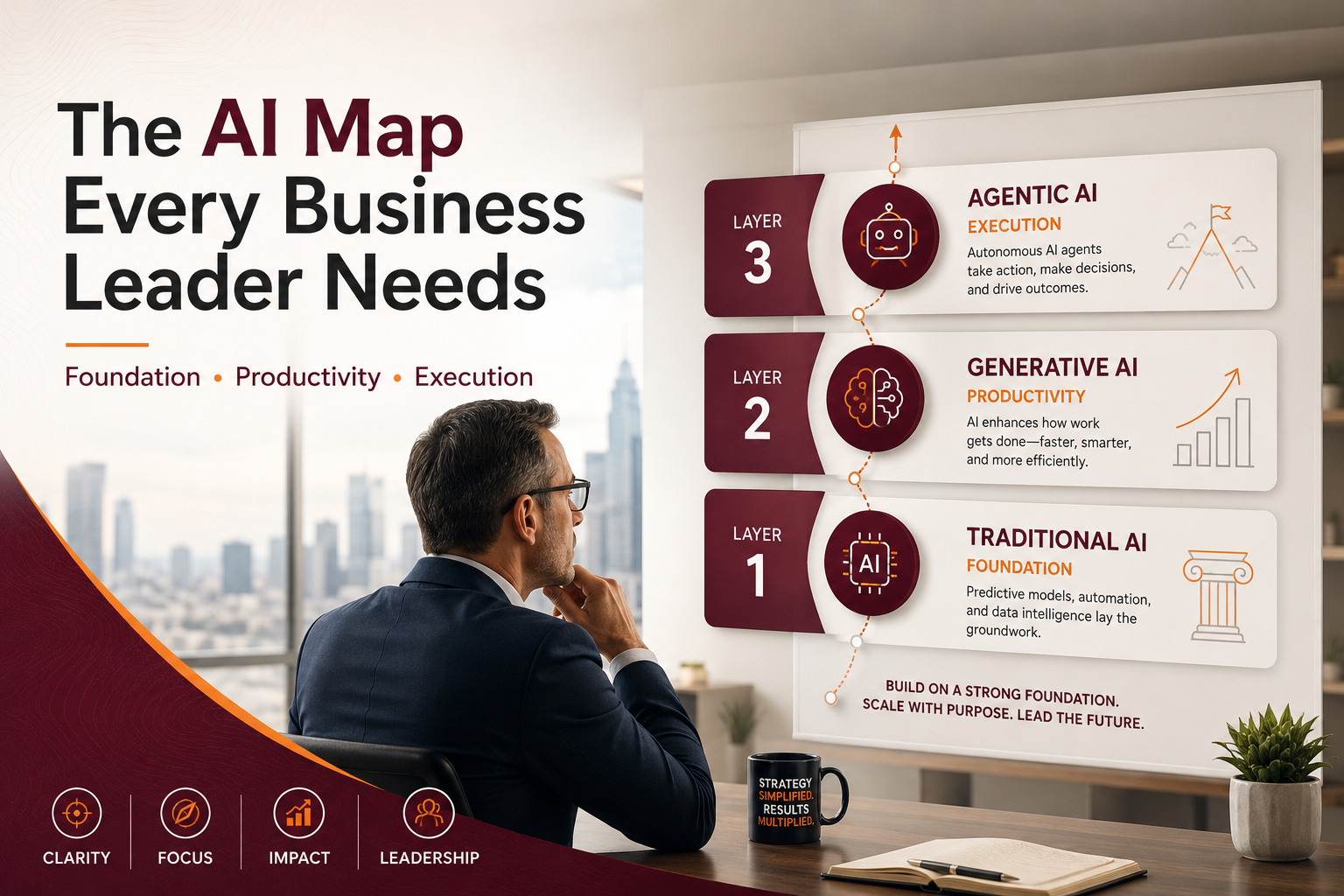
Most businesses are not failing at AI because of the technology. They are failing because they skipped the map.
They jumped straight to automation, agents, and chatbots — before fixing the foundation those tools depend on. The result is not speed. It is faster confusion, at higher cost.
This article gives you a simple AI map: three practical layers, in the right sequence, with the business questions you need to answer before moving to the next one.
Quick Answer
Why do business leaders need a simple AI map? Because AI is not one thing. It is three distinct layers — Traditional AI, Generative AI, and Agentic AI — each requiring different business readiness, different investment decisions, and different governance. Without a map, most businesses fund the wrong layer at the wrong time and get poor results. The map helps leaders sequence AI adoption correctly: foundation first, productivity second, execution third.
Why Leaders Need an AI Map — Not Just AI Awareness
There is no shortage of AI conversations. What is in short supply is AI clarity.
Business leaders today are surrounded by AI products, vendor pitches, and conference sessions. But most of what they hear does not answer the three questions that actually matter for decision-making:
- What type of AI are we funding?
- What business problem does it solve?
- Is our organisation ready for that layer?
Without answers to these three questions, AI investment becomes a series of technology experiments with unclear outcomes and no implementation path. An AI map changes that. It organises AI into layers you can actually evaluate, sequence, and decide on.
“Leaders do not need to memorise every AI term. They need to understand what layer they are buying, what it requires, and whether the business is ready.”
The Three Layers of AI Every Business Leader Should Know
From a business strategy perspective, AI can be organised into three practical layers. Each layer has a different purpose, different readiness requirement, and different risk profile.
| Layer | What It Does | Business Goal | Readiness Required |
|---|---|---|---|
| Layer 1 — Traditional AI | Predicts, classifies, detects patterns from data | Better decisions | Organised, structured data |
| Layer 2 — Generative AI | Creates content, summaries, answers, workflows | Productivity at scale | Clear customer journey and offer positioning |
| Layer 3 — Agentic AI | Executes tasks autonomously across systems | Scalable execution | Clean processes, governance, human oversight |
The sequence matters. Most businesses want to start at Layer 3. Most businesses need to start at Layer 1 — or even before that, at the operational foundation that makes Layer 1 worth investing in.
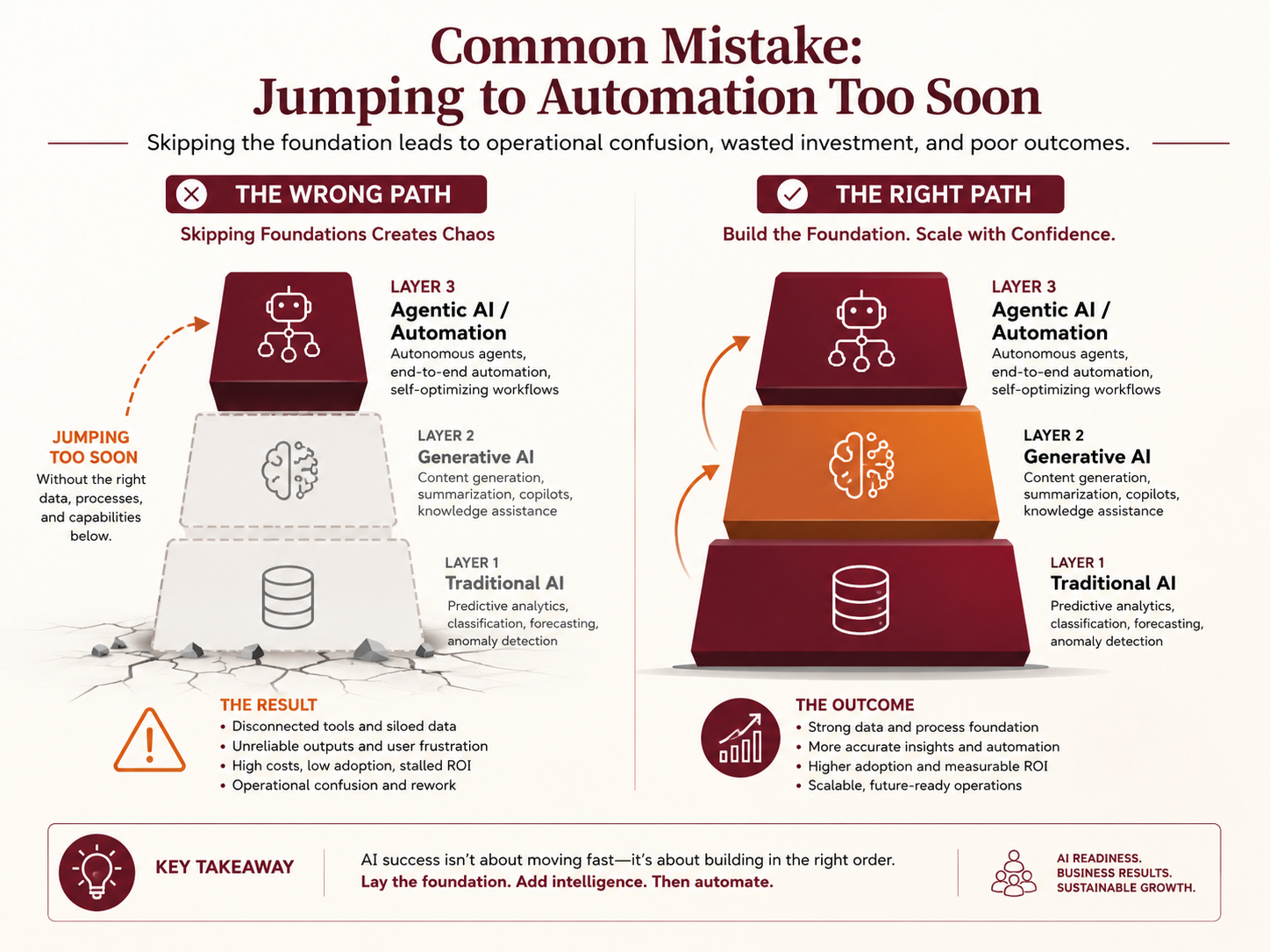
Layer 1: Traditional AI — The Foundation
Traditional AI
Traditional AI uses structured, historical data to make predictions, classify information, and identify patterns. This is the AI that has been operating quietly inside many businesses for years — in CRM systems, banking fraud detection, supply chain forecasting, and recommendation engines.
Business examples: Predicting customer demand · Lead scoring models · Fraud detection · Risk analysis · Inventory management · Customer segmentation · Recommendation engines
For many Malaysian SMEs, the starting point for Traditional AI is simpler than it sounds. It begins with asking: What data do we already have? Is it clean and organised? What decisions are we currently making by gut feel that data could improve?
A logistics company that knows its delivery failure rate by area, driver, and time-of-day is already positioned for Traditional AI to reduce cost and improve customer satisfaction. The AI is not the hard part. The organised data is.
Layer 2: Generative AI — The Productivity Layer
Generative AI
Generative AI is the layer most businesses are exploring today. Tools like Claude, ChatGPT, and Gemini fall into this category. They create — drafting proposals, generating marketing content, summarising research, producing training materials, and answering complex questions.
Business examples: Proposal and report drafting · Marketing content creation · Customer communication templates · Internal knowledge assistants · Sales scripts · Meeting summaries · Training material development
The business opportunity here is real. A consultant who previously spent three hours preparing a proposal can now produce a first draft in twenty minutes. A training provider who needed a week to develop content for a new module can now compress that to two days.
The hidden risk at Layer 2: If your customer journey is unclear, your offer is poorly positioned, and your workflows are scattered — Generative AI will not fix that. It will simply help you produce more scattered content, faster. Clarity must come before generation.
Not sure which AI layer your business is ready for?
Take the free DigitalAI Readiness Assessment and get a clear picture of where you stand — and what to prioritise next.
Take the Free Assessment Join DigitalAI Business ClubLayer 3: Agentic AI — The Execution Layer
Agentic AI
Agentic AI moves beyond answering and generating. It acts. AI agents are designed to use tools, connect to APIs, and execute multi-step workflows across systems — often with minimal human input for each individual action.
Business examples: Automated customer follow-up workflows · Lead qualification pipelines · AI agents connecting CRM, calendar, and communication systems · Multi-department task coordination · Intelligent document processing · Inventory management automation
Agentic AI is powerful. It is also where the most risk accumulates when the foundation has not been built correctly. An AI agent executing the wrong workflow, at scale, creates problems that are expensive to unwind.
This layer requires more than technical configuration. It requires clean, documented processes. Clear governance policies. Defined points of human oversight. And a team that understands what the agent is doing and why.
The Biggest Mistake SMEs Make with AI
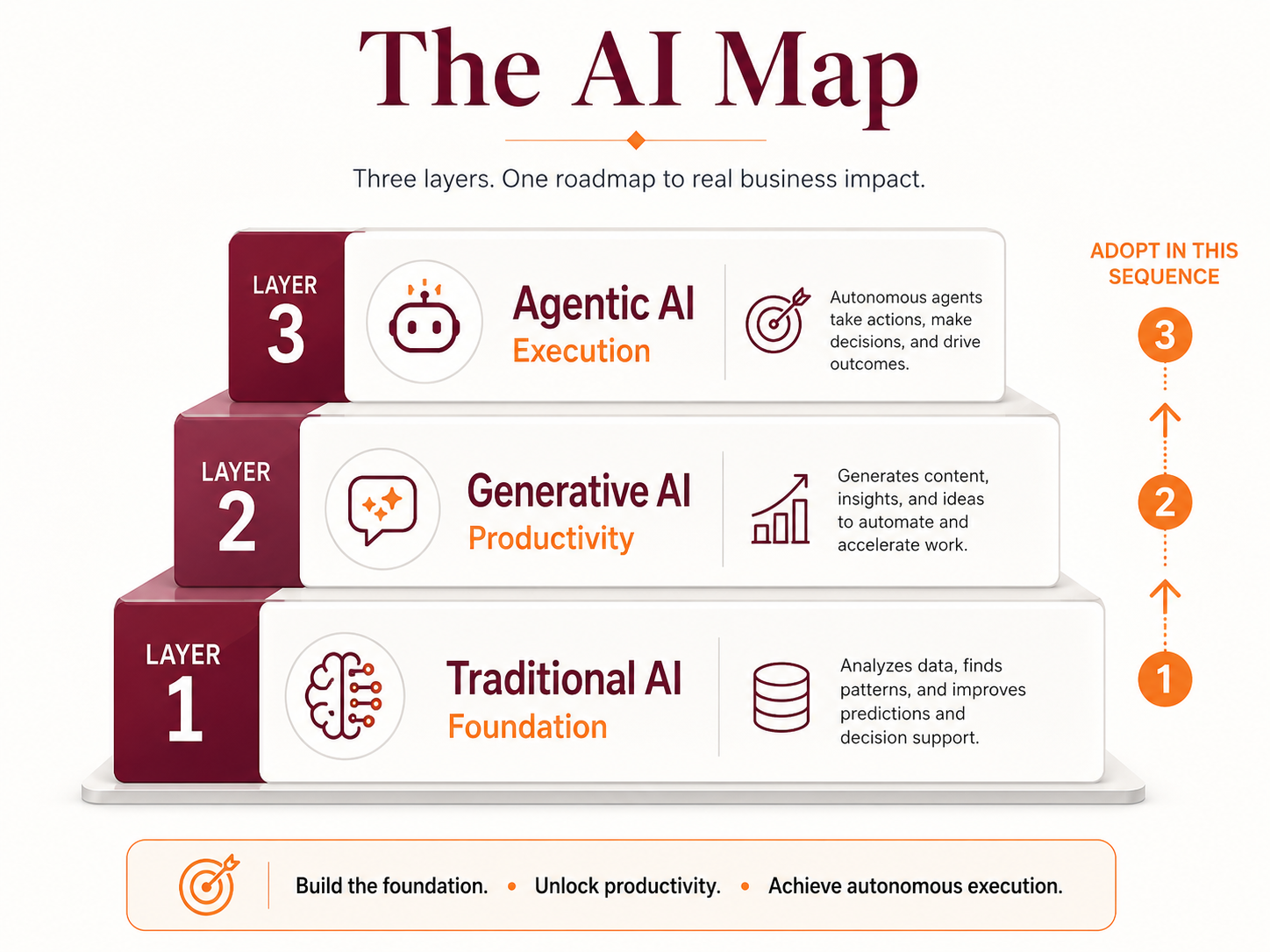
The most common AI failure pattern is not a technical one. It is a sequencing one.
Many SMEs see a competitor using an AI chatbot or an automated sales pipeline and decide to implement the same thing immediately. They hire a developer, connect a tool, and deploy — without first asking whether their customer journey is clear enough to hand to an agent, whether their data is clean enough to feed into automation, or whether their team has the capacity to manage and oversee what the system does.
AI cannot fix operational confusion. It amplifies it. The businesses that fail with AI are not failing because the technology is bad. They are failing because they deployed technology into a foundation that was not ready to carry it.
A professional services firm in Kuala Lumpur once told me they had invested in an AI-powered CRM with automated follow-up sequences. Six months later, their leads were getting the wrong messages at the wrong time, their pipeline data was unreliable, and their sales team had lost confidence in the system. The AI was functioning as designed. The problem was that their customer journey had never been properly mapped. The automation simply ran the broken process faster.
A Practical AI Adoption Path for SMEs
The right adoption sequence is not complicated. It maps directly to the three layers:
Stage 1: Build the Foundation
- Organise and clean your existing data
- Document your core business workflows and SOPs
- Map your customer journey — from first contact to repeat purchase
- Identify where revenue is leaking (conversion drop-offs, slow follow-up, poor onboarding)
- Define your ideal customer profile with clarity
Stage 2: Deploy Generation
- Use Generative AI to accelerate communication and content production
- Build internal knowledge assistants from your existing SOPs and documents
- Speed up proposal, reporting, and training material development
- Improve customer-facing communication templates
- Support decision-making with AI-generated summaries and research
Stage 3: Scale with Agents — Carefully
- Identify workflows that are clean, documented, and repeatable
- Define the points where human oversight is required
- Deploy agents in contained, measurable pilots before full rollout
- Integrate systems gradually with clear rollback plans
- Track outcomes against defined business metrics — not just activity metrics
Each stage builds on the previous one. Skipping stages does not save time. It creates technical debt and operational confusion that compounds as the AI scales.
AI Readiness Is About Operational Maturity — Not Tools
There is a difference between AI awareness and AI readiness. Awareness is knowing that AI exists and broadly what it can do. Readiness is having the operational foundations that allow AI to work correctly and deliver measurable business outcomes.
The businesses that succeed with AI share three characteristics — and none of them are purely technical:
- Clear positioning. They know who their ideal customer is, what problem they solve, and what makes them the right choice. Generative AI helps amplify clear positioning. It cannot create positioning from scratch.
- Structured workflows. They have documented how work gets done, where decisions are made, and how information moves between teams. Agentic AI can automate structured workflows. It cannot structure unstructured ones.
- Organised knowledge. They have their customer data, product information, pricing, and process documentation in accessible, usable form. AI models learn from what you give them. If what you give them is scattered, the output will be scattered too.
The AI readiness question is not “Which tool should we use?” It is: “Do we have the operational foundation that makes any tool worth using?” Start with that question. The tool decision becomes much simpler once you can answer it honestly.
When these foundations are in place, AI becomes a multiplier. When they are absent, AI becomes a cost centre with impressive-looking dashboards and disappointing business outcomes.
Prompt: Diagnose Your AI Layer Readiness
Role: Act as an experienced AI strategy advisor helping me assess my business readiness for AI adoption.

Context: I run [describe your business — industry, team size, main products or services]. My current challenges with AI are [describe where you are stuck or uncertain].

Task: Ask me a series of structured diagnostic questions across three readiness areas:
1. Foundation readiness — data organisation, workflow documentation, customer journey clarity
2. Generation readiness — communication clarity, offer positioning, team AI familiarity
3. Agentic readiness — process documentation quality, governance policies, oversight capacity

Structure your questions one area at a time. After each area, summarise what I have told you and give me a simple readiness rating: Not Ready / Partially Ready / Ready.

Milestone: End with a prioritised list of 3 actions I should take before investing further in AI tools.
Use this prompt in Claude or ChatGPT to run your own AI readiness diagnostic. Be honest in your answers — the more specific you are, the more useful the output.
Know Where Your Business Stands on the AI Map
The DigitalAI Readiness Assessment is a structured diagnostic that shows you which layer you are ready for, where your gaps are, and what to prioritise. Free to take. Built for SME owners and business leaders.
Take the Readiness Assessment Explore DigitalAI MembershipFrequently Asked Questions
What is an AI map for business leaders?
An AI map is a simple framework that organises AI into three practical layers: Traditional AI (data-driven prediction and pattern recognition), Generative AI (content creation and productivity), and Agentic AI (task execution and workflow automation). It helps business leaders understand which layer to adopt, in what order, and whether their business is operationally ready for each stage.
What is the difference between Traditional AI, Generative AI, and Agentic AI?
Traditional AI analyses historical data to predict outcomes, classify information, and detect patterns — demand forecasting, fraud detection, and lead scoring are common examples. Generative AI creates new content based on prompts — tools like Claude and ChatGPT fall here. Agentic AI goes further by executing tasks autonomously across systems, handling multi-step workflows and integrating with APIs and tools with minimal human input per action.
Why do SMEs fail when adopting AI?
Most SMEs fail with AI because they skip the foundation. They invest in tools and agents before their workflows are documented, their customer journey is mapped, and their data is organised. AI does not fix operational confusion — it amplifies it. The businesses that succeed start with foundation clarity, then move to Generative AI productivity, then carefully add Agentic execution.
How do I know which AI layer my business is ready for?
Ask three questions: Is your data organised and structured? (Foundation layer.) Is your customer journey and offer positioning clearly defined? (Generative layer.) Do you have clean, documented processes with governance and human oversight in place? (Agentic layer.) If you cannot answer yes to the first two, the third layer will create more problems than it solves. The DigitalAI Readiness Assessment is a structured way to answer these questions.
Should business leaders understand AI technically?
No. Business leaders do not need to understand the technical mechanics of AI. They need to understand what type of AI they are funding, what business problem it is designed to solve, and whether their organisation has the operational maturity to benefit from it. Strategy before technology is the correct sequence.
What is AI readiness and how is it different from AI awareness?
AI awareness is knowing that AI exists and broadly what it can do. AI readiness is whether your business has the operational foundations — organised data, structured workflows, defined customer journey, and governance capacity — to benefit from AI investment. Most businesses have awareness. Far fewer have readiness. That gap explains why most AI pilots fail to deliver measurable business outcomes.