
The Business Prompt Playbook · Article 2 of 8
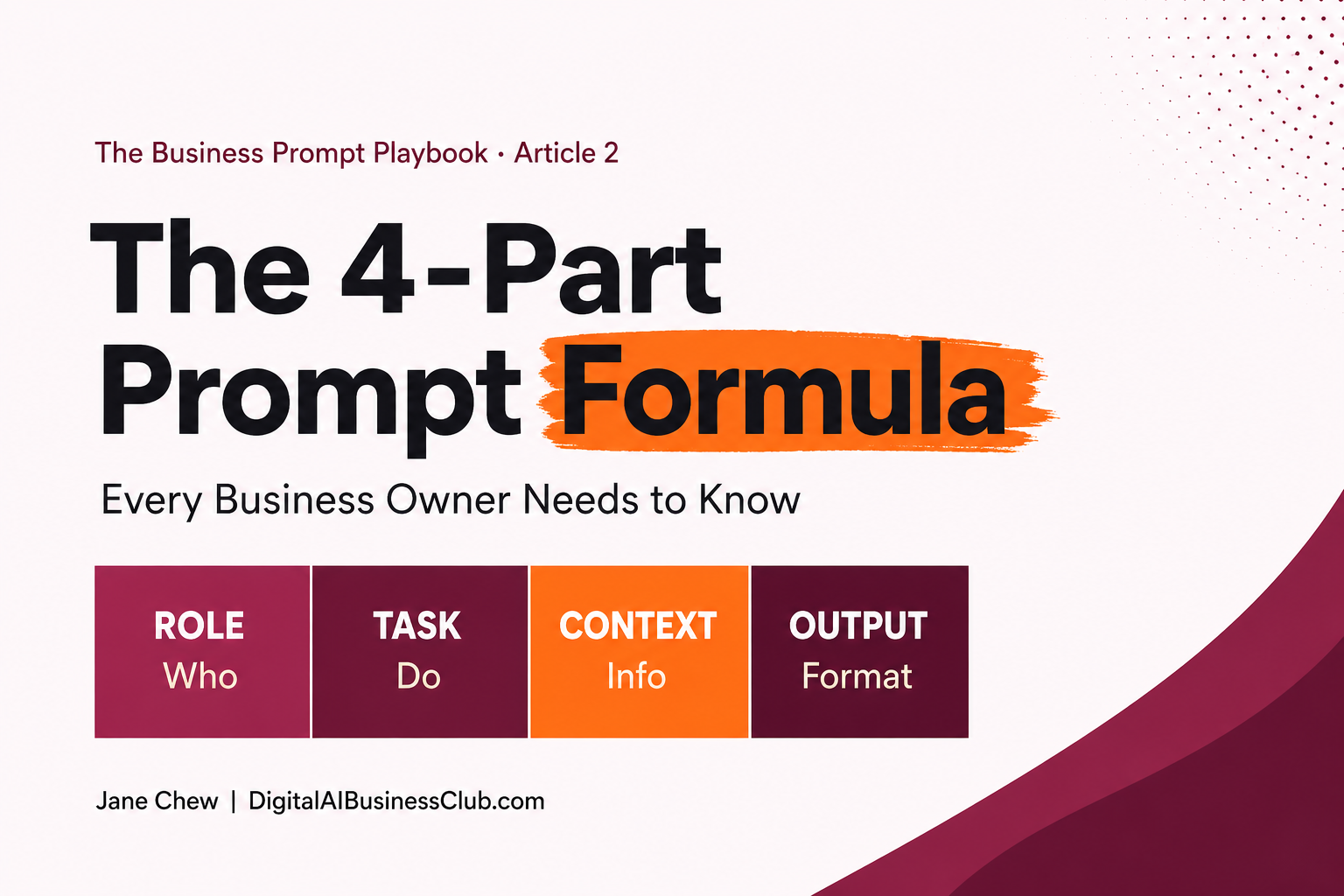
The 4-Part Prompt Formula Every Business Owner Needs to Know
By Jane Chew · AI Strategy Coach, DigitalAI Business Club · May 2026

There is one structural pattern behind almost every high-quality AI output a business gets. It is not complicated, it does not require technical knowledge, and it works on every major AI tool available today. It is a four-part formula — and once you understand each part, you will never write a weak prompt again.
Why structure changes everything
AI tools do not read your prompt the way a person reads a message. They scan for signals — patterns that tell them how to interpret your intention and what kind of response is appropriate. A structured prompt sends clear signals. An unstructured one forces the AI to guess, and guessing produces generic output.
Think of structure as a briefing document. When you brief a supplier, a contractor, or a new team member, you give them the background, the objective, the constraints, and the expected deliverable. The 4-part prompt formula mirrors that briefing process exactly.
The formula is: Role → Task → Context → Output. Each part has a distinct function. None of them is optional for complex tasks.
The 4-Part Prompt Formula
Who the AI should be
Sets expertise, tone, vocabulary, and the knowledge space the AI draws from.
What you want done
The specific action. Always starts with a verb: write, analyse, summarise, create, draft.
The world the AI works inside
Goals, audience, constraints, background, examples. Prevents hallucination.
The final authority
Format, length, tone, structure, must include / must avoid. The last instruction the AI obeys most.
Jane Chew | DigitalAIBusinessClub.com
Part 1: Role — who the AI should be
Every AI tool has a vast range of knowledge across many domains. Without a role, it defaults to a broad generalist position. With a role, it narrows to a specific expertise — and the quality of its reasoning, vocabulary, and structure shifts accordingly.
A role is not just a job title. It works best when it includes relevant experience or domain focus. Compare these two:
Weak role:
“You are a marketing expert.”
Strong role:
“You are a marketing consultant with 12 years of experience helping Malaysian professional services firms grow their client base through referral and content strategies.”
The specificity in the strong role activates the right knowledge base. The AI knows which industry context to draw from, which audience assumptions to make, and what style of advice is appropriate.
Role examples by business type
- Retail SME: “You are a retail operations consultant experienced in Malaysian consumer behaviour and shopping mall retail environments.”
- Professional services: “You are a senior business development advisor for accounting and advisory firms serving SME clients.”
- F&B operator: “You are a restaurant management consultant with experience helping mid-sized F&B chains in KL improve margin and customer retention.”
Part 2: Task — what you want done
The task is the engine of your prompt. It is the instruction that tells the AI what operation to perform. A strong task is direct and starts with an action verb.
The clearest action verbs for business prompts: Write, Analyse, Summarise, Draft, Create, Identify, Compare, Evaluate, Rewrite, List, Explain, Prioritise, Recommend.
One task per prompt. When you give the AI multiple things to do at once — “write me a proposal, summarise the key risks, and give me three alternatives” — the output quality drops on all three. Break complex work into separate prompts or into a structured multi-step workflow (covered in Article 5 of this series).
Part 3: Context — the world the AI works inside
Context is where most business owners underinvest. They give the AI the task but not the world the task exists in. The result is an answer that could apply to any business anywhere — which means it applies specifically to none of them.
Context answers the questions a good employee would ask before starting a task: Who is the audience? What is the goal? What are the constraints? What has been tried before? What must not appear in the output?
Context elements to include
- Goal: What outcome does this output need to produce?
- Audience: Who reads or receives this? What do they already know?
- Constraints: Word count, platform, legal restrictions, tone rules
- Background: Industry, business size, product type, location
- Examples: A sample output you liked, or a reference to match
- What to avoid: Topics, language, approaches that are off-limits
Start applying this formula to your business today
Join DigitalAI Business Club and get monthly prompt libraries structured around this formula — ready to copy, adapt, and use for your specific business tasks.
Join the Membership — RM100/yearPart 4: Output — the final authority
AI processes your prompt from top to bottom. The last instruction carries the highest priority. This is why the output section is placed at the end — it is the specification the AI obeys most strictly.
An output instruction can include: format (bullets, table, numbered list, paragraph), tone (formal, conversational, direct), length (word count, number of points), required elements (must include an action item, must end with a question), and exclusions (no jargon, no passive voice, no statistics older than 2023).
Strong output instruction example:
“Output: Three concise paragraphs. Professional but not stiff. Under 200 words total. No bullet points. End with a recommended next step for the reader.”
Even a partial output instruction improves results. If you add nothing else, at least define the format and length. These two constraints alone eliminate the most common frustrations: outputs that are too long, too listy, or structured in a way you cannot use.
The full formula in action
Here is a complete 4-part prompt for a common business scenario — preparing a short brief for a new service launch.
Full Prompt Example: Service Launch Brief
Role
Task
Context
Output
This prompt takes under two minutes to write. The output it produces is usable, specific, and commercially structured — because every part of the formula is doing its job.
In Article 3, we cover the 15 AI terms every business owner should understand — so that conversations about AI tools, models, and capabilities make sense without needing a technology background.
Frequently Asked Questions
What is the best prompt formula for business owners?
The most reliable prompt formula for business owners is the 4-part structure: Role, Task, Context, Output. Each part plays a specific function. Role sets the AI’s expertise. Task defines the action. Context provides the business details. Output specifies the format you need. Together they produce consistently better results than unstructured prompts.
How long should a business prompt be?
A good business prompt is as long as it needs to be — not longer, not shorter. For simple tasks, three to five sentences across the four parts is enough. For complex tasks like report drafting or strategy analysis, one to two paragraphs per part may be needed. Quality and specificity matter more than length.
What does ‘role’ mean in a prompt and why does it help?
Role is the identity or expertise you assign to the AI before giving it a task. Assigning a role shifts the AI into a specific knowledge space, making its vocabulary, assumptions, and problem-solving more aligned to your actual need.
Can I use the same prompt formula for ChatGPT and Claude?
Yes. The Role-Task-Context-Output formula works across all major AI tools — ChatGPT, Claude, Gemini, and Perplexity. The structure is model-agnostic. You may find slight differences in tone and style between models, but the same prompt structure produces reliable improvements on all of them.
What is the most important part of a prompt?
All four parts matter, but the Output instruction carries the most weight because the AI prioritises the final instruction in your prompt. If you only have time to improve one part, define your output format clearly — structure, tone, length, and what to include or avoid.
Get monthly prompt libraries built on this formula
DigitalAI Business Club members receive practical, ready-to-use prompt libraries every month — structured around the 4-part formula and mapped to real business tasks.
Membership from RM100/year. Built for business owners, not developers.
Join the Membership Take the Free Assessment