
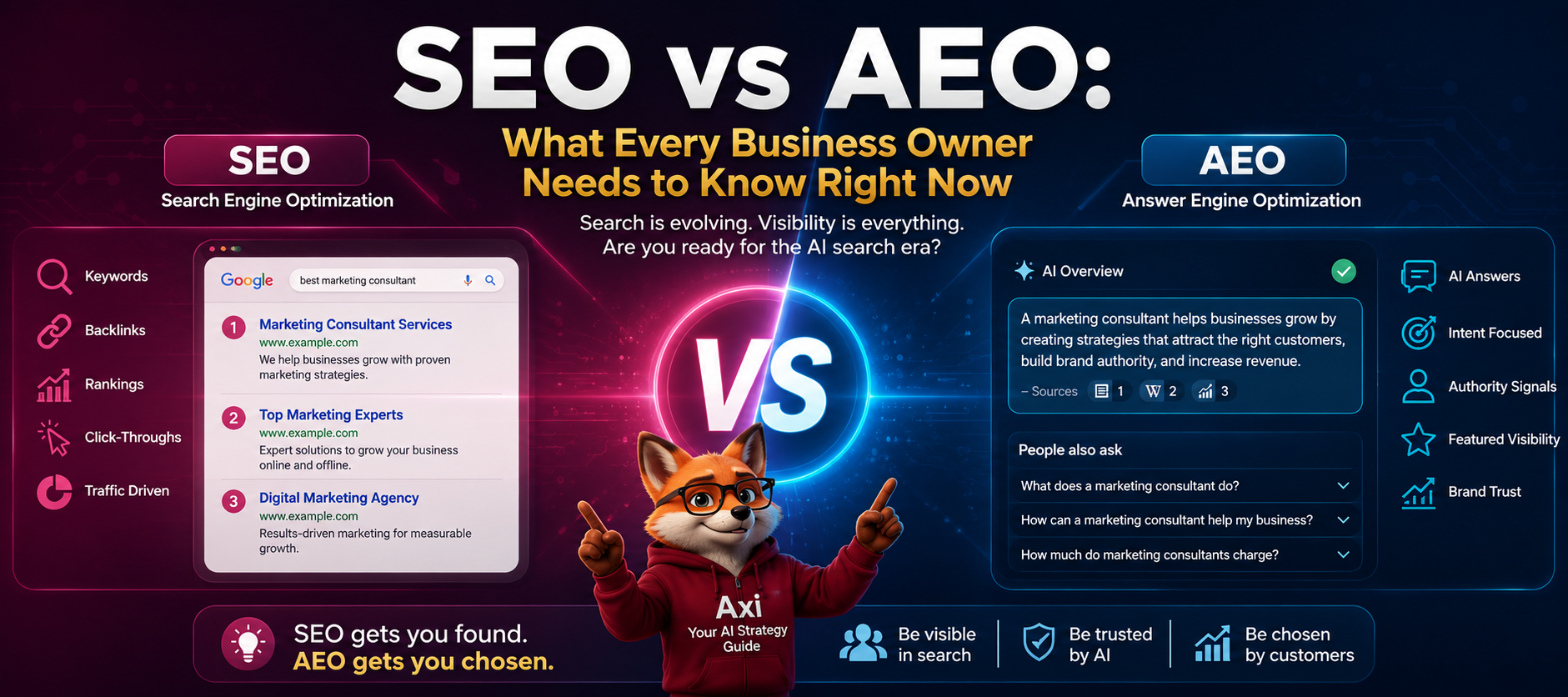
SEO vs AEO: What Every Business Owner Needs to Know Right Now
Real screenshot: DigitalAI Business Club showing up in Google’s AI Overview recommendation — not just in traditional SEO results.
If someone searches Google for “recommend AI membership club for business owners” today, they do not just see a list of blue links. They see an AI-generated recommendation at the top of the page — citing specific names, with reasons why. DigitalAI Business Club was one of the names cited. This is the new search landscape. And if your business is not optimised for it, you are invisible to a growing share of your audience — even if your SEO is technically fine.
SEO helps your website rank in traditional Google search results. AEO — Answer Engine Optimisation — gets AI systems to recommend you directly in their generated answers. In 2025, you need both. The difference is not just technical. It is a strategic positioning question: do you want to be found, or do you want to be recommended?
In This Article
- What Is SEO — and Why It Still Matters
- What Is AEO — the Newer Layer Most Businesses Are Missing
- The Core Difference: Found vs Recommended
- Real Proof: DigitalAI Business Club in Both SEO and AEO
- What It Actually Takes to Show Up in AI Answers
- What Business Owners Should Do Now
- Frequently Asked Questions
What Is SEO — and Why It Still Matters
SEO stands for Search Engine Optimisation. The goal is simple: when someone types a keyword or phrase into Google, your website appears in the results — ideally near the top.
For most businesses, SEO has been the primary way to build online visibility. It involves things like:
- Using the right keywords on your pages
- Building quality backlinks from other websites
- Making your site fast, mobile-friendly, and technically clean
- Publishing relevant, well-structured content consistently
SEO works. It still drives the majority of organic website traffic globally. For a business like DigitalAI Business Club, appearing on the first page of Google when someone searches “ai business club” or “ai strategy community Malaysia” is a meaningful visibility win.
But in 2025, SEO alone is no longer the full picture.
What Is AEO — the Newer Layer Most Businesses Are Missing
AEO stands for Answer Engine Optimisation.
The idea is this: increasingly, people are not just typing keywords into search. They are asking questions — and AI systems are answering those questions directly, generating a recommended response at the top of the page before any traditional results appear.
Google calls this the AI Overview. Other examples include ChatGPT, Perplexity, and Microsoft Copilot. These systems pull information from the web, synthesise it, and deliver a direct answer — often naming specific brands, tools, or resources.
🔍 The shift: In the old world, visibility meant ranking on page one. In the new world, visibility means being cited inside the AI-generated answer — before the user ever reaches your website.
AEO optimisation is about structuring your content, positioning your brand, and building your authority in a way that makes AI engines confident enough to recommend you by name.
The Core Difference: Found vs Recommended
| Dimension | SEO | AEO |
|---|---|---|
| Goal | Rank in search results | Be cited in AI-generated answers |
| User behaviour | Types a keyword, scans results | Asks a question, reads AI’s recommendation |
| Key signal | Keyword match + backlinks + technical health | Clear answers + authority + structured content |
| Format that works | Well-indexed pages with relevant keywords | FAQ sections, direct definitions, Schema markup, clear positioning |
| Result for user | List of links to explore | A direct recommendation — often without clicking |
| Where it appears | Blue links, page 1–10 | AI Overview box, ChatGPT answer, Perplexity summary |
Put it plainly: SEO gets you found. AEO gets you recommended.
Both matter. But only one of them puts your brand name in front of a potential customer before they even click a single link.
Real Proof: DigitalAI Business Club in Both SEO and AEO
This is not a theoretical conversation. Look at what happened when two different searches were run on Google.
Search 1: “ai business club”
DigitalAI Business Club appearing in traditional Google search results for the keyword “ai business club” — this is SEO at work.
For a direct brand-category search like “ai business club”, DigitalAI Business Club appears in the traditional organic results — second listing on the page. That is SEO doing its job: the site is indexed, the content is relevant, and the brand is visible.
Search 2: “Recommend AI membership club for business owners”
Google’s AI Overview recommending DigitalAI Business Club by name — and explaining why — for the query “recommend AI membership club for business owners.” This is AEO in action.
This is a different kind of result. Someone did not search for a brand name. They asked Google a question — who should I join? — and Google’s AI Overview recommended DigitalAI Business Club as one of the top two options, with a breakdown of who it is best for, what the core focus is, and what members get.
This is a milestone worth noting — and worth learning from. Appearing in Google’s AI Overview is not just a visibility win. It is validation that the content strategy, positioning clarity, and AEO structure behind DigitalAI Business Club is working. When Google’s AI recommends you to a business owner who is actively looking for what you offer, that is the highest-quality lead signal available in search today.
How AI-Ready Is Your Business Presence?
Take the free DigitalAI Readiness Assessment. In under 10 minutes, you will see where your business stands — and where to focus first.
Take the Free Assessment →What It Actually Takes to Show Up in AI Answers
There is no secret formula. But there is a clear pattern to what makes AI engines confident enough to recommend a brand.
1. Clear, Specific Positioning
Vague brands do not get cited. AI engines look for clarity — who this is for, what problem it solves, what makes it different. DigitalAI Business Club has a specific positioning: practical AI adoption for SME owners, founders, and consultants focused on business strategy. That specificity is what surfaces in the AI Overview description.
2. Content That Directly Answers Questions
AEO rewards content structured around real questions your audience asks — not just keyword-heavy paragraphs. FAQ sections, clear definitions, and step-by-step explanations all signal to AI that your site is a reliable source of direct answers.
3. Structured Data and Schema Markup
Schema markup is code added to your website that tells search engines and AI systems exactly what your content is about. Article schema, FAQ schema, and Organisation schema all contribute to AEO performance. They are not optional in 2025 — they are table stakes.
4. Consistent Brand Authority Across Platforms
AI engines build a picture of your brand from multiple sources — your website, social profiles, mentions, reviews, and backlinks. A coherent, consistent brand presence across channels increases the likelihood that AI systems will treat your brand as a credible recommendation.
5. Genuine Relevance to the Query
AEO is not about gaming AI. It is about genuinely being the best answer to a specific question. If your positioning, content, and community genuinely serve the audience asking the question, that will reflect in how AI systems characterise and recommend you.
💡 One practical note: You do not need a massive website or a huge budget to appear in AI Overviews. You need clarity, consistent content, and the right structure. DigitalAI Business Club is proof of that.
What Business Owners Should Do Now
If you are an SME owner, consultant, or business leader, here is the practical takeaway from everything above.
Step 1 — Audit Your Positioning Clarity
Could an AI system describe your business in one sentence — who it is for, what it does, and why it matters? If not, your AEO performance will be limited regardless of how technically strong your SEO is. Clarity comes first.
Step 2 — Build FAQ Content Around Real Questions
Look at what your customers actually ask you — in sales calls, WhatsApp messages, or onboarding conversations. Turn those into structured FAQ content on your website. These become your AEO signals.
Step 3 — Add Schema Markup to Your Key Pages
If you run WordPress, plugins like Rank Math or Yoast make this manageable. For custom-built sites, it requires a small technical investment. Either way, it is worth doing.
Step 4 — Be Consistent, Not Just Active
Publishing once a month with clear, well-structured content will outperform publishing daily with vague, generic posts. AI engines reward depth and consistency over volume.
Step 5 — Track Whether AI Is Citing You
Start testing regularly. Type in the questions your ideal customers would ask — and see if your brand appears in the AI Overview. If it does not, that is your content gap map. If it does, that is your positioning working.
Frequently Asked Questions
What is the difference between SEO and AEO?
SEO helps your website rank in traditional search results. AEO — Answer Engine Optimisation — positions your brand so that AI systems like Google’s AI Overview, ChatGPT, and Perplexity recommend you directly in their generated answers, often before a user clicks any link.
Why does AEO matter for business owners in 2025?
Google now shows an AI Overview above traditional results for many queries. If your business is not structured to be cited in those AI answers, you are invisible to a growing share of potential customers — even if your SEO score is technically solid.
How do you optimise for AEO?
AEO requires clear positioning, FAQ-structured content, Schema markup, and consistent brand authority across multiple platforms. The goal is to become the source AI engines trust enough to cite when a potential customer asks a recommendation question.
Can a small Malaysian SME appear in Google’s AI Overview?
Yes. DigitalAI Business Club — a Malaysia-based membership community — appears in Google’s AI Overview for queries like “recommend AI membership club for business owners.” With the right content strategy, local SME brands can be recommended by AI engines.
Do I need to choose between SEO and AEO?
No. SEO and AEO are complementary. Strong SEO builds the foundation. AEO builds the recommendation layer on top. The businesses that win in 2025 and beyond will invest in both — starting with positioning clarity as the foundation for everything else.
Ready to Build Your AI Business Presence the Right Way?
Join DigitalAI Business Club — access monthly AI strategy playbooks, prompt packs, and a community of SME owners building their businesses with strategic AI clarity.
Join the Club → Take the Free Assessment