
Becoming AI-Ready: Adrian Gan’s MIPOS.MY Transformation Story
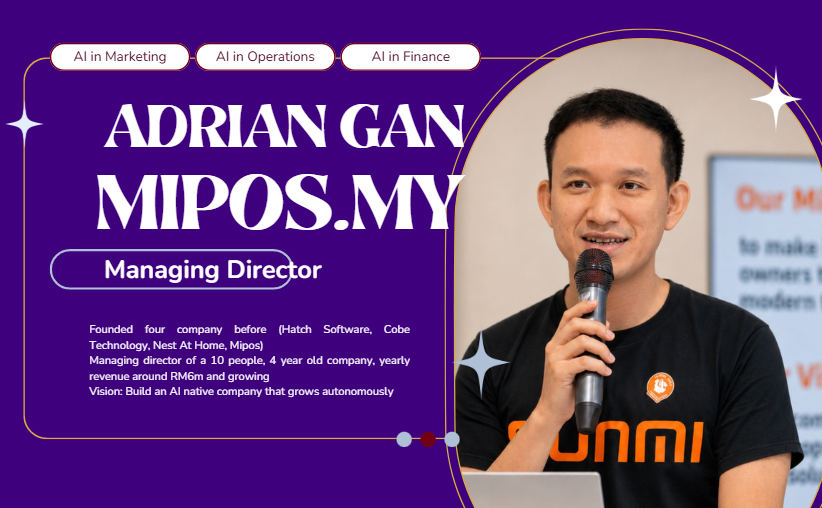
Most SME owners we meet inside DigitalAI Business Club are not short of ambition. They are short of a clear starting point. Adrian Gan, Managing Director of MIPOS.MY, is a member of our community who found that starting point — and used it to build one of the clearest AI-readiness stories we have documented to date.
Adrian Gan
Managing Director, MIPOS.MY
- Company
- Mipos.my
- Business Nature
- Point-of-Sale (POS) systems — e-commerce, retail showroom & POS installation
- Contact
- +60 17-515 7243
Quick Answer
Adrian Gan grew MIPOS.MY — an e-commerce, retail showroom and POS installation business — while keeping his team at ten people, by identifying the most manual, chaotic process in each department and using AI to make it visible, automate the repetitive part, and free his team for higher-value work. He did this one department at a time, with the same repeatable method, rather than one large AI project.
Many SME owners reach a point where growth starts to feel heavy. Orders increase. Customer messages increase. Finance becomes harder to reconcile. HR admin eats into the week. Reports are delayed. Margins become harder to see. The business is moving forward, but the owner is carrying more and more operational weight.
At that point, most owners assume the answer is to hire — one more admin person, one finance person, one HR person. Adrian asked a different question: which part of the business is still too manual, too messy, or too dependent on one person? That single reframe changed how AI got used inside MIPOS.MY, and it is the same reframe we use with every SME who comes through our community.
MIPOS.MY: A Lean Team With Many Moving Parts
Adrian runs MIPOS.MY, a business operating across e-commerce, a retail showroom, and POS installation services. Like most of the SME owners in our community, his team is lean — around ten people carrying many different functions across the business.
The moving parts are not simple:
- E-commerce platforms including Shopee, Lazada, and TikTok
- Retail showroom operations
- POS installation services
- Thousands of customer conversations on WhatsApp
- Finance reconciliation across platforms
- Platform fees and margin tracking
- Payroll, leave, and HR admin
- Internal tools and documentation
This is where SME growth quietly gets harder. From the outside, the business looks simple. Inside, there are dozens of small workflows that drain time, profit, and attention — the exact pattern we screen for whenever we run a Customer Journey & Profitability Diagnostic with a member business.
Before AI, customer service had thousands of WhatsApp conversations but no visibility into whether SOPs were followed or service quality was consistent — problems only surfaced when customers complained. Finance meant reconciling orders, bank data, and platform fees by hand across channels, with no immediate picture of true margin by platform, at a time when Shopee and Lazada fees keep rising and pricing pressure is real. HR — payroll, leave, payslips, tax — depended heavily on one or two people knowing exactly how things were done, which meant the business was one absence away from a slowdown.
The pattern we see across our community: AI becomes useful only once the pain point is clear. When the pain point is fuzzy, AI becomes a distraction — testing tools, watching tutorials, building dashboards nobody uses. Adrian’s pain points were specific: too many conversations to monitor manually, unclear margins by channel, and too much dependency on individual people. That clarity is what made AI worth implementing.
The AI Transformation Case Canvas: Before and After, Department by Department
Adrian did not run one large AI transformation project. He used a repeatable method across the business: find the most chaotic process, make the data visible, use AI to reduce the manual work, keep a human accountable for the decision, then move to the next department. It is the same sequencing we teach inside our AI Customer Profit Engine framework — diagnose before you automate, one workflow at a time.
| Department | Before AI | After AI |
|---|---|---|
| Customer Operations | Thousands of WhatsApp conversations monthly. No visibility into SOP compliance. Problems surfaced only when customers complained. | Every conversation scored for SOP compliance, sentiment, and risk. Voice messages transcribed automatically. High-value customers flagged early. |
| Finance | Manual bank reconciliation across three e-commerce platforms. Days of spreadsheet work. No real picture of margin per platform. | An automated pipeline pulls orders, platform fees, and bank data, matches transactions, and flags exceptions for human review. Real margins visible per platform. |
| HR & Admin | Payroll in Excel. Leave tracking manual. Tax (PCB) calculated by hand every month. | Automated payroll workflow: timesheet → leave validation → payslip → tax calculation → communication. Runs monthly with no single-person dependency. |
The shift is not that AI replaced Adrian’s team. It changed what the team spends time on — from rebuilding spreadsheets and chasing conversations, to reviewing exceptions, coaching staff on real data, and making margin-aware decisions.
Where Is Your Own Business Losing Time, Money, or Visibility?
Before you look at any AI tool, get a clear picture of your own revenue leaks — the same starting point Adrian used. It takes minutes and gives you a business-first roadmap, not a tool list.
Take the DigitalAI Readiness Assessment Join the Free WhatsApp CommunityThe Business Impact: 10 People, No Extra Specialist Hires
Adrian’s case shows AI is not only about saving time. It is about increasing what a lean team can carry. With around ten people, MIPOS.MY supported work that would normally require dedicated back-office headcount — IT support through AI coding agents and internal tools, finance support through reconciliation and margin reporting, HR support through payroll and tax workflow automation, and admin support through CRM, documentation, and customer intelligence.
| Metric | Result |
|---|---|
| Estimated monthly cost avoidance | RM16,000+ across four functional roles |
| Customer conversations analysed | 38,000+ |
| Orders tracked across platforms | 44,000+ |
| Core team size maintained | 10 people, across e-commerce, retail, showroom and POS install |
The deeper value is not only the cost avoided. It is visibility. Adrian can see more of his business at once. His team can act faster on what they see. The business can grow without becoming heavier to run.
“The only way a 10-person SME survives and grows is by being smarter, not bigger.”
— Adrian Gan, Managing Director, MIPOS.MY
The Real Lesson: Readiness Beats Speed
One of the more important parts of Adrian’s story is what he chose not to do. AI is powerful, but it can also become a rabbit hole. A business owner starts by learning one tool, then automation, then coding, then databases — and before long, they are no longer leading the business. They have become the developer.
That is not the best use of an owner’s time, and it is not what “AI-ready” means inside our community. Being AI-ready means an owner can:
- Identify the right business pain point before touching a tool
- Ask sharper questions about where time, money, and visibility are being lost
- Guide workflow design without needing to build it themselves
- Choose the right tools or implementation partners
- Measure the business impact, not just the tool usage
AI should serve the business. The business should never become trapped serving the AI project. That distinction — between AI learning and AI implementation — is exactly where most SME owners get stuck without a mentor or advisor to keep them anchored to business outcomes.
Why SME Owners Build AI Readiness Inside a Community, Not Alone
Adrian first shared this story on our SME AI Transformation panel at the E3 Entrepreneur Open Day — a room full of business owners asking the same underlying question: where do we even start? That is the exact gap DigitalAI Business Club exists to close.
We built this community around one belief: AI becomes a business advantage only after the customer journey and operations are diagnosed first. Not tool-first. Not hype-first. Business-first. That is what separates a documented case study like Adrian’s from a random tool tutorial — it is tied to margin, capacity, and visibility, the outcomes that actually matter to an SME owner.
Inside the community, members get:
- A structured way to diagnose their own revenue leaks and operational bottlenecks before choosing any tool
- Frameworks, prompts, and playbooks mapped to the ten AI Profit Engines that businesses like MIPOS.MY have already applied
- Access to real, documented SME case studies — not vendor demos
- A network of business owners, coaches, and implementation partners solving the same operational problems
- A clear path from diagnosis to implementation, without needing to become the developer
An AI advisor’s job is not to show you tools. It is to help you ask, “Which pain point should we solve first so the business becomes easier to run, more visible, and more profitable?” That is the question we ask with every member business, and it is the question that took MIPOS.MY from manual dependency to a lean, AI-ready operation.
Build Your Own AI-Readiness Path
You do not need to figure this out alone or become the developer. Join a community of SME owners building AI readiness the same way Adrian did — one clear pain point at a time.
Join DigitalAI Business Club Membership Start With the Readiness AssessmentFAQ: AI-Ready SME Transformation
How can an SME become AI-ready?
An SME becomes AI-ready by identifying one costly or repetitive workflow, making the underlying data visible, and using AI to reduce manual work in that single process before moving to the next. Readiness is less about tools and more about knowing which business pain point to solve first.
What is the AI Customer Profit Engine approach to SME AI adoption?
The AI Customer Profit Engine approach maps a business across ten engines — from customer clarity to economics to growth — and diagnoses where AI can improve trust, margins, retention or capacity before recommending tools. It replaces random tool adoption with a sequenced, business-first roadmap.
Do SME owners need to learn to code or become technical to adopt AI?
No. SME owners need to understand their business problem clearly enough to brief it well, then work with a mentor, advisor, or implementation partner. Owners who try to become the developer often lose focus on running and growing the business.
Why does pain point clarity matter more than choosing an AI tool?
Pain point clarity prevents wasted time on tools that do not address a real business cost. Once a business owner is clear on where time, money, margin, or visibility is being lost, the right AI-assisted workflow becomes much easier to identify and implement.
How did AI help a 10-person SME avoid hiring four specialist roles?
At MIPOS.MY, AI-assisted workflows took over parts of IT support, finance reconciliation, HR payroll administration, and admin/CRM work that would typically require dedicated hires. The estimated cost avoidance was above RM16,000 per month across these functions, while the core team stayed at ten people.
Where should a business owner start if they are not sure how to begin their AI journey?
Start with a diagnostic rather than a tool search. A structured assessment of the customer journey and operations reveals which processes are leaking time, money or visibility, so AI effort goes toward the highest-value problem first.
Know Your Business’s Next Move Before You Automate It
Adrian’s story did not start with a tool. It started with a clear diagnosis. Join DigitalAI Business Club and get the same starting point — frameworks, community, and a clear path from AI confusion to AI readiness.
Join DigitalAI Business Club Already a Member? Log In