
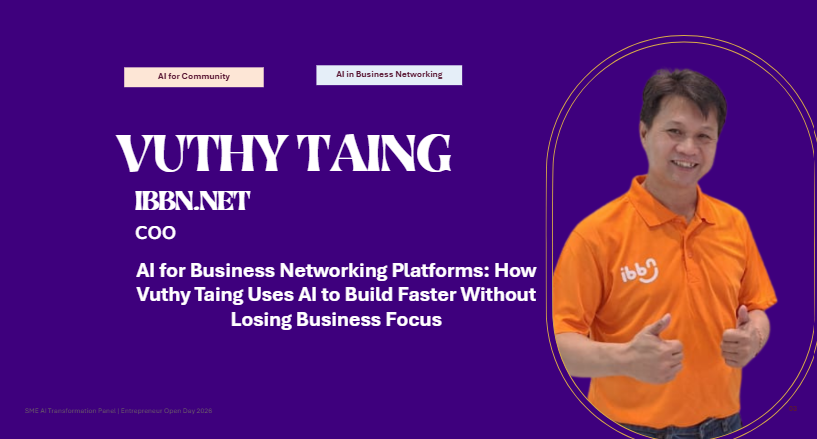
How Vuthy Taing Builds Faster With AI Without Losing Focus

Not every AI-readiness story is about saving hours on a spreadsheet. Some are about where the idea itself came from. Vuthy Taing is a member of our community who was coached under Jane Chew’s AI Business Model Innovation Program — and it was inside that program that the idea for Ibbn.net first took shape. What started as a business model exercise became a working business matching platform, built faster because AI was used with purpose from day one.
Vuthy Taing
COO, Ibbn.net
- Company
- Ibbn.net
- Business Nature
- Business Matching Platform
- Coached Under
- Jane Chew’s AI Business Model Innovation Program — where the Ibbn.net concept originated
- Contact
- +6016 348 6345
Quick Answer
AI can help business communities and SMEs build web apps, test platform ideas, review applications, customise features, support eKYC workflows, and reduce the time needed to launch digital systems. The business owner’s job is to stay focused on the business purpose — not to become the developer.
Many business communities, associations, and networking groups have good ideas. They want to connect people, build member platforms, and offer appointment systems, payment gateways, affiliate programmes, directories, application review, and digital community tools. But once the cost and complexity of building a customised platform becomes clear, the project often gets too heavy — needing developers, designers, plugins, hosting, and ongoing technical support. For smaller organisations, that becomes a real barrier.
This is where Vuthy Taing’s story at Ibbn.net, a business matching platform, becomes relevant. It is not just about using AI to build a website. It is about using AI to shrink the distance between an idea and a working business platform — and it is the same distance we help members of our community close.
The Strategic Question Behind the Platform
Vuthy’s story begins with a question that shapes everything that follows:
“How can businesses thrive and help the community at the same time?”
— Vuthy Taing, Ibbn.net
A business networking platform is never only a technology project. It is a community project, a trust-building project, and a business model project — useful only if it helps people connect, collaborate, refer, and create opportunity for one another. That is why AI implementation had to begin with purpose, not with tools. The question was never “what can AI build?” It was “what business or community problem are we trying to solve?” — the same question we ask every member business that walks through our diagnostic process.
Vuthy worked through this exact question inside Jane Chew’s AI Business Model Innovation Program. He did not walk in with Ibbn.net already built. He walked in with a business model exercise — and walked out with the concept that would become Ibbn.net: a platform where businesses could thrive commercially while genuinely helping the community around them. The program’s focus was never tool selection. It was business model clarity first — pressure-testing who the platform should serve, why it matters, and what should be automated versus kept human, before a single feature got built.
The Problem Before AI: Slow, Expensive Platform Building
Before AI, building a customised platform for member registration, appointment booking, payment gateways, affiliate programmes, directories, event tracking, application review, eKYC, and matching tools was difficult. Each feature typically needed different tools, plugins, subscriptions, or developers.
For a small organisation, this creates familiar friction: development costs climb, customisation becomes difficult, maintenance needs technical support, new features take too long to test, and the whole project becomes dependent on specialists. It is a common pattern for SMEs and business communities — they rarely lack ideas. What they lack is a faster, more affordable way to test those ideas.
The pattern we see across our community: do not start with the AI tool — start with the pain point. Without a clear pain point, AI becomes a distraction: weeks spent learning tools, testing platforms, and building features nobody asked for. For Vuthy, the pain points were specific — building customised platforms was too slow, traditional plugin-based development was rigid, specialist support was costly, and good business ideas were staying stuck at the planning stage.
The AI Transformation Case Canvas
With AI, Vuthy explored a more flexible approach to platform building. AI-assisted development tools — including Firebase and Google AI — helped the team explore faster ways to build and deploy web applications, support eKYC-related workflows, and add new features without depending entirely on outsourced developers.
| Stage | What Happens |
|---|---|
| Before AI | The team was unable to easily build a customised networking platform with affiliate marketing and community-driven features. Progress depended heavily on ready-made systems, plugins, or specialist developers. |
| AI Implemented | AI-assisted development tools were used to build and deploy web apps, review applications, support eKYC checks, and add new platform features more flexibly. |
| After AI | The team gained confidence that new concepts could be implemented faster, customised more easily, and maintained with a smaller team. |
“AI helped me focus on innovating the products and services.”
— Vuthy Taing, Ibbn.net
Which Idea in Your Business Is Still Stuck at the Planning Stage?
Before you brief a developer or test another tool, get clear on the business pain point worth solving first — the same starting point Vuthy used.
Take the DigitalAI Readiness Assessment Join the Free WhatsApp CommunityThe Business Impact: Faster Time to Market
One of the strongest outcomes from Vuthy’s story is faster time to market. Instead of waiting many months for a fully customised platform, AI-assisted development reduced the timeline significantly.
| Metric | Result |
|---|---|
| Time to market reduced by | ~6 months |
| Customisation | Easier to adjust based on requirements |
| Maintenance | Supported by a smaller team |
| Business focus freed up | More time for relationships and community connection |
Speed matters in business. When an owner can test ideas faster, they learn faster — and when they learn faster, they improve the product, the service, and the business model faster.
The Real Lesson: AI Is a Big Brain That Needs Purpose
AI can help you build faster, but that does not mean you should spend all your time becoming the developer. There is a point where learning too much of the technical side pulls a business owner away from the real business role — which is to understand the market need, define the pain point, clarify platform purpose, prioritise the most important features, validate whether users actually need the solution, and make sure the technology serves the business, not the other way around.
Vuthy put it simply:
“AI is a big brain that needs to be polished and guided for a purpose.”
— Vuthy Taing, Ibbn.net
AI can generate ideas, write code, create workflows, support analysis, and help build platforms — but it does not automatically know your business purpose, your community’s values, or which feature matters most to your members. That direction has to come from the business owner. AI is powerful, but it still needs leadership.
Why Platform Builders Grow Faster Inside a Community
Vuthy first shared this story on our SME AI Transformation panel — a room full of founders and community builders asking the same underlying question: how do we build without losing focus? That is the exact gap DigitalAI Business Club exists to close.
We built this community around one belief: AI becomes a business advantage only after the purpose and pain point are diagnosed first — not tool-first, not feature-first. That is what separates a documented case study like Vuthy’s from a generic “build with AI” tutorial. It is tied to time-to-market, community trust, and sustainable business value — the outcomes that matter to a platform builder or association leader.
Inside the community, members get:
- A structured way to diagnose the pain point worth solving first, before choosing any AI tool or developer
- Frameworks and playbooks mapped to the ten AI Profit Engines that businesses like Ibbn.net have already applied
- Access to real, documented case studies from founders building platforms, not vendor demos
- A network of business owners, community leaders, and implementation partners solving the same build-vs-focus tension
- A clear path from idea to implementation, without needing to become the full-time developer
An AI advisor’s job is not to show you tools. It is to help you identify the real pain point, prioritise which workflow or feature to build first, avoid overbuilding, and connect AI implementation to business outcomes — revenue, operations, customer value, and community impact. For Vuthy, that guidance did not just speed up a build already in motion. It is where Ibbn.net began.
Build Your Own AI-Readiness Path
You do not need to figure this out alone or become the developer. Join a community of SME owners and platform builders building AI readiness the same way Vuthy did — purpose first, tools second.
Join DigitalAI Business Club Membership Start With the Readiness AssessmentFAQ: AI for Business Networking Platforms
Can AI help build a business networking or matching platform?
Yes. AI can support web app development, platform prototyping, application review, automation, member workflows, content generation, and faster customisation — reducing the cost and time normally needed to build member registration, matching, payment, and directory features.
Should business owners learn to code with AI?
Business owners can learn enough to understand what is possible, but they do not need to become full-time developers. Their main role is to focus on the business model, customer journey, platform purpose, and implementation direction.
Why is pain point clarity important before building a platform with AI?
Pain point clarity prevents overbuilding. It helps a business or community focus on the feature or workflow that creates the most immediate value for members, rather than building every feature at once.
What is the biggest risk when using AI to build a platform?
The biggest risk is building too many features without validating the business purpose. AI makes building easier, but business owners must still focus on strategy, user needs, and sustainable value.
How much faster can AI-assisted development get a platform to market?
In Vuthy Taing’s case at Ibbn.net, AI-assisted development helped reduce time to market by an estimated six months compared to traditional plugin-dependent or fully outsourced development.
Why should community and platform builders adopt AI inside a community instead of alone?
A community provides diagnosed, business-first starting points, real implementation stories, and access to peers solving similar platform and community-building problems — reducing the trial-and-error cost of building alone.
Know Your Business Purpose Before You Start Building
Vuthy’s platform did not start with a tool. It started with a clear question about who it should serve. Join DigitalAI Business Club and get the same starting point — frameworks, community, and a clear path from AI confusion to AI readiness.
Join DigitalAI Business Club Already a Member? Log In