
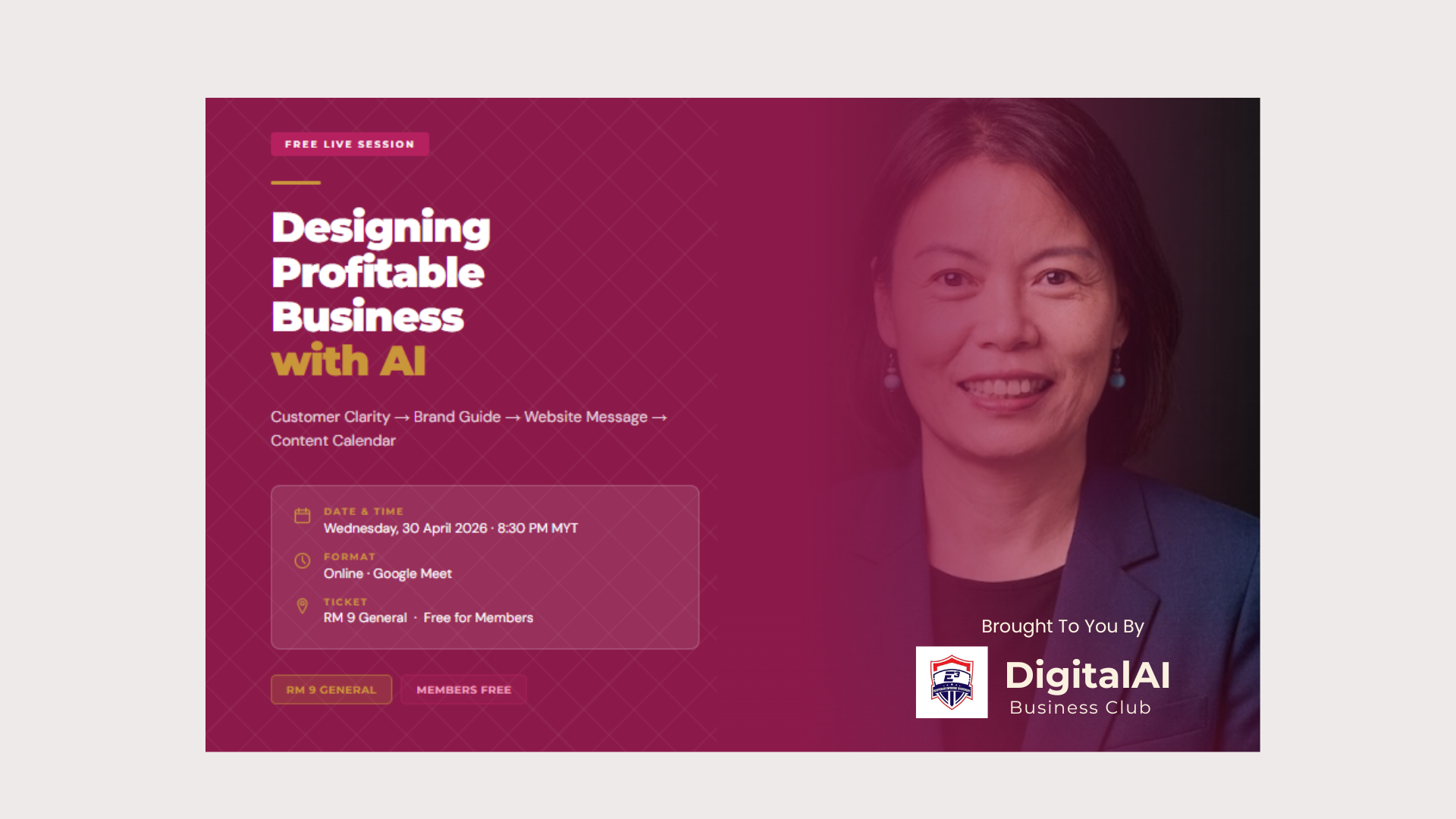
Webinar Recap: Stop Random Prompting. Start Building a Profitable Customer Business With AI.
By Jane Chew · AI Strategy Coach, Founder of DigitalAI Business Club · 1 May 2026

Yesterday, I hosted a practical DigitalAI Business Club webinar on how business owners can use AI more strategically — not just to create more content, but to build a clearer, more profitable customer journey.
The key message was simple.
Random prompting creates random outputs.
Business clarity creates business leverage.
Many business owners are already using ChatGPT, Gemini, Canva, website builders, automation tools, and many other AI platforms. But despite having more tools, many still feel stuck.
They are posting more.
Trying more apps.
Testing more prompts.
Subscribing to more platforms.
But the business message is still unclear. The customer journey is still messy. The follow-up is still inconsistent. The offer is still not converting as well as it should.
That is why I believe the next stage of AI adoption for business owners is not about chasing more tools. It is about using AI to build a profitable customer business system.
The Problem: Most People Start AI Too Late in the Process
Many people start with prompts like:
“Write me a social media post.”
“Create a website headline.”
“Give me marketing ideas.”
“Write a sales message.”
These are not wrong prompts. But they are incomplete prompts.
Because before AI can write effectively, it needs to understand the business clearly.
Who is the customer? What problem are they trying to solve? What do they care about? Why should they trust you? What offer are you really making? What action do you want them to take?
Without this foundation, AI will fill in the gaps with generic answers. That is why random prompting often leads to content that sounds active but does not move the business forward.
The Shift: From Prompting Randomly to Building a Customer Profit Engine
In the webinar, I shared a more strategic way to use AI. Instead of asking AI to produce isolated outputs, we should use AI to support a clear business sequence.
Suggested DigitalAI Learning Path:
If you want to go deeper into this sequence, start with defining your Ideal Customer Profile with AI, then build your AI Brand Guide Prompt Library, and finally use that clarity to create a strategy-led website with vibe coding.
This sequence matters. Because if you do not understand the customer, your offer becomes vague. If your offer is vague, your website message becomes weak. If your website message is weak, your content becomes random. If your content is random, your leads may not trust you enough to buy. And if your follow-up and onboarding are not designed properly, you may win customers but fail to nurture them into long-term value.
A profitable business is not built from one good prompt. It is built from a clear customer journey.
Foundation First: Customer Clarity
The first foundation is customer clarity. Before asking AI to create marketing content, business owners need to teach AI who they serve.
This means defining:
- Who the customer is
- What problem they urgently want solved
- What outcomes they desire
- What objections they have
- What triggers them to make a decision
- What language they naturally use
When AI understands the customer, the output becomes much more relevant. The content sounds less generic. The website becomes clearer. The sales message becomes sharper. The offer becomes easier to explain.
This is where business strategy must come before prompting. If you are still unclear who your best-fit customer is, you can start with this guide on how to define your Ideal Customer Profile with AI. Once AI understands the right customer, every downstream output becomes sharper — from content to sales messages to onboarding.
Next: Offer Clarity
Once the customer is clear, the next step is offer clarity. Many business owners are good at what they do, but they struggle to explain their offer in a way that customers immediately understand.
AI can help sharpen the offer, but only when we give it the right business input. A strong offer should answer:
- Who is this for?
- What problem does it solve?
- What result can the customer expect?
- What is included — and what is not?
- Why is this approach different or more practical?
When offer clarity improves, AI can help generate stronger landing pages, social posts, sales emails, proposal outlines, and follow-up messages. But again, the foundation must come first.
Want to build your customer clarity and offer foundation with guided AI implementation?
The AI Customer-to-Revenue Engine Bootcamp is a 4-session live online programme every Thursday in June. You will use Claude.ai to build your own AI Marketers across four engines — and walk away with practical assets for your own business.
Register for the Bootcamp →Then: Brand Guide and Website Message
The third step is creating a simple AI-powered brand guide. This is where AI stops behaving like a random writer and starts becoming a more consistent communication assistant. To make this easier, I created an AI Brand Guide Prompt Library that helps business owners define voice, tone, message pillars, customer language, and repeatable brand prompts.
A useful brand guide tells AI how the business should sound, what words to use, what words to avoid, what message pillars to repeat, what tone to maintain, and what examples to follow.
For DigitalAI Business Club, the tone is not hype-driven or overly technical. It is calm, practical, strategic, and business-first. That matters because the way we communicate affects trust.
After the brand guide, the website message becomes much easier to build. A good homepage should quickly answer four questions:
- Is this for me?
- What problem does this solve?
- Why should I trust you?
- What should I do next?
AI can help draft the website, but only after customer clarity, offer clarity, and brand direction are in place.
If you want to see how this connects to website building, read this next: From Brand Guide to Website: How Business Owners Can Use Vibe Coding to Build a Strategy-Led Website. The main idea is simple: the website should not start from design. It should start from customer clarity, offer clarity, and brand message.
Content Calendar: Stop Posting Randomly
Many business owners ask AI to create content too early. They want 30 posts, 50 captions, or 100 content ideas. But if the customer, offer, and brand message are unclear, the content calendar becomes noise.
A good content calendar should flow from the same business strategy. It should guide customers through awareness, trust, consideration, and action. For example:
- Monday: customer pain point
- Tuesday: business insight
- Wednesday: case study or example
- Thursday: offer angle
- Friday: call to action
This creates consistency. Not just more content, but better business communication.
Full Automation Comes Later
One important point I highlighted in the webinar is this: do not automate confusion.
Many business owners want to jump straight into automation. AI agents, auto-posting, CRM workflows, sales follow-up automation, onboarding systems. These are useful. But if the business foundation is weak, automation only scales the mess.
Before full automation, we need clarity. Before building workflows, we need to understand the customer journey. Before automating follow-up, we need the right sales message. Before using AI for onboarding, we need to know what “first win” the customer should experience.
That is why I always recommend this order:
This is how AI becomes a business growth tool, not just a productivity toy.
The Real Goal: More Than Winning Customers
The goal is not only to win customers. The bigger goal is to build a business that can attract, convert, onboard, nurture, and grow customer value more consistently. This is where customer profitability becomes important.
A profitable customer business is not just about getting leads. It is about improving the full journey:
When this journey is clear, AI can support every stage. It can help create better content. It can help prepare better sales conversations. It can help write better follow-up messages. It can help design onboarding journeys. It can help create customer education materials. It can help business owners increase Customer Lifetime Value.
That is the real opportunity. Not just AI for content. Not just AI for automation. But AI for customer growth and business profitability.
My Key Takeaway from the Webinar
If there is one thing I hope every business owner remembers from this session, it is this:
AI is powerful, but it is only as strategic as the thinking behind it. When the business direction is unclear, AI gives generic answers. When the business direction is clear, AI becomes a powerful partner for strategy, messaging, content, sales, and customer growth.
That is the shift we need to make.
From random prompting — to business clarity.
From isolated AI outputs — to a repeatable customer journey.
From tool usage — to profitable customer growth.
Next Step: Build Your Lead-to-Customer Revenue Engine
If you want to go deeper and build this properly, join my upcoming bootcamp — designed for business owners, consultants, coaches, and service providers who want to move beyond random AI use and start building a clearer customer journey with AI support.
In this bootcamp, we will work on the business foundation first, then build toward practical AI-supported systems for customer clarity, offer messaging, content, sales follow-up, and onboarding. You will not just learn prompts. You will learn how to build a more profitable customer journey.
Strategy before tools. Clarity before automation. Customer journey before content.
Join the AI Customer-to-Revenue Engine Bootcamp → Take the Free AI Readiness AssessmentFrequently Asked Questions
Why does random prompting not produce good business results?
Random prompting produces random outputs because AI has no context about your customer, offer, or brand. Without that foundation, AI fills the gaps with generic answers. The content may look polished, but it does not resonate with the right people and does not move the business forward. The fix is to build business clarity first — then prompt from that foundation.
What is the right sequence for using AI in a business?
The right sequence is: Customer Clarity → Offer Clarity → Brand Guide → Website Message → Content Calendar → Sales Follow-Up → Customer Revenue System. Each step gives AI a clearer brief, so each output becomes more relevant and commercially useful. Skipping the early steps means every downstream output is weaker.
Should I automate my business with AI before I have a clear customer journey?
No. Automating without clarity only scales the confusion. Before building automation workflows, you need to know who your customer is, what your offer delivers, how your business should communicate, and what a “first win” looks like for the customer. The right order is: Clarify first. Systemize second. Automate third.
How does customer clarity improve AI-generated content?
When AI understands who the customer is — their pain, desired outcomes, buying triggers, objections, and natural language — the output it generates becomes far more specific and relevant. The content sounds less generic. The offer explanation becomes sharper. The sales message becomes easier to write. Everything downstream improves because the input is stronger.
What is a customer profit engine and why does it matter for SME owners?
A customer profit engine is a designed system that helps your business attract, convert, onboard, nurture, and grow customer value consistently — rather than relying on one-off campaigns or reactive follow-up. For SME owners, most revenue leakage happens after the first sale: inconsistent follow-up, weak onboarding, and no clear path to repeat business or referrals. AI can support every stage of this journey when the foundation is in place.
What will I build in the AI Customer-to-Revenue Engine Bootcamp?
You will build practical assets across four engines using Claude.ai: a Customer Want Map and Revenue Leak Map (Customer Clarity); a Brand Voice System and Authority Positioning Statement (Brand Authority); a 28-Day Content Engine and AEO-ready content topics (Demand); and sales scripts, an onboarding journey map, and a First Win Plan (Customer Revenue). All built for your own business during live sessions.