
Lofty Questions for Identity Shift: My 8 Answers
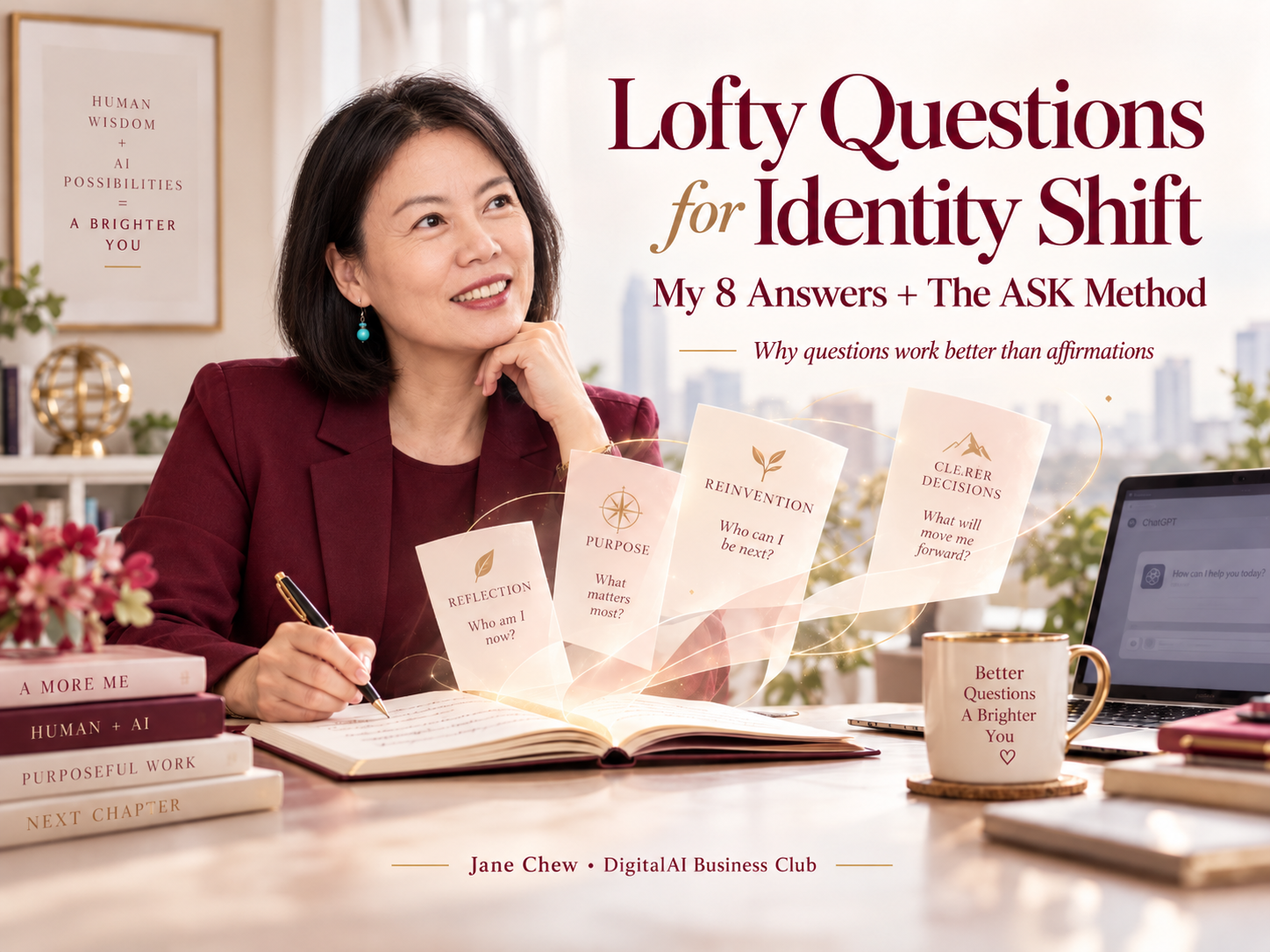
In this post: I answer eight lofty questions about who I am becoming, in public, so you know me better, including my mission to humanize AI. Then I share the simple method I now teach business owners in place of daily affirmations.
Use it for your next planning session, your positioning work, or the next time your title no longer fits the work you want to do.
Quick Answer
A lofty question is an expansive question you ask yourself about the person you are becoming. Instead of declaring “I am a confident leader,” you ask “Why am I becoming increasingly confident in expressing what I truly believe?” A statement asks you to believe something. A question invites your mind to search, notice and create possibilities, which makes it a practical tool for identity shift.
My path has had three chapters. First, a long corporate career. Then the leap into entrepreneurship, riding the rise of social media to build a digital publishing business. Now a third chapter: leading a movement to humanize AI for business owners and leaders.
Each shift asked me to become someone I had not been before. Along the way I used every tool I could find. I manifested. I wrote affirmations and repeated them daily. Both helped me hold a picture of where I wanted to go.
Affirmations have a limit, though. When I said “I am a thought leader” before I had led anything, a quiet voice inside replied, “Are you, really?” It is hard to convince yourself of something you have not yet become. The more the words ran ahead of my reality, the louder that voice got.
Lofty questions answered that voice. Asking “What would a thought leader in my position decide this week?” does not ask me to believe anything yet. It asks me to think, choose and act. Each answer becomes a small piece of evidence. Enough evidence, and the new identity stops feeling like a claim and starts feeling like a fact.
That is why I now teach lofty questions alongside, and often ahead of, affirmations. Below are eight of the questions I use, with my own answers.
My mission is to humanize AI. I help people and businesses find their way through change with confidence, so disruption does not decide their future for them.
I want my children and the next generation to grow up in a world where AI and people are in balance. The leaders and businesses I work with today are shaping that world now.
What is a lofty question?
Most of us have been taught to use affirmations when we want to change our lives.
“I am successful.”
“I am confident.”
“I am abundant.”
There is nothing wrong with affirmations. But I have been exploring something I find even more powerful: lofty questions.
A lofty question is an expansive question you ask yourself about the person you are becoming.
| Instead of declaring | You might ask |
|---|---|
| “I am a confident leader.” | “Why am I becoming increasingly confident in expressing what I truly believe?” |
| “I am successful.” | “Why are the right opportunities, people and ideas increasingly finding their way into my work?” |
The difference may seem small, but psychologically the experience is very different.
A statement asks us to believe something. A question invites the mind to search, notice, interpret and create possibilities.
That is why I now treat lofty questions as more than a mindset exercise. They are a tool for identity shift.
Two kinds of lofty questions. “Why” questions help you notice evidence that you are already changing. “What” questions, like the eight I answer below, help you decide what the person you are becoming would do next. I use both.
For business owners this matters commercially. Your answers become your positioning, your offers and your content. Identity work turns into business decisions.
The ASK Method: how to use lofty questions
I use a three-step method with clients and members. It is short on purpose.
A: Ask above your current role
Write the question at the level of the person you want to become. If it feels comfortable to answer, raise it.
S: Self-answer in writing, specifically
Answer in your own words, with names, numbers and years. “Help more people” is too vague. “Help 10,000 SME owners in Malaysia make clearer AI decisions by 2027” is an answer.
K: Keep it alive with one decision
Every answer ends with one decision you can act on within seven days. No decision, no shift.
Rule of thumb: one question a day for two weeks. The answers that keep returning are your identity statements.
My answers to 8 lofty questions
These are honest, current answers. Some will change. That is the point of asking again.
1Who am I becoming in this next chapter of my life, beyond my current titles and achievements?
I am becoming someone who humanizes AI for business leaders. My titles (trainer, consultant, coach, director) describe how I deliver. What I am for is helping people stay steady and in control while AI changes their work and their markets.
I help leaders rethink their business before they automate it, and keep human judgment and values at the centre of every decision. I want to be the calm voice in the room when everyone else is chasing the newest tool.
Decision: I introduce myself by my mission first, and the titles come after.
2What problem do I care enough about to spend the next 10 years solving?
SME owners being left behind by AI because nobody translated it into business decisions for them. They are capable people. They have been handed tool demos when they needed strategy.
I want to close that gap for Malaysia and ASEAN: strategy before tools, clarity before automation.
Decision: every workshop I run starts with a business question, never a tool.
3What am I uniquely positioned to contribute that combines my experience, perspective, strengths and values?
Three decades of customer thinking. I learned CRM, loyalty and analytics inside agencies and banks, long before AI made it fashionable. I know that most growth problems are customer clarity problems.
Add fencing for Malaysia, which taught me timing and discipline under pressure, and a decision in my 50s to learn instead of retire. I can show other experienced professionals that it is not too late to lead in the AI era.
From that background I built the Human Advantage Matrix for companies. Most organisations measure AI by productivity: hours saved, output produced, cost reduced. I believe KPIs should also measure human values, such as judgment, trust, care for customers and growth of people. The matrix helps leadership teams track both side by side.
Decision: every AI roadmap I design includes human-value KPIs next to productivity KPIs.
4What am I no longer willing to be known as, even if that identity helped me succeed before?
The person you call for a tool demo. The trainer who runs a session and leaves. Someone who does custom work that never becomes a reusable asset.
Those roles paid bills and built skills. They also kept me small.
Today I run AI with business strategy, and I bring human values into every room. A session that teaches people to click buttons faster, with no thought for the people affected, the customers served or the values at stake, is a session I will no longer run.
Decision: I say no to tool demos and training with no strategy or human element, and no to one-off work that cannot become a framework, playbook, workshop or membership asset.
5Where am I still playing the role of trainer or service provider when I could be thinking like a movement builder?
When I measure success by the number of sessions I deliver. A movement is measured by what people do without me in the room.
DigitalAI Business Club is my answer: a community where business owners, experts and partners learn from each other, with my frameworks as the shared language.
Decision: I track community growth and member wins alongside training days.
Use AI with strategy and human judgment
The Claude AI for Business 3-Level Training Pathway takes you from simple prompting to building real business systems, with your strategy and values in charge.
Explore the Claude Mastery Pathway6What would I build if I knew it needed to outlive my personal involvement?
A library of frameworks, playbooks and AI skills that any business owner can pick up and use, plus a community that keeps teaching them. The 10 AI Profit Engines, the Customer Clarity chain and the Strategy Vault are the start of that library.
If I stepped away for a year, members should still get clearer, sell better and decide faster.
Decision: every new piece of work I create gets packaged so someone else can teach it.
7What would it look like for wealth to flow to me every day as a natural result of the value I create, and am I ready to receive it without guilt or hesitation?
It looks like members joining the Strategy Vault while I sleep, companies booking AI assessments because a past client sent them, and partners running my programmes in rooms I am not in. Income that comes from assets and trust, so it does not depend on my calendar alone.
Am I ready? Mostly. Like many people from a corporate background, I was trained to undercharge for my own expertise. I am unlearning that. Charging properly for clarity is respectful to both sides.
Decision: I make a clear offer at the end of every free session, without apologising for it.
8At the end of this decade, what would make me say, “This is who I was meant to become”?
When business owners across ASEAN say they adapted to AI with confidence because of something they learned through DigitalAI Business Club. When companies report on human values with the same seriousness as productivity. When people and AI are working together in those businesses to create more value, and the people in them feel more capable.
And when my children and their generation inherit a world where AI and people are in balance, and they see that reinvention after 50 is a choice worth making. The businesses I help today are building that world.
Decision: I review these eight answers every quarter and change my plans when they no longer match.
Your turn: 15 lofty questions to start with
Pick one today. Answer it in writing using the ASK Method. End with one decision.
- Who am I becoming in this next chapter, beyond my current titles and achievements?
- What do I want people to say I helped them see, believe or become?
- What am I uniquely positioned to contribute from my experience, strengths and values?
- What do I want to be known for in the AI era, beyond the services I sell?
- If I stopped trying to prove myself, what work would I choose to do?
- What problem do I care enough about to spend the next 10 years solving?
- What beliefs about business, leadership, AI and human potential will I stand behind publicly?
- What am I no longer willing to be known as, even if it helped me succeed before?
- What must I let go of to become the person who can build the next version of my vision?
- What would my decisions look like if I already saw myself as a category leader?
- Where am I still playing service provider when I could be building a movement?
- What transformation do I want my name associated with?
- Who do I most want to serve, and what should their future look like because of my work?
- What would I build if it needed to outlive my personal involvement?
- What would it look like for wealth to flow to me daily from the value I create, and am I ready to receive it?
Prompt: Use Claude as your reflection partner
Act as my strategic reflection coach.

Context: I am [your role] serving [who you serve]. In the next 3 years I want to [your goal].

Task: Ask me ONE lofty question from the list below. Wait for my answer. Then:
1. Point out where my answer is vague and ask me to make it specific (names, numbers, years).
2. Ask what I am still protecting or avoiding.
3. Help me turn the final answer into one decision I can act on within 7 days.

Questions: [paste the 15 questions]

Keep your tone calm and direct. No motivational language.
Do one question per session. Save your final answers in one document so you can review them each quarter.
Identity shows up in what you decide this week. A well-asked question gives you something to decide.
Frequently asked questions
What is a lofty question?
A lofty question is an expansive question you ask yourself about the person you are becoming, such as “Why am I becoming increasingly confident in expressing what I truly believe?” An affirmation asks you to believe a statement. A lofty question invites your mind to search, notice and create possibilities, which supports a lasting identity shift.
Why use lofty questions instead of affirmations?
An affirmation states an outcome you have not reached yet, so part of you quietly argues with it. A lofty question asks you to supply the evidence and the next step yourself. The answer is yours, it is specific, and it usually points to a decision you can make this week.
How often should I answer lofty questions?
Answer one question a day for two weeks, in writing. After that, revisit the full set once a quarter during planning. The answers that keep coming back become your identity statements and your positioning.
Can business owners use lofty questions for strategy and branding?
Yes. Your answers about who you serve, what you stand for and what you refuse to be known as feed directly into positioning, offer design and content. Many of the best LinkedIn hooks and workshop openers come from a well-answered identity question.
Is it okay to include money and wealth in identity questions?
Yes. Wealth is part of building something that lasts. A good wealth question links income to the value you create and checks whether you are ready to receive it. That keeps the money goal tied to your purpose.
Learn Claude mastery, the human-first way
Your answers tell you who you are becoming. The Claude AI for Business 3-Level Training Pathway gives you the skills to build it: from clear prompting, to repeatable workflows, to AI systems that run your business with your strategy and human values at the centre.
Start the Claude Mastery Pathway Join the free WhatsApp communityPrefer to talk first? Email janechew@digitalaibusinessclub.com
Jane Chew / AI Strategy Coach, HRDC Corporate Trainer / Founder of digitalaibusinessclub.com