

Where Is Your Marketing Revenue Leaking?

Many SME business owners are already using AI. But more AI-generated content does not automatically create more revenue.
If your customer clarity is weak, AI helps you create more unclear content faster. If your follow-up is inconsistent, AI can help you write messages — but the lead may still go cold. If your marketing journey is disconnected, AI simply adds more output into a leaking system.
This article will help you identify where your marketing revenue may be leaking and how to use AI strategically to build a system that attracts, follows up and converts.
Best Answer
A marketing revenue leak happens when potential customers drop off somewhere in your customer journey — from lead generation to trust-building, sales conversion, onboarding, first win, retention or referral. AI can help fix these leaks only when it is used as a strategic system builder, not merely as a content tool. The goal is to connect customer clarity, offer positioning, content, lead capture, follow-up and measurement into one working marketing engine.
Let me begin with a question.
If someone asked you right now, “Where is your marketing losing money?” — could you answer specifically?
Not generally.
Not, “I think my Facebook is not working.”
Not, “Maybe I need to post more.”
Not, “Maybe I need to use better AI tools.”
But specifically.
Is the leak happening because you are attracting the wrong people?
Is it because your message is not building enough trust?
Is it because prospects enquire, then disappear?
Is it because your team creates content, but the content does not lead anywhere?
Or is it because your offer is good, but your customer journey is unclear?
This is where many SME business owners are stuck today.
They are not doing nothing. In fact, they are doing many things.
They are posting on social media. They are using ChatGPT. They are creating posters. They are sending WhatsApp messages. They are testing short videos. Some are even building landing pages.
But after all that effort, they still ask the same painful question:
“Why are we not getting more qualified leads, more follow-up and more sales?”
Here is the uncomfortable truth.
AI does not automatically fix a broken marketing system.
AI speeds up what is already there.
If there is clarity, AI can help you scale clarity.
If there is confusion, AI can help you scale confusion.
That is why the real conversation is not, “Which AI tool should I use?”
The better question is:
“Where is my marketing revenue leaking — and how can AI help me fix the system?”
The Story Behind the Revenue Leak
Imagine this.
A business owner attends a webinar on AI. She gets excited. She goes back to her team and says, “We must start using AI for marketing.”
The team opens ChatGPT and starts asking for captions.
They generate social media ideas. They create a few designs. They write a few posts. They maybe even create a content calendar.
For a short while, everyone feels productive.
There is more output.
More captions.
More visuals.
More activity.
But after one month, the business owner looks at the numbers and asks:
“Where are the enquiries?”
“Why are people still asking for price and disappearing?”
“Why are we still following up manually?”
“Why does the content get likes, but not serious leads?”
This is the moment where many businesses realise something important.
AI helped them create more content, but it did not fix the customer journey.
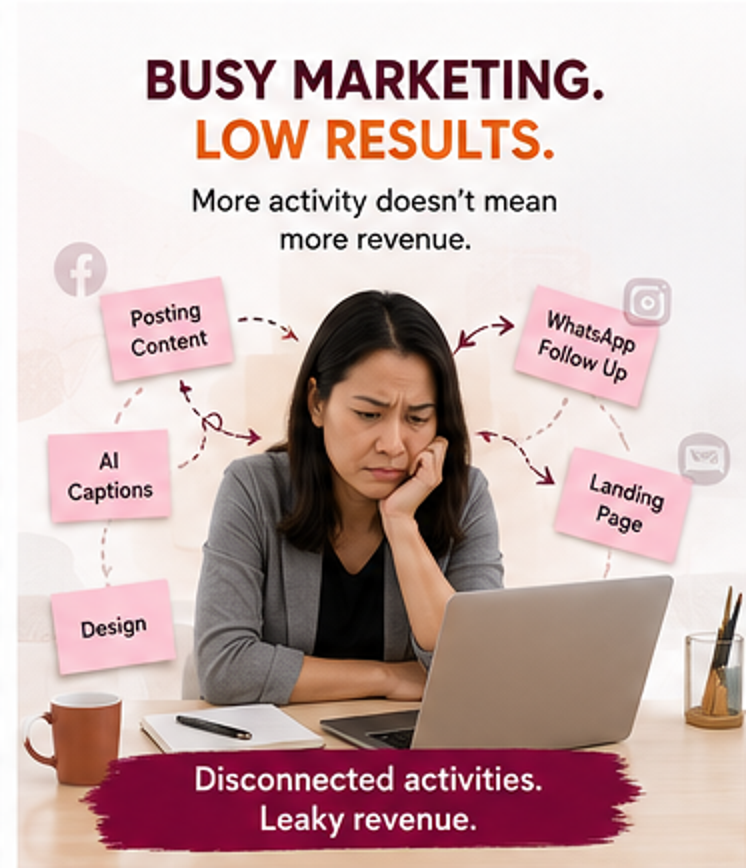
This is why the first step is not to add more tools.
The first step is to identify the leak.
Because when you know where the leak is, you can use AI with direction.
If you do not know where the leak is, you may keep asking AI for more activity without improving the business result.
Are you using AI to create more marketing output — or are you using AI to build a better marketing system?
Why More AI Content Does Not Always Create More Sales
Many business owners believe their marketing problem is a content problem.
So they ask AI for:
- 30 content ideas,
- 10 Facebook captions,
- a sales post,
- a webinar invitation,
- a landing page headline,
- or a promotional WhatsApp message.
All these can be useful.
But content alone does not create revenue if the deeper business questions remain unanswered.
Who are you trying to attract?
What problem are they ready to solve now?
Why should they trust you?
What offer should they consider?
What happens after they click, comment, enquire or attend?
What follow-up happens next?
What proof helps them decide?
What metric tells you whether the system is improving?
AI tools generate output. A business system creates outcomes.
This is why AI marketing must move from random prompting to system design.

The 3 Hidden Revenue Leaks in SME Marketing
Leak 1: Content Without Customer Clarity
The business is producing content, but the content is not anchored on a clear understanding of the customer.
The posts look active. The captions sound acceptable. The visuals are presentable. But the message is too broad.
It speaks to everyone, so it moves no one.
This is where many businesses mistake activity for strategy.
Before asking AI for content, ask:
- Who is the most profitable customer we want to attract?
- What urgent problem are they trying to solve?
- What triggers them to look for help now?
- What objection stops them from taking action?
- What proof do they need before they trust us?
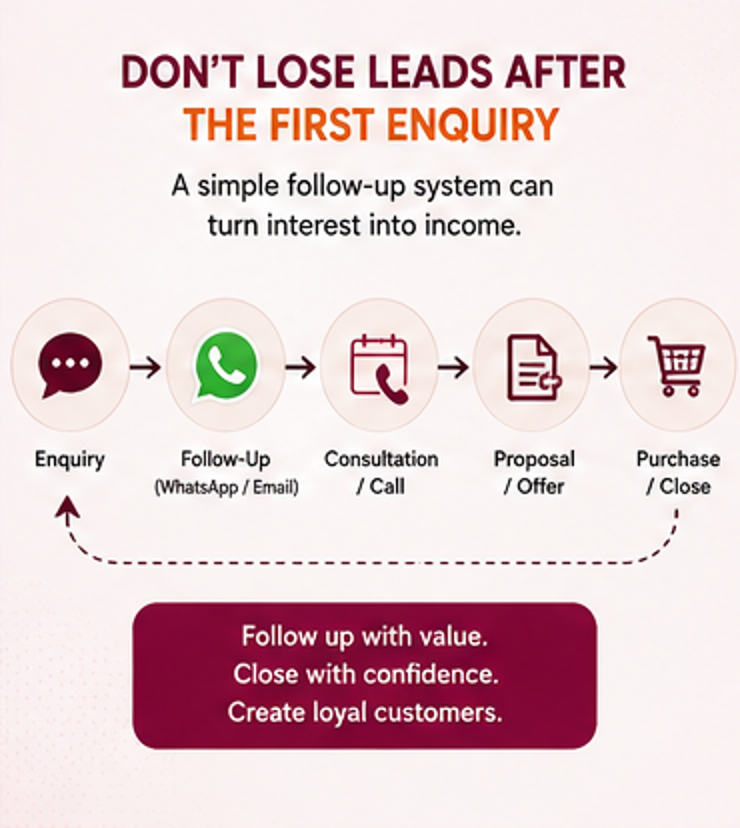
Leak 2: Leads Without Follow-Up
This leak is extremely common.
Someone comments on a post.
Someone scans a QR code.
Someone asks for more information.
Someone attends a webinar.
Then the follow-up depends on memory, mood, timing or whoever is available.
Some leads are followed up. Some are forgotten. Some receive a message too late. Some never receive a clear next step.
In many SMEs, the money is not lost because there are no leads.
The money is lost because leads are not nurtured into trust and action.
Leak 3: AI as a Drafting Tool, Not a Business System
AI is powerful, but many businesses still use it at the surface level.
They use it to write a post.
They use it to rewrite a message.
They use it to create a design idea.
Those are useful tasks, but they are not enough.
The real value comes when AI supports the full customer journey:
- Customer clarity
- Offer positioning
- Content planning
- Lead capture
- Follow-up
- Conversion
- Onboarding
- Retention and referral
That is when AI becomes more than a content assistant.
It becomes part of your marketing operating system.
The Customer Journey Revenue Leak Map
To identify where revenue is leaking, we need to stop looking only at content.
We need to look at the full customer journey.
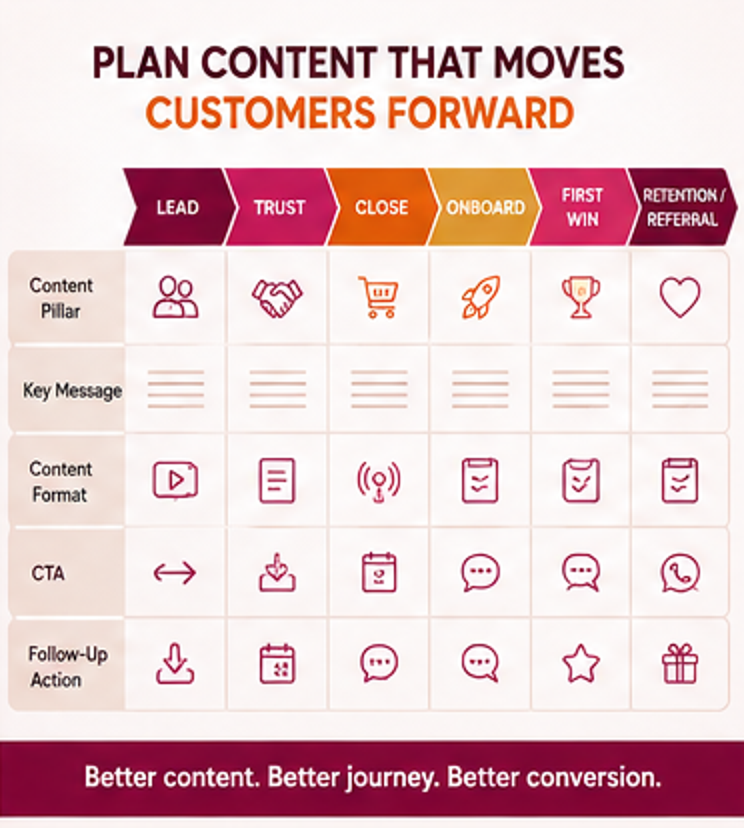
At DigitalAI Business Club, we often use this simple flow:
Lead → Trust → Close → Onboard → First Win → Retention / Referral
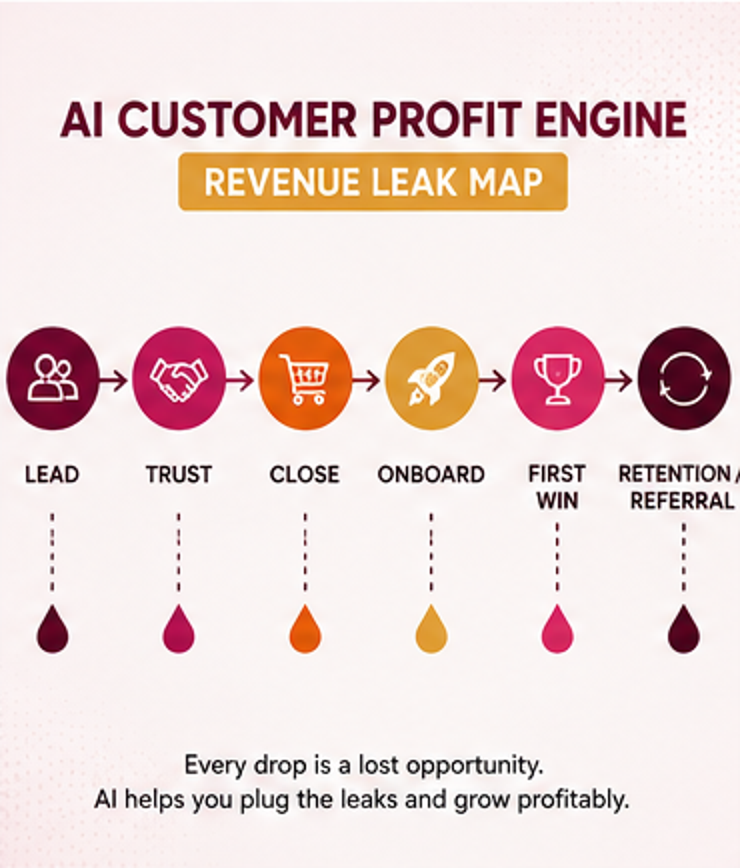
| Journey Stage | Revenue Leak | Business Question | How AI Can Help |
|---|---|---|---|
| Lead | Attracting the wrong audience | Are we visible to the right people? | Analyse ICP, buying triggers and content angles. |
| Trust | Content does not build confidence | Does our content educate and prove credibility? | Create authority content, proof posts and objection-handling messages. |
| Close | Offer is unclear or not compelling | Can customers understand why they should act now? | Review offer positioning, landing page and sales messaging. |
| Onboard | New customers do not get clarity quickly | Does the customer feel guided after payment? | Create onboarding emails, welcome kits and first-step guides. |
| First Win | Customer does not experience early progress | What is the first result they should see? | Design first-win checklists, templates and quick-start workflows. |
| Retention / Referral | No system for repeat business or referral | How do we continue the relationship? | Create nurture content, renewal reminders and referral scripts. |
This is where AI becomes strategic.
Not because AI replaces your business thinking.
But because AI can help you diagnose, design and improve every stage of this journey.
The Shift From AI Tools to AI Marketing System
Most business owners start with this question:
“Can AI help me create content faster?”
Yes, it can.
But the better question is:
“Can AI help me create content that attracts the right people, builds trust, captures leads, follows up and improves conversion?”
That is a very different level of thinking.
The first question creates output.
The second question builds a system.
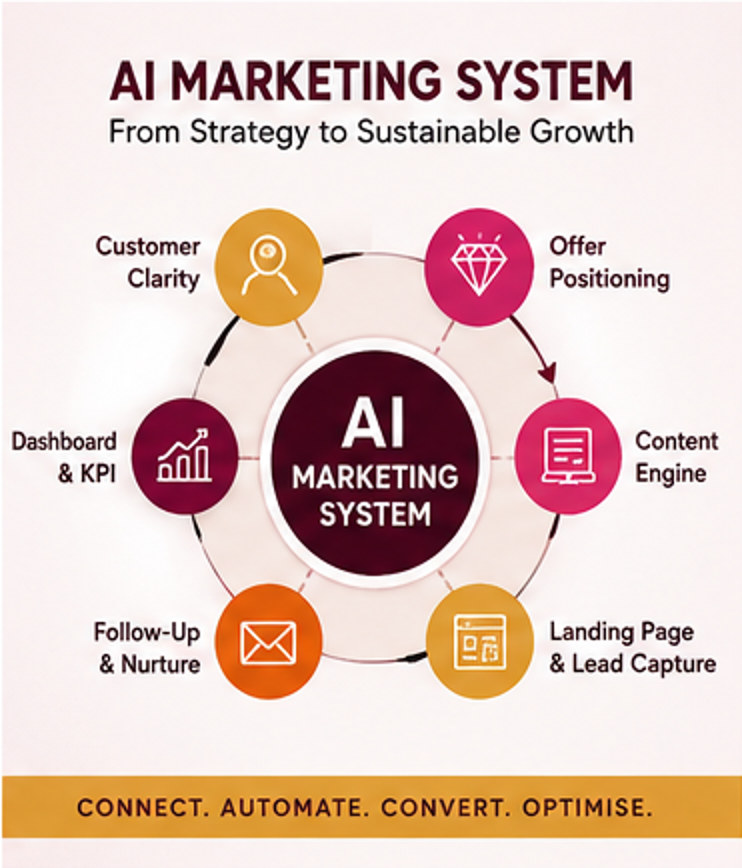
| Old Way | Better Way |
|---|---|
| Random prompts | Reusable AI skills |
| One-off captions | Customer-aware content engine |
| Manual follow-up | Structured nurture flow |
| Static landing page | Lead capture and conversion path |
| Guessing what works | KPI dashboard and improvement loop |
This is why strategy must come before automation.
If you automate confusion, you scale confusion.
If you automate clarity, you scale growth.
Quick Audit: Where Is Your Marketing Leaking?
Use this quick scorecard before you create more AI content.
Score each item from 1 to 5.
| Question | Score 1–5 | What This Reveals |
|---|---|---|
| I know exactly who my most profitable customer is. | Customer clarity | |
| My offer is clearly positioned against competitors. | Offer positioning | |
| My content builds trust before selling. | Demand and authority | |
| I have a landing page or lead capture path that converts. | Conversion flow | |
| I follow up with every lead consistently. | Follow-up system | |
| I know which marketing activities create enquiries or sales. | Measurement and optimisation |
24–30: You have structure. Now optimise.
16–23: You have pieces, but not yet a system.
Below 16: You are likely losing revenue through hidden gaps.
AI Prompts to Diagnose and Fix Marketing Leaks
Use these prompts to begin diagnosing your marketing system. The goal is not to get generic AI answers. The goal is to make your business thinking clearer.
Prompt 1: Marketing Revenue Leak Audit
Act as an AI Strategy Coach and SME marketing systems advisor.

I want to identify where my marketing revenue is leaking.

My business is:
[Describe your business]

My target customers are:
[Describe your target customers]

My main offer is:
[Describe your offer]

My current marketing activities are:
[List your current channels, content, ads, referrals, events, WhatsApp, email, etc.]

Please analyse my customer journey using this flow:
Lead → Trust → Close → Onboard → First Win → Retention / Referral

For each stage, identify:
1. What may be working
2. Where revenue may be leaking
3. What question I should ask my team or myself
4. What AI can help me improve
5. What action I should prioritise first

Format the answer as a table with:
Stage | Possible Leak | Business Impact | AI Support | Priority Action
Use this when you want to diagnose the full marketing journey before creating more content.
Prompt 2: Ideal Customer Profile Discovery
Act as an AI Strategy Coach and customer profitability advisor.

Help me define a commercially useful Ideal Customer Profile for my business.

My business is:
[Insert business description]

My current offer is:
[Insert offer]

My target audience is:
[Insert current target audience]

My best past customers are:
[Describe best customers, if available]

My most difficult customers are:
[Describe customers who are hard to serve, if available]

Please analyse:
1. Who is most likely to buy this offer
2. What urgent business problem they are trying to solve
3. What triggers them to look for help now
4. What objections may stop them from buying
5. What result they care about most
6. What message would attract them
7. Which segment is likely to be most profitable

Format the answer into:
- Primary ICP
- Secondary ICP
- Buyer pain points
- Buying triggers
- Revenue opportunity
- Best content angles
- Offer positioning recommendation
Use this before building a content calendar, webinar, landing page or sales message.
Prompt 3: Offer Positioning Review
Act as a positioning strategist for SME businesses.

I want to make my offer clearer, more differentiated and easier to buy.

My offer is:
[Describe offer]

My target customer is:
[Describe customer]

The main problem I solve is:
[Describe problem]

My competitors or alternatives are:
[List competitors or alternatives]

My current sales message is:
[Paste current message]

Please review my offer positioning and provide:
1. What is clear
2. What is confusing
3. What sounds too generic
4. What makes the offer valuable
5. What proof is missing
6. What urgency or trigger should be strengthened
7. A sharper positioning statement
8. Three headline options
9. Three CTA options

Use a calm, strategic, business-first tone.
Avoid hype.
Use this when prospects show interest but do not clearly understand why they should buy now.
Prompt 4: Competitor Brand Review
Act as a brand positioning analyst and AI marketing strategist.

I want to compare my brand message against competitors and identify positioning gaps.

My business:
[Describe your business]

My offer:
[Describe your offer]

My target customer:
[Describe target customer]

Competitors:
[Paste competitor names, websites or descriptions]

Please analyse:
1. How each competitor positions themselves
2. What they emphasize most
3. What customer pain points they address
4. What proof they use
5. What is missing from their message
6. Where my business can differentiate
7. What message territory I can own
8. What content topics can help me build authority

Format the output as:
- Competitor summary table
- Positioning gap
- My opportunity
- Recommended message angle
- Content ideas to support the positioning
Use this before rewriting your website, offer page or authority content.
Prompt 5: Customer Journey Content Plan
Act as a content strategist for SME marketing.

Create a 30-day content plan that supports my customer journey, not just random posting.

My business:
[Describe business]

My ideal customer:
[Describe ICP]

My offer:
[Describe offer]

My customer journey stages are:
Lead → Trust → Close → Onboard → First Win → Retention / Referral

Please create a 30-day content plan with:
1. Content topic
2. Customer journey stage
3. Purpose of the post
4. Key message
5. Suggested format
6. CTA
7. Suggested caption angle

Make sure the content builds trust and moves people toward action.
Avoid generic motivational content unless it supports a business objective.
Use this when you want content to support conversion, not just visibility.
Prompt 6: Follow-Up Sequence for Warm Leads
Act as a sales follow-up strategist for service-based SME businesses.

I want to create a follow-up sequence for people who show interest but have not yet bought.

My business:
[Describe business]

My offer:
[Describe offer]

Lead source:
[Example: webinar, WhatsApp group, Facebook comment, landing page, referral, event]

What the lead has done:
[Example: asked for details, downloaded guide, attended webinar, clicked link]

Please create a 7-day follow-up sequence using WhatsApp or email.

For each message, include:
1. Timing
2. Purpose
3. Message
4. Soft CTA
5. What to do if they reply
6. What to do if they do not reply

Tone:
Warm, professional, helpful, not pushy.
The goal is to build trust and help the lead take the next logical step.
Use this to stop warm leads from going cold after the first interaction.
Prompt 7: Landing Page Conversion Review
Act as a landing page conversion strategist.

Review my landing page copy and identify where it may be leaking conversions.

Landing page copy:
[Paste copy or URL content]

Target customer:
[Describe customer]

Offer:
[Describe offer]

Traffic source:
[Where visitors come from]

Please analyse:
1. Is the headline clear?
2. Is the customer problem specific?
3. Is the desired outcome visible?
4. Is the offer easy to understand?
5. Is there enough proof?
6. Are objections addressed?
7. Is the CTA clear?
8. What may cause visitors to leave?
9. What should be improved first?

Provide:
- Top 5 conversion leaks
- Improved headline options
- Improved section structure
- CTA recommendations
- Suggested FAQ questions
Use this when your page receives clicks but does not produce enough enquiries or registrations.
Prompt 8: Marketing KPI Dashboard Design
Act as a marketing operations advisor for SME businesses.

Help me design a simple marketing KPI dashboard.

My business:
[Describe business]

My main marketing channels:
[List channels]

My sales process:
[Describe how leads become customers]

My current tools:
[List tools such as WhatsApp, Google Sheets, CRM, email, landing page, social media]

Please recommend:
1. The key metrics I should track weekly
2. The key metrics I should track monthly
3. Which metrics show lead quality
4. Which metrics show follow-up effectiveness
5. Which metrics show conversion
6. Which metrics show customer retention
7. A simple dashboard layout
8. What data I need to collect
9. What decisions I should make from the dashboard

Keep the dashboard practical for an SME team.
Use this when you want to move from guessing to measurable marketing improvement.
Prompt 9: 90-Day AI Marketing System Roadmap
Act as an AI Strategy Coach and implementation roadmap advisor.

Create a 90-day roadmap to build an AI-supported marketing system for my business.

My business:
[Describe business]

My current marketing gaps:
[List gaps]

My team capacity:
[Describe who will implement]

My tools:
[List current tools]

My priority outcome:
[Example: more qualified leads, better follow-up, more conversion, stronger content system]

Please create a 90-day roadmap divided into:
- First 30 days: clarity and foundation
- Next 30 days: content and conversion assets
- Final 30 days: follow-up, automation and dashboard

For each phase, include:
1. Key objective
2. Actions
3. AI prompts or tools needed
4. Deliverables
5. Success metric
6. Common mistake to avoid

Keep the plan realistic for an SME business.
Use this to turn diagnosis into a realistic implementation path.
Prompt 10: PRISM Prompt Builder for Marketing Tasks
Use the PRISM Prompt Framework to help me write a better AI prompt.

P — Problem:
[What business problem am I trying to solve?]

R — Role:
[What expert role should AI take?]

I — Instruction:
[What task should AI perform?]

S — Structure:
[What format should the output follow?]

M — Milestone:
[What outcome, decision or next step should this help me achieve?]

Based on my inputs, please:
1. Improve my prompt
2. Make it more specific
3. Add missing context
4. Suggest the best output structure
5. Explain how I should use the result in my business
Use this when your prompt feels too general and you want AI to produce more useful business outputs.
Build Your AI Profit Marketing Automation System

If you can see that your marketing is not just missing content, but missing connection, then the next step is to build the system properly.
Inside the AI Profit Marketing Automation System, we guide you step by step to build the foundation of your AI-supported marketing engine.
You will not just learn prompts.
You will work on your actual business.
You will clarify your ideal customer, strengthen your offer, create content that supports the customer journey, build marketing assets, design a lead capture path, structure follow-up and create a more measurable marketing operating system.
This is for SME owners, coaches, consultants, trainers, service providers and business leaders who are ready to move beyond random AI usage.
The goal is not to become more technical.
The goal is to become more strategic, more consistent and more profitable in how you attract, follow up and convert customers.
Ready to Find and Fix the Revenue Leaks in Your Marketing?
If your marketing feels busy but not connected, this bootcamp will help you build the system behind better leads, follow-up and conversion.
Join the AI Profit Marketing Automation System and build your AI marketing engine step by step.
Join the Bootcamp Explore DigitalAI Business ClubFrequently Asked Questions
What is a marketing revenue leak?
A marketing revenue leak happens when potential customers drop off somewhere in the journey — for example, unclear targeting, weak trust, no follow-up, unclear offer, poor onboarding or no retention system.
Why are SME owners using AI but still not getting more sales?
Many SME owners use AI to create content faster, but the customer journey remains disconnected. If the offer, message, follow-up and conversion path are unclear, more AI-generated content will not automatically create more revenue.
How can AI help fix marketing revenue leaks?
AI can help diagnose customer clarity gaps, review offer positioning, create content mapped to the customer journey, design follow-up sequences, review landing pages and support KPI tracking. The key is to use AI strategically, not randomly.
What is an AI marketing system?
An AI marketing system connects customer clarity, offer positioning, content planning, lead capture, follow-up, conversion and measurement. It helps a business move from scattered AI usage to a more structured and repeatable marketing engine.
Who should join the AI Profit Marketing Automation System?
It is suitable for SME owners, coaches, consultants, trainers, service providers and business leaders who want to build a practical AI-supported marketing system that improves leads, follow-up and conversion.