
How Karen Lee Uses AI to Cut Company Secretarial Document Risk
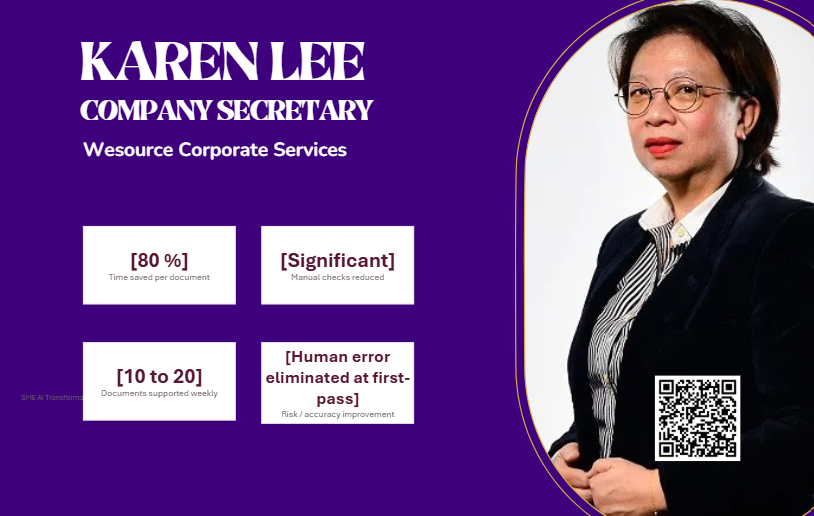
Not every AI-readiness story starts in a warehouse or a call centre. Some start at a desk stacked with resolutions, director details, and bank templates that all have to match — perfectly — before anything gets signed. Karen Lee, Company Secretary at Wesource Secretary Services, is a member of our community whose AI story shows what “AI-ready” looks like for compliance-heavy professional services.
Karen Lee
Company Secretary, Wesource Secretary Services (Wesource Group)
- Company
- Wesource Secretary Services (Wesource Group)
- Business Nature
- Corporate secretarial & compliance services
- Contact
- 012-213 6353
Quick Answer
AI can support company secretarial and compliance work by acting as a structured first-pass reviewer — flagging mismatched company names, registration numbers, dates, or director details before a document is printed or signed. The human professional still makes the final decision. AI simply reduces how much repetitive checking it takes to get there.
AI adoption does not start with the flashiest workflow. It starts with the one that is repetitive, high-risk, and quietly draining a team’s attention. For Karen, that workflow was document checking — and AI is now her team’s first line of defence before anything gets signed.
The Problem: Too Much Manual Checking, Too Much Risk
In company secretarial work, small mistakes carry real cost. A mismatched company name, an incorrect registration number, the wrong ID type, inconsistent director details, or a missing date can delay signing, create confusion with a client, or raise compliance concerns that take days to unwind.
For many small Co-Sec teams, this checking is still done manually — line by line, across resolutions, company information, bank account opening documents, director details, credentials, dates, and supporting templates.
The issue was never a lack of knowledge. Karen’s team knew exactly what to check. The real problem was that human attention thins out when the same type of checking repeats across dozens of documents a week — the same pattern we see across compliance-heavy members of our community, whether they run a Co-Sec practice, an accounting firm, or an HR advisory desk.
Why AI was the right answer: Karen’s team needed a practical way to reduce repetitive checking and build confidence before a document moved to the next stage — without handing over the compliance decision itself. The goal was never to let AI decide what is compliant. It was to let AI ask the questions a tired professional might miss on the fifth document of the afternoon: are the names consistent, do the registration numbers match, are the dates aligned, are director details correct?
That single shift freed the team to spend less time on repeated comparison and more time on judgement, client advisory, and exception handling — the work that actually requires a qualified professional.
The AI Transformation Case Canvas
Karen’s implementation followed a simple, low-risk path — one that any document-heavy SME or professional practice can apply to its own highest-friction workflow. It is the same sequencing we teach inside our AI Customer Profit Engine framework: diagnose the workflow, get the data visible, let AI take the first pass, keep the human accountable for the final call.
| Stage | What Happens |
|---|---|
| Before AI | The team checked documents line by line — resolutions, company information, directors’ credentials, dates, and bank templates — against each other, manually. |
| AI Implemented | An AI-assisted resolution checker was introduced. The team uploads resolution-related content and asks AI to flag possible mismatches in company data before final printing or signing. |
| After AI | AI verifies and flags possible issues. Co-Sec executives still make the final decision, but checking becomes faster, more structured, and more consistent. |
Nothing about this required a large technology project. It required one painful workflow, one clear checklist of what “good” looks like, and a willingness to let AI do the first pass.
“AI helped me move from repetitive checking to higher-value professional judgement.”
— Karen Lee, Company Secretary, Wesource Secretary Services
Where Is Your Own Team Losing Time to Repetitive Checking?
Most professional service firms have at least one workflow like Karen’s — repetitive, risk-heavy, and quietly draining hours every week. Find it before you look at any AI tool.
Take the DigitalAI Readiness Assessment Join the Free WhatsApp CommunityThe Business Impact: Confidence, Not Just Speed
The most meaningful improvement was not speed alone. It was confidence — fewer avoidable errors, less back-and-forth, and more consistent documents before a client or a bank ever sees them.
| Metric | Result |
|---|---|
| Time saved per document | ~80% |
| Manual checks reduced | Significant |
| Documents supported weekly | 10 to 20 |
| Risk / accuracy improvement | Human error eliminated at first-pass |
For a professional services firm, this matters commercially. Clients are not only paying for documents. They are paying for accuracy, reliability, and peace of mind — and that is exactly what a calmer, more consistent checking process protects.
“The biggest improvement was not just speed. It was reducing repetitive checking and giving us more confidence before documents go to clients or banks.”
— Karen Lee, Company Secretary, Wesource Secretary Services
What Other Professional Service Firms Can Learn
Karen’s story is a reminder that AI adoption does not need to start with a big transformation project. It can start with one painful, repetitive, high-risk workflow.
For accountants, company secretaries, consultants, lawyers, HR advisors, and compliance teams across Malaysia and the wider region, AI can practically support:
- Document review and template checking
- Summary preparation for company or client records
- Client communication drafts
- Consistency checks across related documents
- Risk flagging before final review
The key is positioning AI correctly from the start. It is not the final authority in compliance work. It is a support layer that helps professionals notice issues earlier and act with more confidence — the same role AI plays for SMEs catching revenue leaks before they reach the customer.
Why Compliance-Heavy Firms Build AI Readiness Inside a Community
Karen first shared this story on our SME AI Transformation panel — a room of business owners and professionals asking the same underlying question: where does AI actually fit in work this precise? That is the exact gap DigitalAI Business Club exists to close.
We built this community around one belief: AI becomes a business advantage only after the workflow is diagnosed first — not tool-first, not hype-first. That is what separates a documented case study like Karen’s from a generic AI tool tutorial. It is tied to risk, accuracy, and client trust — the outcomes that matter most to a professional services firm.
Inside the community, members get:
- A structured way to diagnose their own highest-risk, most repetitive workflow before choosing any tool
- Frameworks and playbooks mapped to the ten AI Profit Engines that businesses like Wesource have already applied
- Access to real, documented professional-services case studies — not vendor demos
- A network of business owners, consultants, and compliance professionals solving the same operational problems
- A clear path from diagnosis to implementation, without handing over professional judgement to a tool
The opportunity is the same for any document-heavy business reading this: start with one workflow where mistakes are costly, repetitive checking is common, and human judgement still has to make the final call. That is where AI creates immediate, measurable business value.
Build Your Own AI-Readiness Path
You do not need to figure this out alone. Join a community of SME owners and professional service leaders building AI readiness the same way Karen did — one workflow at a time.
Join DigitalAI Business Club Membership Start With the Readiness AssessmentFAQ: AI for Company Secretarial Work
Can AI replace a company secretary’s judgement?
No. AI does not make the final compliance decision. It acts as a first-pass reviewer that flags possible mismatches in names, registration numbers, dates, or director details so the Co-Sec executive can review faster and with more confidence before final sign-off.
How is AI used for document checking in professional services?
AI is used to compare resolutions, company information, and supporting documents against each other, highlighting inconsistencies such as mismatched company names, registration numbers, or director details before the document is printed or signed.
What kind of business should start with this AI use case?
Any document-heavy, compliance-sensitive business — company secretarial firms, accounting practices, law firms, HR advisory, or compliance teams — where repetitive checking is common and small mismatches carry real cost.
Does this AI implementation require a big technology project?
No. It can start with one workflow, such as resolution checking, using AI to flag inconsistencies before a human makes the final decision. This is a practical, low-risk way to introduce AI into a professional services team.
How much time can AI-assisted document checking actually save?
In Karen Lee’s case, AI-assisted first-pass checking cut review time by an estimated 80% per document, while supporting 10 to 20 documents a week and reducing human error at first pass — without removing the Co-Sec executive’s final decision.
Why should SME owners build AI adoption inside a community instead of alone?
A community provides diagnosed, business-first starting points and real case studies instead of generic tool lists, so owners avoid wasted effort and can see exactly how similar businesses sequenced their AI adoption.
Find the Repetitive Workflow Costing Your Team the Most
Inside DigitalAI Business Club Membership, you’ll find more real AI implementation stories, frameworks, and practical playbooks built for SME owners and professional service leaders — not generic AI tool lists.
Join the Club Join the Free WhatsApp Group
Want to use Claude AI like this in your own business?
Learn practical, business-first Claude AI skills through our structured 3-Level Training Pathway.
Explore the Claude AI Course →