
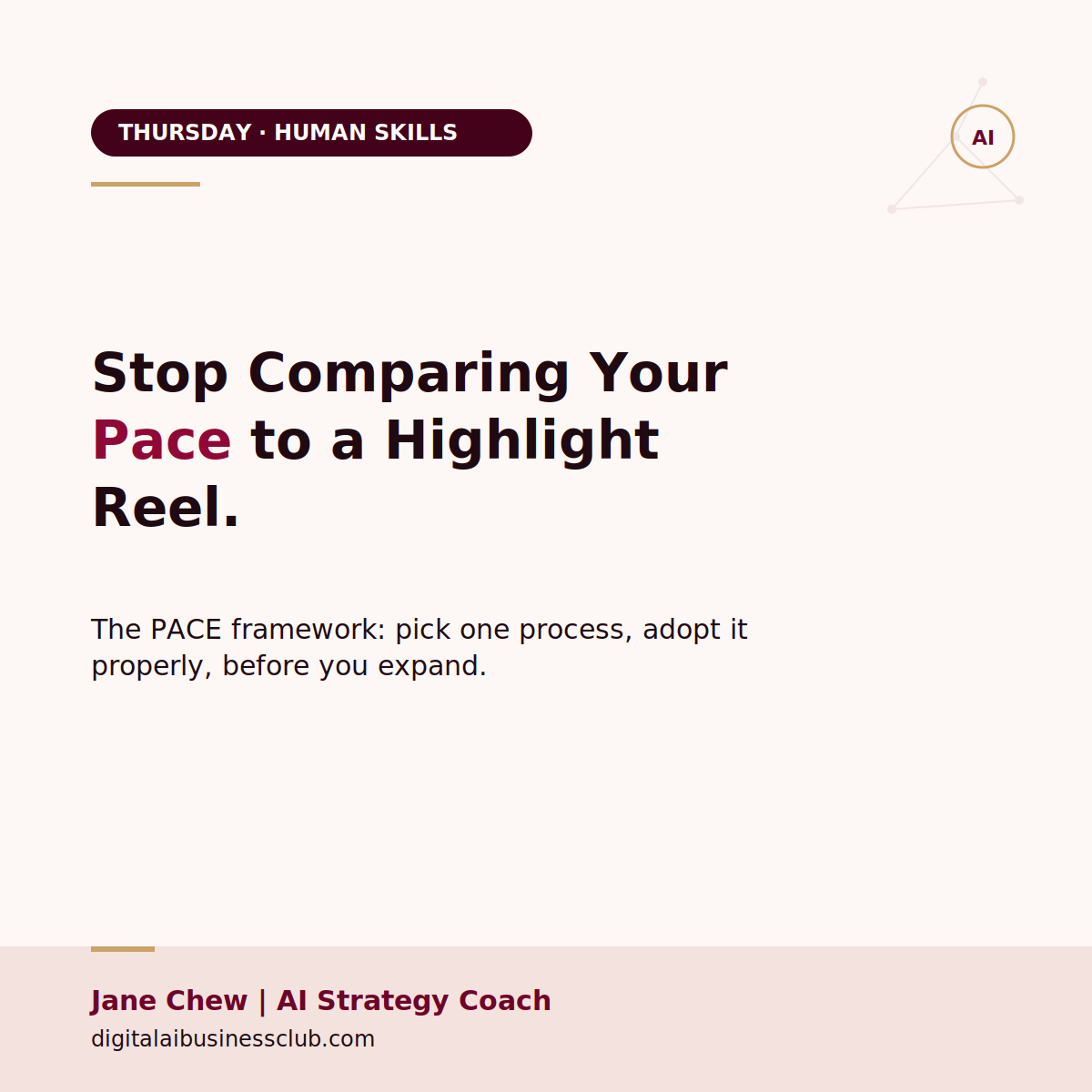
The PACE Framework: How to Adopt AI Without Burning Out Your Own Judgment
Most of the stress around AI adoption isn’t about the technology. It’s about comparison — a highlight reel of “we automated everything” posts that skip the failed attempts and the cleanup afterward. Here’s a simple way to adopt AI at a pace your business can actually absorb, without burning out the judgment that makes it work in the first place.
Best answer
The PACE framework — Pick one process, Adopt it properly, Compare only to your own baseline, Expand to the next one — is a way to adopt AI tools without the burnout that comes from trying to match everyone else’s pace. It works because it treats AI adoption as a sequence of properly-finished changes, not a race.
In this article
Where AI stress actually comes from
In every SME I coach, the pattern is the same. Someone sees a post about a workflow that saved ten hours a week, or a founder announcing they’ve “automated their entire business” — and a business owner who’s been quietly running a good, profitable company suddenly feels behind. Not because anything in their business changed. Because someone else’s highlight reel did.
Here’s what that highlight reel leaves out: the six failed prompts before the one that worked. The month spent cleaning up a mistake an AI tool made confidently and wrong. Most “we automated everything” posts are a finished result with the process invisible — and comparing your Tuesday to someone else’s finished result is a losing game by design.
This sits underneath every one of the 10 AI Profit Engines: no framework, prompt library, or automation matters if the person running the business is too overwhelmed to apply it with judgment. That’s Intelligence Engine work — not building a new dashboard, but making sure the human interpreting the data is thinking clearly.
The PACE framework
Four steps, in order, repeated for each process you bring AI into:
- P — Pick one process to improve, not five
- A — Adopt it properly, end to end, before moving on
- C — Compare only to your own baseline — before-and-after, not business-to-business
- E — Expand to the next process, once the first one is actually running on its own
P — Pick one process
Not “AI for my whole business.” One process: your month-end close, your lead follow-up, your customer onboarding email. Something specific enough that you’ll know, concretely, whether it worked.
A — Adopt it properly
This is the step most people skip under pressure to move fast. “Properly” means: you’ve actually run it a few times, you trust the output, and you (or someone on your team) understands it well enough to explain it to someone else — not just well enough to have tried it once.
C — Compare only to your own baseline
The only comparison that matters: what did this process look like before, and what does it look like now, in your business. Not what a stranger on LinkedIn claims about theirs. A before-and-after you can actually verify beats a highlight reel you can’t.
E — Expand to the next one
Once the first process is running properly and you’ve measured the before-and-after, move to the next one. This is what makes PACE compound instead of scatter — each new process starts from a business that’s already calmer, not more overwhelmed.
Ready to pick your first process?
Join the Claude AI For Business Masterclass to build it hands-on, live, inside your own Claude account.
Join Claude AI For Business MasterclassNone of this is anti-AI. I use Claude every day in my own business. It’s pro-sustainable — because the businesses still standing in two years won’t be the ones who moved fastest. They’ll be the ones who didn’t burn out their own judgment trying to keep up with everyone else’s pace.
FAQ
One. That’s the point of the framework — adopting one process properly beats starting five and finishing none. You can run PACE on a second process once the first is genuinely running on its own.
You’ve run the process a few times, trust the output, and could explain it to someone else on your team — not just tried it once and moved on.
Market awareness is useful. Using someone else’s finished, curated result as your daily benchmark isn’t — you’re comparing your process to their outcome, which is rarely a fair or even accurate comparison.
Yes — it’s the pacing layer underneath whichever Engine you’re working on. If this week’s engine is Economics, “pick one process” might be your month-end close; if it’s Demand, it might be one content channel.
Your next step
Join DigitalAI Strategy Vault Membership for the frameworks, prompt libraries, and pace-setting guidance across all 10 AI Profit Engines — one process at a time, not everything at once.
Join DigitalAI Strategy Vault MembershipJane Chew | AI Strategy Coach, HRDC Corporate Trainer | Founder of digitalaibusinessclub.com