
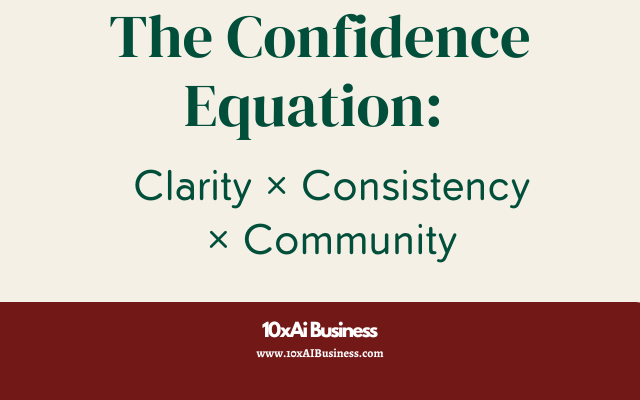
Confidence isn’t luck — it’s a formula. In a noisy AI era, leaders don’t need more hype; they need a simple way to act with conviction. This piece shows how Clarity × Consistency × Community compounds into unshakable confidence—and how AI can quietly enable each step.
Table of Contents
- Why this matters now
- Clarity: Decide what matters
- Consistency: Make progress visible
- Community: Confidence is contagious
- Action steps for SMEs & corporates
- Conclusion
Why this matters now
Generative AI is crossing from experiment to execution. McKinsey’s 2024 State of AI reports a sharp rise in regular gen-AI use and business value as workflows are redesigned (McKinsey, May 2024). Yet confidence still lags—leaders must cut through noise, choose priorities, and build momentum deliberately.
On the human side, confidence grows by doing. As Harvard Business Review notes, even seasoned CEOs must actively build confidence to drive change (HBR, Jul 2024). Put simply: confidence is constructed, not granted.
Clarity: Decide what matters
Clarity is a decision, not a document. Define a one-line 2026 vision, 3 strategic bets, and 5 measurable outcomes. Use AI to surface signal from noise—dashboards for customer demand, margin drivers, and “what-if” scenarios—but you choose the few metrics that truly matter.
Tool tip: Start with a simple “confidence dashboard” (customers, cash, capacity). Review weekly. If a metric doesn’t influence action, remove it.
Consistency: Make progress visible
Consistency compounds trust—with clients, teams, and yourself. Automate repetitive updates, nudge follow-ups, and meeting prep so human energy goes to judgement and coaching. Small, high-frequency wins beat sporadic big launches.
Rhythm to copy: 30-minute weekly review → 15-minute stand-ups with an AI summary → monthly “learning log” of wins, misses, fixes.
Community: Confidence is contagious
Leaders don’t grow in isolation. Curate a peer circle that challenges thinking and shares playbooks. Use collaboration tools and asynchronous AI notes to keep conversations focused on learning, not loudness.
Action steps for SMEs & corporates
For SME owners: (1) Write your one-line 2026 vision. (2) Pick one daily non-negotiable that moves revenue or retention. (3) Join a peer circle where shipping beats showmanship. Consider our AI Playbook (free access) to jump-start workflows.
For corporate leaders: (1) Stand up an executive “confidence dashboard” for AI value, risk, and adoption. (2) Institutionalize weekly, data-driven rituals. (3) Sponsor a cross-functional community of practice to spread wins. If you need a catalyst, try the 10xAI Business Compass.
Conclusion (120 words): Confidence is not a mood to wait for—it is a system to build. When leaders commit to clarity (choose what matters), consistency (show up and measure progress), and community (learn with others), results accelerate and uncertainty shrinks. AI helps by removing friction—cleaner information, steadier rituals, tighter collaboration—but it does not replace judgement. Start small: define a one-line vision, a weekly operating rhythm, and a peer circle that rewards real progress. The compound effect is quiet but definitive: a team that knows where it’s going, moves together, and trusts itself under pressure. That is the real moat in 2026—confidence built on alignment, not noise.
Next step: Join my upcoming AI-Powered Strategy Workshop to turn this equation into a working operating rhythm for your team.
FAQ
What is the “Confidence Equation”?
It’s a simple leadership formula: Clarity × Consistency × Community = Confidence. Define what matters, act repeatedly, and grow with peers.
How does AI help me build confidence, practically?
AI clarifies signal (dashboards, analysis), sustains consistency (automation, summaries), and supports community (shared notes, knowledge bases).
Where should I start this week?
Write your one-line 2026 vision, set a 30-minute weekly review, and invite two peers to a monthly “learning log” session.
Related reads
Tags: Leadership, AI Strategy, SME Growth, Operating Rhythm, Confidence