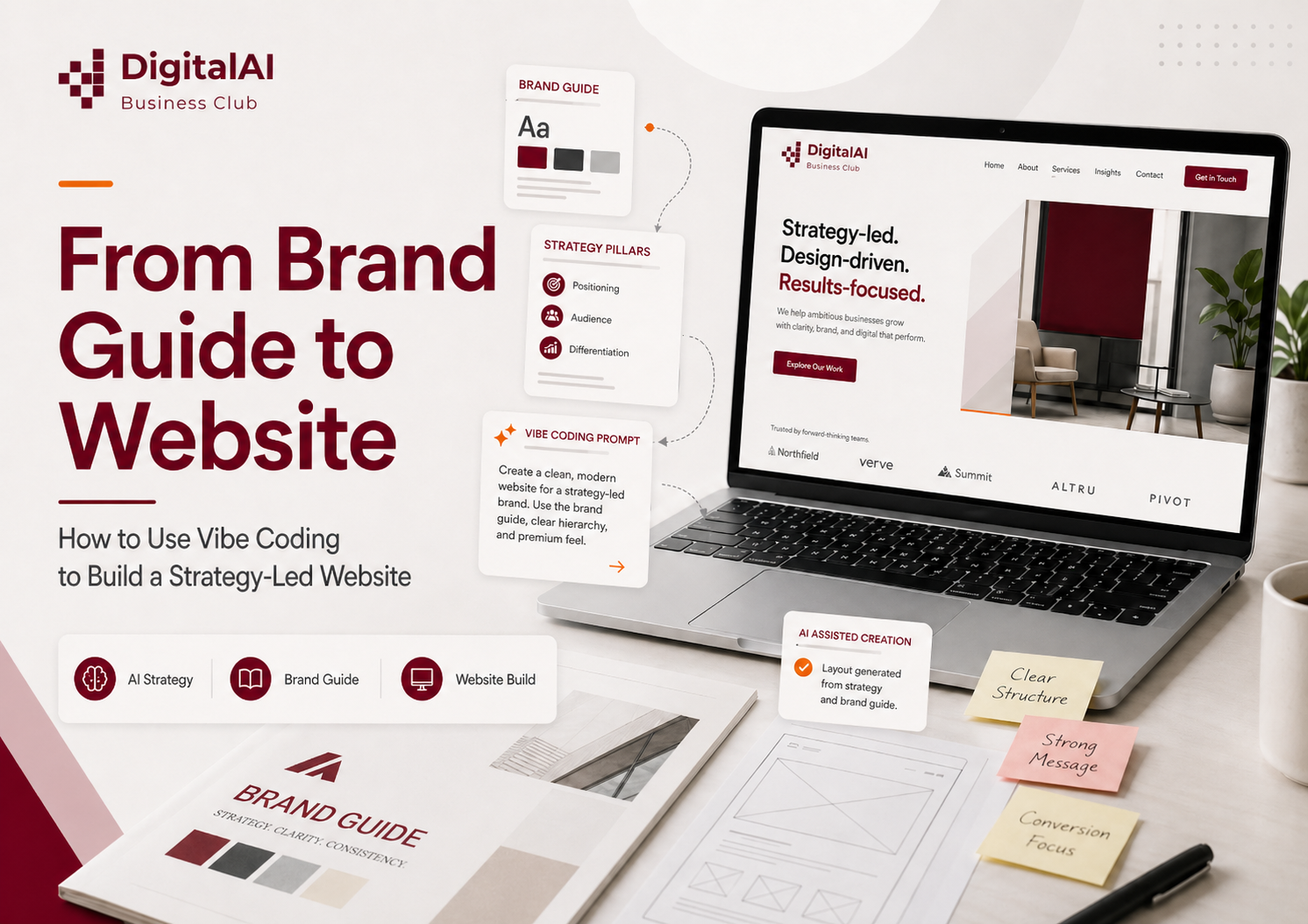
From Brand Guide to Website: How Business Owners Can Use Vibe Coding to Build a Strategy-Led Website
Most business owners do not have a website problem. They have a clarity problem.
They ask for a new website because the old one looks outdated. But very often, the real issue is deeper: unclear positioning, weak offer message, generic copy, poor customer journey, and no strong reason for visitors to enquire.

Quick Answer: A vibe coding platform can help business owners create a website faster by turning natural language instructions into working web pages. But the quality of the website depends heavily on the clarity of the brand guide. When your audience, offer, positioning, tone, trust signals, and call-to-action are clear, AI can help you build a more strategic, conversion-focused website.
Table of Contents
Why the Brand Guide Must Come Before the Website
Many business owners start website creation by choosing colours, templates, images, or layouts.
That feels productive, but it often leads to a website that looks presentable yet does not clearly answer the customer’s most important questions:
- Who is this business for?
- What problem does it solve?
- Why should I trust them?
- What result can I expect?
- What should I do next?
A good brand guide gives the website a strategic foundation. It tells AI what the business stands for, who it serves, what it offers, and how it should sound.
Strategic reminder: AI does not replace business clarity. AI amplifies the clarity you already have. If your positioning is weak, the website will simply make the weakness look polished.
What Is Vibe Coding?
Vibe coding is a simple way of building a website, app, or digital prototype by describing what you want in plain language to an AI coding platform.
Instead of manually writing every line of code, you tell the AI what kind of website you want, who it is for, what sections should appear, what tone to use, and what action visitors should take.
For business owners, this is powerful because you no longer need to wait weeks just to test a website idea. You can move from strategy to prototype much faster.
What Your Website Must Do for the Business
A website is not just an online brochure. It should support the customer journey.
| Customer Stage | Website Role | Example Content |
|---|---|---|
| Problem Awareness | Help visitors recognise the problem they are facing | Common challenges, symptoms, pain points |
| Trust Building | Show why you understand their situation | Founder story, expertise, case studies, testimonials |
| Offer Understanding | Explain what you offer and who it is for | Programs, services, workshops, consulting packages |
| Decision Support | Reduce doubt and answer buying questions | FAQs, outcomes, process, proof, comparison |
| Action | Make the next step clear | Book a call, join workshop, request proposal, WhatsApp enquiry |
How to Turn a Brand Guide into a Website
Once your brand guide is ready, you can use it as the foundation for your website prompt.
Your brand guide should ideally include:
- Target audience: Who you serve
- Main problem: What pain or gap you solve
- Desired outcome: What result the customer wants
- Positioning: Why your business is different
- Offer: What you sell or invite people into
- Credibility: Why people should trust you
- Tone of voice: How the brand should sound
- Visual direction: Colours, mood, imagery, layout style
- CTA: What action you want visitors to take
A simple website flow after your brand guide is created
- Hero section: Say clearly who you help and what outcome you create.
- Problem section: Show that you understand the customer’s current challenge.
- Solution section: Explain your approach or framework.
- Offer section: Present your program, service, or workshop.
- Proof section: Add testimonials, case studies, media, credentials, or experience.
- FAQ section: Answer common questions and support AEO visibility.
- CTA section: Invite the visitor to take the next step.
A Website Prompt You Can Use
Here is a practical prompt you can use inside a vibe coding platform after completing your brand guide.
Prompt You Can Use in a Vibe Coding Platform
Act as a senior website strategist, conversion copywriter, SEO/AEO specialist, and front-end developer.

I want to create a professional website based on my brand guide.

Business name:
[Insert business name]

Website purpose:
[Explain what the website should achieve — example: generate enquiries, promote a workshop, sell a service, attract corporate clients, invite people to join a community]

Target audience:
[Insert your target customer]

Main problem my audience faces:
[Insert problem]

Desired outcome my audience wants:
[Insert outcome]

My offer:
[Insert service, workshop, program, product, or membership]

My unique advantage:
[Insert experience, method, framework, proof, industry background]

Brand tone:
[Insert tone — example: calm, strategic, practical, premium, friendly, professional, non-hype]

Visual direction:
[Insert colour, mood, design preference, image style]

Call-to-action:
[Insert main CTA — example: Book a call, Join the workshop, Request proposal, WhatsApp us, Download guide]

Please create a complete website structure with these sections:
1. Header and navigation
2. Hero section
3. Quick answer section for AEO
4. Problem section
5. Solution / framework section
6. Offer section
7. About / founder section
8. Proof / testimonials section
9. FAQ section
10. Final CTA section
11. Footer

SEO requirements:
- Create one clear H1
- Use proper H2 and H3 headings
- Add SEO title and meta description
- Add image alt text
- Add FAQ schema
- Make the content answer-engine friendly
- Make the site mobile responsive
- Avoid generic copy
- Avoid hype
- Make every section support the customer journey

Output required:
1. Website structure
2. Complete homepage copy
3. HTML
4. CSS
5. JavaScript only if needed
6. SEO meta tags
7. FAQ schema
8. Suggested sitemap
9. Final checklist before publishing
This prompt works because it gives the AI enough business context before asking it to build.
When you only ask AI to “create a website”, the result is usually generic. But when you provide the brand guide, customer journey, offer, tone, and CTA, the website becomes much more aligned with your business.
Common Mistakes to Avoid
1. Starting with design before strategy
A nice-looking website cannot fix unclear positioning. Start with the customer, message, offer, and outcome first.
2. Asking AI for a website without giving business context
AI needs direction. If your prompt is too broad, the output will sound like a template.
3. Making the website too tool-focused
Visitors do not buy because you use AI. They buy because you solve a real problem and help them achieve a valuable result.
4. Forgetting the call-to-action
Every website should make the next step clear. Do you want visitors to book a call, join a workshop, download a guide, WhatsApp you, or request a proposal?
5. Ignoring SEO and AEO
Your website should not only look good to humans. It should also be easy for Google and AI search engines to understand. That means clear headings, direct answers, FAQ sections, schema, and strong topical relevance.
How This Fits Into the DigitalAI Business Club Approach
At DigitalAI Business Club, we do not teach AI as a collection of random tools.
We teach AI as a way to improve business clarity, customer journey, productivity, and revenue systems.
| Step | Business Question | AI Output |
|---|---|---|
| 1. Customer Clarity | Who are we serving and what do they really want? | ICP, pain points, desired outcomes |
| 2. Brand Guide | How should the business be positioned? | Brand message, tone, credibility, differentiator |
| 3. Website Blueprint | What journey should visitors experience? | Page structure, section flow, CTA map |
| 4. Vibe Coding | How can we turn the strategy into a working prototype? | HTML, CSS, layout, prototype |
| 5. Optimization | How do we improve visibility and conversion? | SEO, AEO, FAQ, analytics, testing |
Final Thought
Vibe coding is exciting because it gives business owners the power to move from idea to website prototype much faster.
But the real advantage is not speed alone.
The real advantage is when a business owner can combine clear strategy, strong positioning, customer understanding, and AI execution.
That is when a website stops being a digital brochure and becomes a business growth asset.
Want to Build Your Brand Guide Before Creating Your Website?
Join DigitalAI Business Club to learn how to turn customer clarity into brand message, website structure, content ideas, and practical AI-supported business assets.
Join DigitalAI Business ClubFrequently Asked Questions
What is vibe coding for business websites?
Vibe coding is a practical way of using AI coding platforms to create websites or prototypes by describing what you want in natural language. For business owners, it reduces the technical barrier, but it still requires clear business direction.
Do I need to know coding to use vibe coding platforms?
No. You do not need to be a developer. However, you do need to understand your customer, offer, positioning, and website goal. The clearer your strategy, the better the AI output.
Why should I create a brand guide before building my website?
A brand guide gives the AI clear direction. It defines your target audience, tone of voice, visual style, offer, credibility, and key message. Without it, the website may look nice but fail to communicate your business value clearly.
Can AI create my full website?
AI can help create the structure, copy, layout, HTML, CSS, and even a prototype. But the business owner still needs to review the message, check accuracy, refine the offer, test the links, and make sure the website supports real business outcomes.
Is this suitable for SMEs, consultants, trainers, and coaches?
Yes. This approach is especially useful for service-based businesses where trust, positioning, expertise, and clear customer outcomes matter. A strategy-led website can help convert visitors into enquiries, leads, workshop participants, or clients.