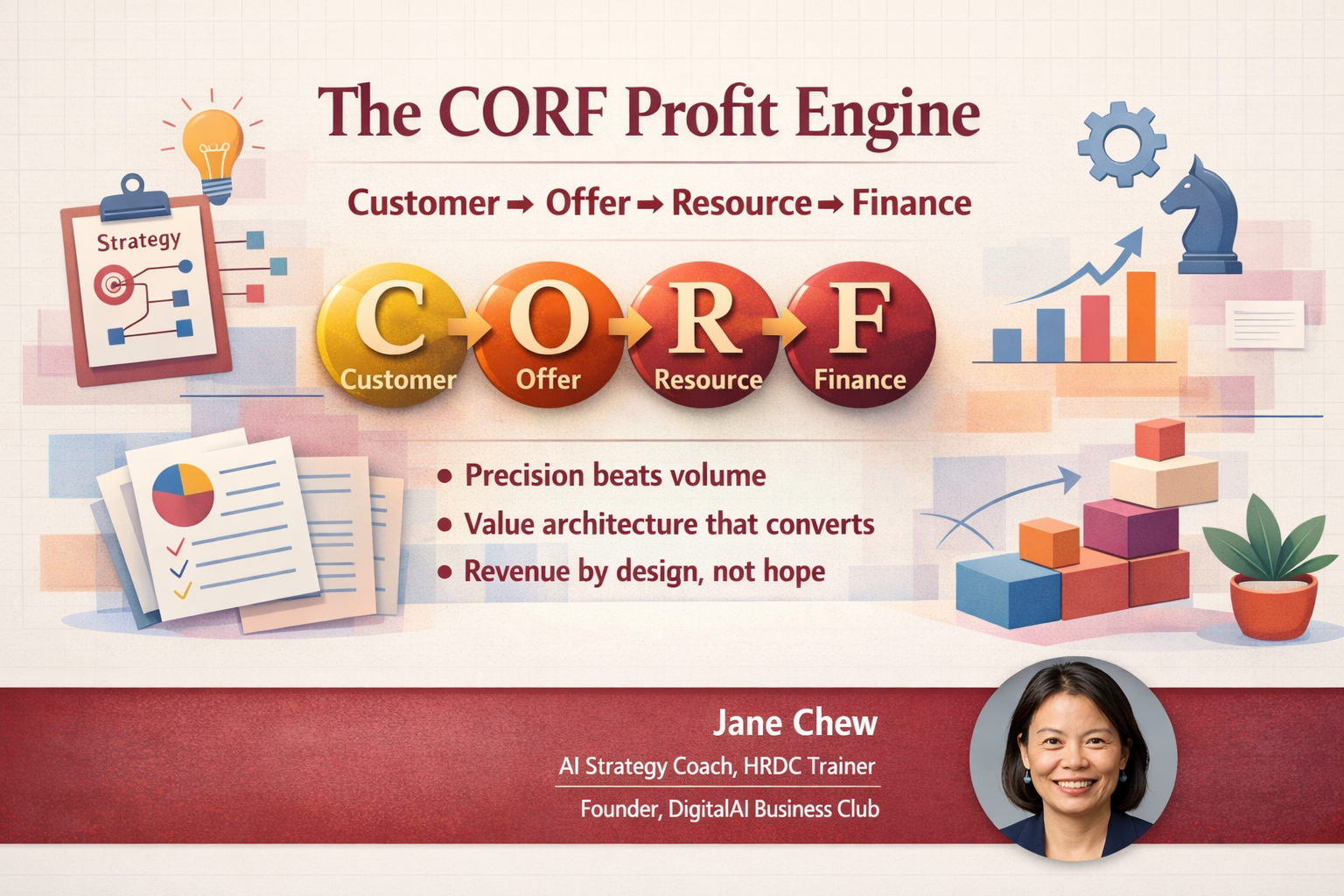
The AI Customer Profit Engine™ — Part 2: The CORF Profit Engine

Part 2 The CORF Profit Engine: Customer → Offer → Resource → Finance

The AI Customer Profit Engine™ — Part 2: The CORF Profit Engine

By Jane Chew — AI Strategy Coach | Founder, DigitalAI Business Club

What CORF does: It turns “customer insight” into a repeatable revenue system — so AI amplifies profit, not chaos.

Why CORF is the real engine

Most businesses treat growth like a “marketing problem.” So they chase tactics: more content, more ads, more funnels, more followers.

But revenue doesn’t grow because you worked harder. Revenue grows because your system is clear. In the AI economy, clarity is not a branding exercise — it’s operational.

CORF is my strategic filter: If one pillar is weak, AI will amplify that weakness at scale.

The CORF Profit Engine is simple: Customer → Offer → Resource → Finance. Each pillar is a decision layer. And the goal is not to “use AI.” The goal is to design profit — then use AI as leverage.

C — Customer: precision beats volume

In the AI era, broad targeting is expensive and weak. Customers can compare instantly. If your message feels generic, you lose attention.

Customer clarity is not “who you want.” It’s who you are designed for — based on urgency, profitability, and adoptability. If you serve everyone, you become forgettable.

Worksheet: 3-Filter ICP (Score 1–10)

  • Profitability: Do they have budget and willingness to pay?
  • Urgency: Is the pain present and costly right now?
  • Adoptability: Can they implement fast with minimal resistance?

Decision rule: Your primary segment should score high in at least two filters — ideally all three.

AI makes customers more informed. That means your message must be sharper: not “what you do,” but what pain you remove and what outcome you deliver.

O — Offer: value architecture that converts

Most SMEs believe they have a marketing problem. But what they really have is an offer problem: unclear outcomes, unclear scope, weak proof, too much friction.

In the AI economy, value is increasingly measured as: time saved, risk reduced, complexity removed, confidence gained. If your offer doesn’t deliver at least one of these clearly, customers hesitate.

Worksheet: ERRC Offer Redesign

Use this to redesign your offer so it becomes obvious, compelling, and easy to buy.

  • Eliminate: What steps or confusion can we remove entirely?
  • Reduce: What complexity can we simplify into a template or guided flow?
  • Raise: What proof, certainty, or guarantees can we strengthen?
  • Create: What new AI-assisted experience can we introduce?

Output: One sentence offer promise + 3 bullet outcomes + 1 proof point.

A strong offer does not need heavy persuasion. It creates recognition: “This is exactly what I need.”

R — Resource: leverage with systems (and AI)

Resources are not just people and money. Resources include time, capability, data, tools, process, and leadership attention.

AI becomes powerful when it supports a system. If there is no system, AI becomes scattered productivity — and scattered productivity doesn’t compound.

Decision Framework: Automate, Augment, or Keep Human

  • Automate when the task is repetitive, rule-based, and low-risk.
  • Augment when human judgment matters but AI can speed up drafts, analysis, or options.
  • Human-only when trust, ethics, relationships, or high-stakes decisions are involved.

Quick check: If a mistake here damages trust, keep a human in the loop.

This is what resource leverage looks like in practice: fewer manual steps, faster cycle time, and higher consistency — without compromising trust.

F — Finance: revenue by design, not hope

Most SMEs set revenue targets and then “do more marketing.” That’s not strategy — that’s hope.

Revenue can be reverse-engineered. When you do this, you stop guessing what to fix and start prioritising the highest impact lever.

Worksheet: Reverse-Engineer Your Revenue (90 Days)

  1. Revenue Target: RM ________
  2. Average Deal Value (or annual membership value): RM ________
  3. Customers Needed: Target ÷ Deal Value = ________
  4. Win Rate %: ________%
  5. Leads Needed: Customers ÷ Win Rate = ________

Key insight: If your win rate is low, don’t chase more leads. Fix offer clarity and proof first.

Finance is not only accounting. Finance is strategic clarity: your pricing logic, margin discipline, customer lifetime value, and what you choose to stop doing.

CORF Scorecard (10 minutes)

Score each pillar 1–10. Be honest. This is how you find the real bottleneck.

C — Customer

Do we have a specific segment with urgent pain + budget + fast adoption?

Score: ___ / 10

O — Offer

Is the outcome obvious, the scope clear, and the proof credible?

Score: ___ / 10

R — Resource

Do we have a repeatable process and the right AI leverage (not scattered tools)?

Score: ___ / 10

F — Finance

Can we reverse-engineer revenue and identify the single biggest lever to fix?

Score: ___ / 10

Decision: Your lowest score is your bottleneck. Fix that first — then let AI multiply the improved system.

Want implementation support? Use the WhatsApp contact button on the site.