
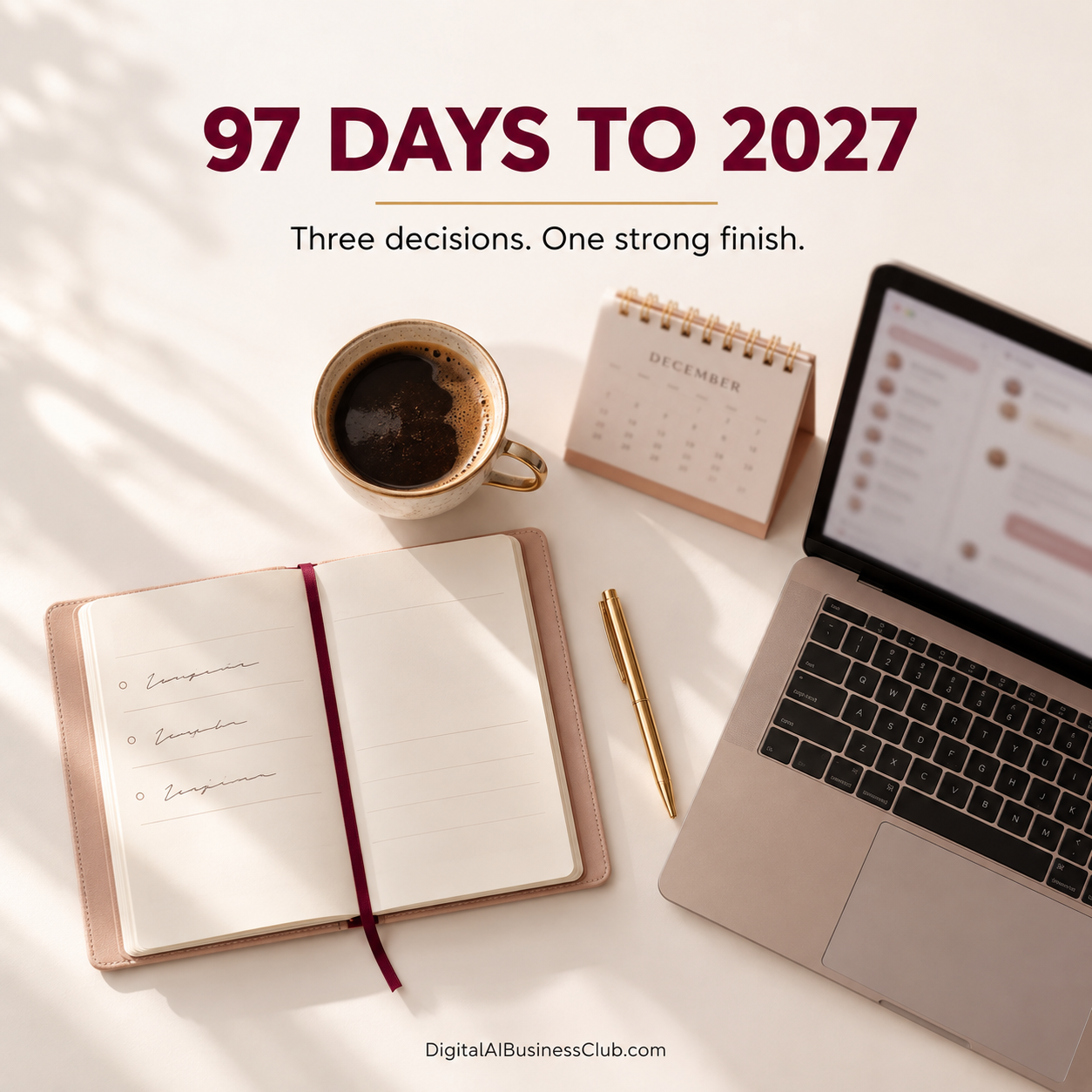
97 Days to 2027: Three Decisions to Finish 2026 Well

The short version: Don’t write a new resolution list for the rest of 2026. Make three decisions: one for your business, one for your learning (starting with AI), and one for your personal life. Give each a finish line, a first move and a weekly check-in. Then let AI keep you honest every Sunday.
Quick Answer
The best way for SME owners to use the last 97 days of 2026 is to commit to three goals only: a business or career result, an AI learning goal, and one personal area. Define what “done” looks like on 31 December, take a first step within 48 hours, and review progress weekly using an AI chat thread as your accountability partner.
The 100-day mark passed quietly last week. Most business owners were too busy to notice.
That’s the real risk of the last quarter. It fills up with activity by default: year-end sales, festive season, staff leave, school holidays. By December, you look back and struggle to name what actually moved.
So here’s a calmer way to use what’s left. Not a new resolution list. Just three decisions.
The Three Decisions
Decision 1: Business & Career
What one result would make you say, “This year moved my business forward”?
A signed client. A launched offer. A process that finally runs without you. Pick one. If you pick five, you’ve picked none.
Decision 2: Continuous Learning. Have you started with AI?
Not reading about it. Not watching others use it. Using it yourself, on real work, every week.
- If you haven’t started: pick one task you repeat every week (proposals, customer replies on WhatsApp, monthly reports) and let AI do the first draft. You review and improve it.
- If you have started: go one level deeper. Move from asking AI questions to building one workflow your team actually uses.
A small training provider in Petaling Jaya, for example, could start by letting AI draft every course proposal. By December, that’s 14 weeks of proposals written faster, and a team that has stopped treating AI as something for “later”.
Decision 3: One Personal Area
Health, money, family, or a skill you keep postponing. Choose the one you’d most regret leaving untouched by 31 December.
Three Questions for Each Decision
| Question | What to write down | Example (AI learning goal) |
|---|---|---|
| The finish line | What does “done” look like on 31 December? Specific enough that you’d know if you got there. | AI drafts every client proposal, and I edit instead of writing from scratch. |
| The first move | What can you do in the next 48 hours? Small is fine. Starting is the point. | Use AI to redraft the last proposal I sent and compare the two. |
| The check-in | Which day each week will you review progress? Block it in your calendar. | Every Sunday, 8pm, 15 minutes. |
Strategy before tools. Notice that the AI goal is tied to a business task, not a tool. “Learn ChatGPT” is vague. “Cut proposal writing time” is a decision you can measure.
Not sure where you stand with AI?
Before you set your learning goal, take the AI Business Readiness & Maturity Assessment. It shows where your business is today, so your next 97 days start from the right place.
Take the AssessmentLet AI Keep You Accountable
Most year-end goals don’t fail because they’re wrong. They fail because nobody checks in. Here’s a simple fix you can set up in five minutes.
- Open ChatGPT, Claude or Gemini.
- Paste in your three decisions, with the finish line, first move and check-in day for each.
- Use the prompt below.
- Keep everything in one chat thread. Come back to it every Sunday.
Prompt 1: 97-Day Accountability Partner
You are my year-end accountability coach. I run a [FILL IN: type of business] in [FILL IN: city/country].

Here are my 3 goals for the rest of 2026:
1. Business & Career: [FILL IN goal, finish line, first move]
2. Continuous Learning (AI): [FILL IN goal, finish line, first move]
3. Personal: [FILL IN goal, finish line, first move]

Task:
- Break each goal into weekly milestones from now until 31 December 2026.
- Present them as a simple table: Week | Goal | Milestone.
- Every Sunday I will update you on what I actually did.
- When I update you, tell me plainly whether I'm on track, what's slipping, and the ONE thing to focus on next week.

Do not motivate me with generic encouragement. Be direct and practical.
Save the chat so you can find it again. Each Sunday, open the same thread and type what you did that week.
Prompt 2: Sunday Update
Week [FILL IN number] update:
- Business goal: [what I did]
- AI learning goal: [what I did]
- Personal goal: [what I did]

Compare this against my milestones. What's on track, what's slipping, and what is my one priority for next week?
Keep it short. Two or three lines per goal is enough.
There are 14 Sundays left this year. That’s 14 honest check-ins, and a clear record of progress by year-end instead of a vague memory of being busy.
And if AI is your learning goal, this exercise already counts as your first use case.
97 days won’t change everything. They are enough to finish one thing that matters in your business, build one new capability, and take care of one part of your life you’ve been neglecting.
Frequently Asked Questions
What should SME owners focus on in the last 97 days of 2026?
Focus on three decisions rather than a long resolution list: one business or career result, one learning goal (ideally starting or deepening your use of AI), and one personal area such as health, money or family. For each, define the finish line, the first move and a weekly check-in day.
How can I use AI to track my year-end goals?
Paste your three goals into ChatGPT, Claude or Gemini and ask it to break each into weekly milestones. Update the same chat thread every Sunday with what you did, and ask it to tell you plainly whether you are on track, what is slipping and what to focus on next week. Keeping one thread gives you a running record of progress.
How do I start using AI in my business if I have not started yet?
Pick one task you repeat every week, such as writing proposals, replying to customers or preparing reports, and let AI produce the first draft. You review and improve it. One real use case a week builds skill faster than reading about AI tools.
Is 97 days enough time to make meaningful progress?
Yes, if you limit yourself to three goals. 97 days is about 14 weeks, which is enough to finish one important business project, build one new capability such as AI, and make visible progress in one personal area. It is not enough if you try to do everything at once.
Why should I check my AI readiness before setting a learning goal?
Your learning goal should start from where your business actually is. A beginner needs a first weekly use case, while a business already using AI may need a shared team workflow. An AI readiness assessment shows your current level so you set a goal that fits.
Finish 2026 with people who are doing the same
Inside the DigitalAI Strategy Vault, members get practical AI playbooks, prompt libraries and a community of SME owners putting AI to work on real business problems. A good place to keep your 97-day commitment on track.
Take the AI Readiness Assessment Join the ClubJane Chew / AI Strategy Coach, HRDC Corporate Trainer / Founder of digitalaibusinessclub.com