
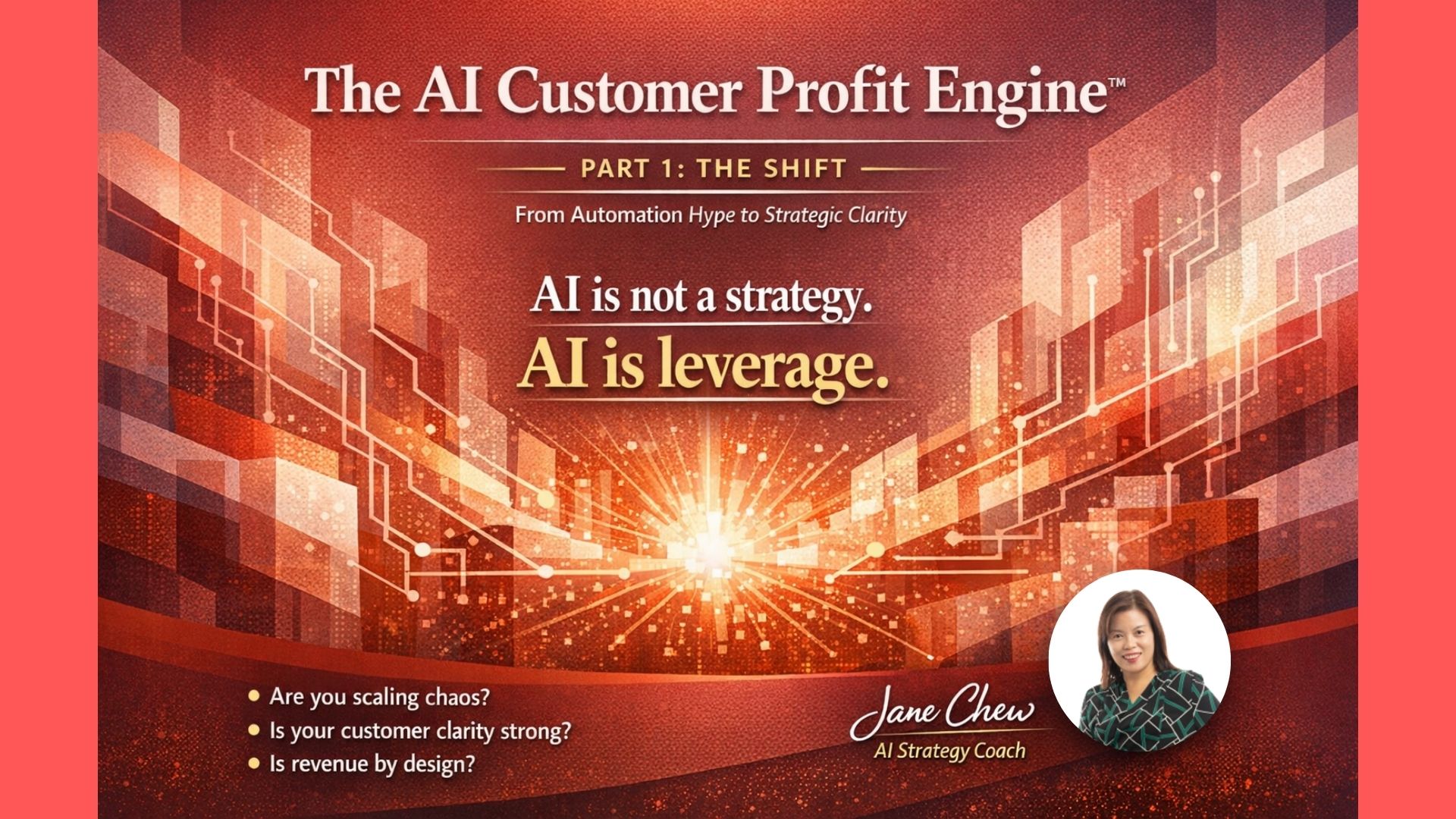
The AI Customer Profit Engine™ — Part 1: The Shift
By Jane Chew — AI Strategy Coach | Founder, DigitalAI Business Club
Big idea: AI is not a strategy. AI is leverage. And leverage applied to the wrong foundation will amplify chaos—fast.
Chapter 1 — The AI Illusion
Every business leader I speak to today is asking the same question: “How can we use AI?” It sounds progressive. It sounds urgent. It sounds necessary. But it’s the wrong starting point.
The better question is: “What exactly are we trying to fix?” AI is not a strategy. AI is leverage. And leverage applied to the wrong foundation will not create growth—it will amplify dysfunction.
- If your targeting is unclear, AI will scale irrelevant traffic.
- If your offer is confusing, AI will accelerate objections.
- If your onboarding is weak, AI will multiply dissatisfaction.
AI does not correct structural flaws. It exposes them. Many SMEs are unknowingly automating chaos—installing chatbots before defining positioning, generating content before validating customer pain, automating follow-ups before fixing the value proposition.
Reflection Exercise (5 minutes)
- List 3 AI tools you’re currently experimenting with.
- For each tool: what specific revenue bottleneck is it solving?
- If you can’t answer clearly, pause. Tools without a defined problem are distractions.
Core rule: AI multiplies clarity—or it multiplies confusion. There is no neutral outcome.
Chapter 2 — The Rise of the AI-Empowered Customer
There was a time when information asymmetry favored businesses. Customers depended on salespeople to educate them. Today, customers arrive informed—sometimes over-informed.
They compare pricing instantly. They ask AI to summarize alternatives. They validate your claims against reviews. They use AI to draft negotiation scripts.
You are no longer competing only against competitors. You are competing against:
- The clarity of someone else’s website
- The speed of someone else’s onboarding
- The confidence AI gives your prospect
This is not about technology. It’s about decision velocity. Customers can now research faster, doubt faster, and switch faster. In that environment, clarity becomes currency.
Worksheet: Customer Trigger Map
Complete this without guessing. Use real conversations and real customer language.
- Primary customer segment: __________
- Trigger event that starts their search: __________
- Top 3 fears driving urgency: __________
- Most common alternative they consider: __________
- Emotional state when they reach you: __________
Chapter 3 — From Activity to Architecture
Many SMEs confuse activity with progress. Posting daily. Running ads. Sending emails. Attending networking events. Activity feels productive. But architecture creates revenue.
Architecture answers:
- Who are we designed for?
- What problem do we remove better than anyone else?
- What transformation do we deliver?
- How does someone move from stranger to loyal customer?
If you cannot map that journey clearly, you don’t have a system. You have tactics. Most revenue leaks are not caused by lack of leads. They are caused by weak targeting, unclear positioning, slow follow-up, inconsistent onboarding, and no retention strategy.
Before you scale traffic, you must fix the engine.
Exercise: Map Your Current Customer Journey
List these stages and identify where friction is highest:
- Awareness
- Interest
- Consideration
- Purchase
- Onboarding
- Delivery
- Retention
Now answer: Where is friction highest? Where is trust weakest? Where is clarity lowest? Circle the top two. Those are not marketing problems—they are design priorities.
Wrap-up: What Part 1 should change for you
- Stop chasing tools. Start with the bottleneck.
- Your customer is AI-empowered. Clarity is currency.
- Revenue growth is a design problem. Fix the engine before scaling traffic.
Next: Part 2 will introduce the CORF Profit Engine (Customer, Offer, Resource, Finance) — the framework I use to turn customer insight into predictable revenue.
If you want implementation support (not just content), reach out via WhatsApp on the site contact button.