
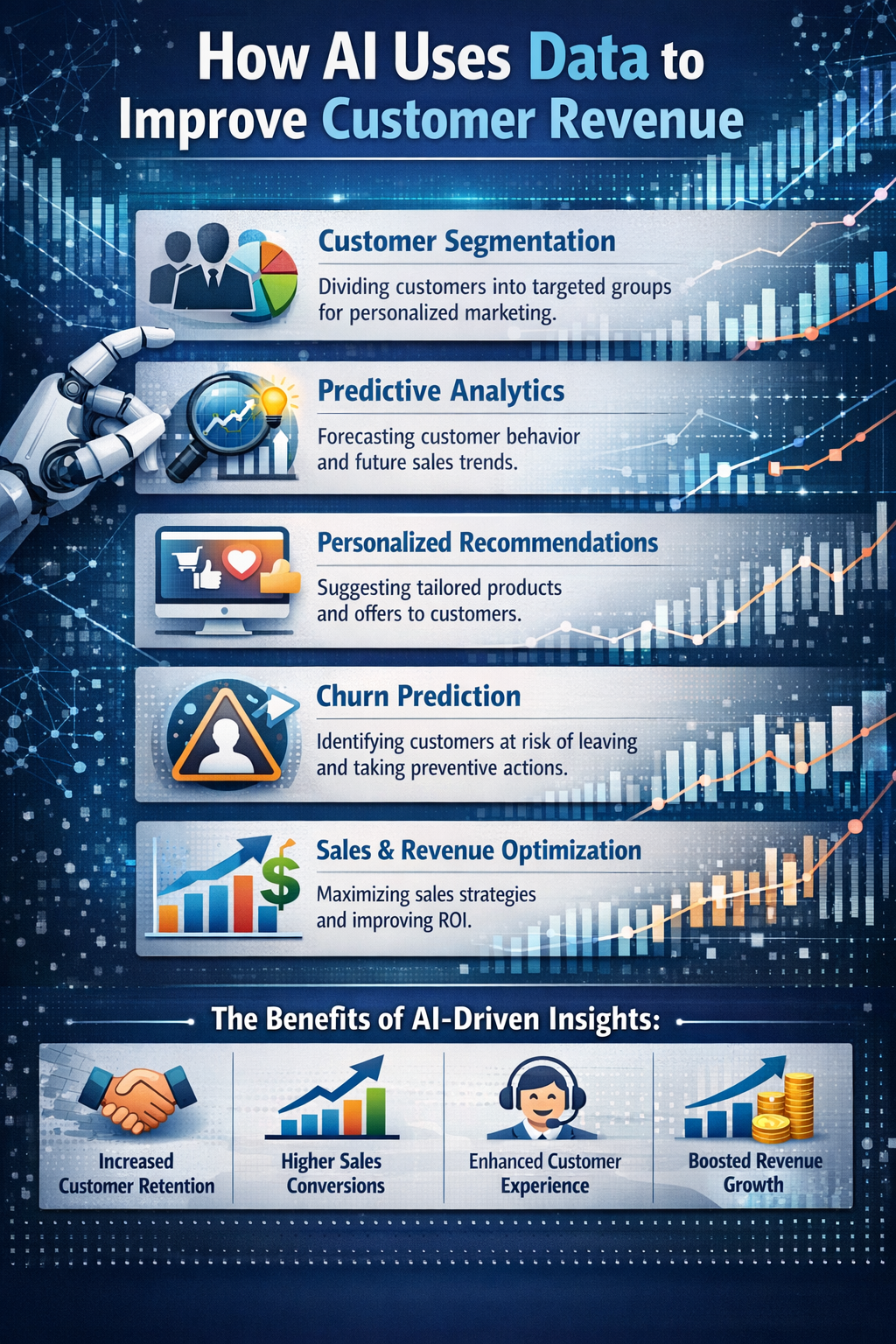
How AI Uses Data to Improve Customer Revenue (without guessing)
The most profitable growth often comes from better decisions, not louder marketing: which customers to prioritize, what offer to recommend next, when to prevent churn, and how to reduce cost-to-serve. AI helps by turning messy customer data into predictive signals and next-best actions.
Best answer: what AI “does” with customer data
This is why “AI + customer experience” often shows up as: personalization (more relevant journeys) and next-best experience/action (recommended steps that reduce churn and improve cross-sell/upsell). :contentReference[oaicite:0]{index=0}
What data matters most (and what to ignore)
High-signal customer data (start here)
- Engagement signals: email opens/clicks, page views, replies, meeting attendance, repeat visits
- Journey signals: where they drop off (checkout, onboarding, renewal)
- Purchase signals: frequency, order size, product mix, upgrade history
- Support signals: ticket volume, unresolved issues, sentiment, refund patterns
- Identity + fit signals: industry, role, company size, use case (when available)
Low-signal data (don’t over-invest early)
- Vanity metrics without conversion linkage (e.g., reach with no downstream action)
- Overly complex dashboards no one checks weekly
- Random “data collection” without decisions tied to it
4 revenue use cases AI can improve
1) Revenue intelligence (predict what’s likely to happen)
AI can detect patterns across your funnel (win/loss, deal velocity, engagement signals) to forecast pipeline health and highlight what needs attention before opportunities are lost. :contentReference[oaicite:2]{index=2}
Revenue impact: better prioritization → higher close rate, fewer stalled deals.
2) Personalization that actually drives purchases
When personalization is executed well, research consistently shows meaningful revenue lift—often cited in the 5–25% range depending on industry and execution maturity. :contentReference[oaicite:3]{index=3}
Revenue impact: higher conversion + higher repeat purchase because the journey becomes more relevant.
3) Next-best action (upsell/cross-sell without being pushy)
Next-best-action/experience models recommend what to do with a customer in real time—often improving cross-sell/upsell and lowering churn when deployed as a journey capability (not just “offers”). :contentReference[oaicite:4]{index=4}
Revenue impact: expansion happens as “next step help,” not random promotions.
4) Churn prediction + proactive retention
AI can parse customer behavior data to better predict which customers are at risk of churning, enabling proactive intervention (support, education, offer adjustments). :contentReference[oaicite:5]{index=5}
Revenue impact: retention compounds LTV; keeping the right customers is often far cheaper than acquiring new ones. :contentReference[oaicite:6]{index=6}
The simple system: Signal → Decision → Action
| Step | What you do | Example output | Revenue effect |
|---|---|---|---|
| 1) Signal | Define 5–10 measurable customer signals | Engagement score, churn risk flags, upgrade readiness | Less guessing |
| 2) Decision | Create rules for “what action to take” | If churn risk high → send help + recap + next step | Faster intervention |
| 3) Action | Automate messages/workflows where safe | Personalized onboarding, renewal sequence, NBA prompts | More conversion + retention |
A 14-day quick-start plan (SME-friendly)
Days 1–3: pick one revenue objective
- Choose ONE: reduce churn, increase upsell, increase conversion, shorten sales cycle
- Define success: “Improve X by Y% within 60 days”
Days 4–6: define your 8–10 signals
- 3 engagement signals (e.g., last activity, key page visited, replies)
- 2 purchase signals (e.g., repeat rate, upgrade history)
- 2 support signals (e.g., ticket volume, unresolved cases)
- 1 fit signal (e.g., segment/type)
Days 7–10: design 3 next-best actions
- Churn save: help → proof → next step
- Expansion: next friction removal add-on (cross-sell) or upgrade ladder (upsell)
- Acceleration: short “best answer” reply + one CTA
Days 11–14: automate the safest parts
- Automate: onboarding steps, reminders, FAQ answers, progress recaps
- Keep human: pricing exceptions, sensitive churn conversations, complex objections
Common mistakes (and how to avoid them)
- Mistake 1: collecting data without decisions tied to it → Fix: every metric must trigger an action
- Mistake 2: automating persuasion too early → Fix: automate clarity, timing, and follow-through first
- Mistake 3: personalization without proof → Fix: pair offers with proof cues and outcomes
- Mistake 4: one-size-fits-all retention → Fix: use journey stages/cohorts where possible
FAQ
Do I need a big CRM to use AI for revenue analytics?
No. Start with consistent signals (engagement, purchase, support) and a simple Signal → Decision → Action system. Many “AI wins” come from small, repeatable interventions like churn-risk nudges and progress recaps. :contentReference[oaicite:7]{index=7}
What’s the first AI use case most SMEs should implement?
The fastest ROI is usually: activation + retention (First Win onboarding, churn-risk detection, and proactive support). Keeping customers is typically far cheaper than acquiring new ones. :contentReference[oaicite:8]{index=8}
How does AI increase upsell/cross-sell without being spammy?
By recommending the next best step based on behavior and journey stage (next-best experience/action), and by positioning the offer as friction removal—not “more selling.” :contentReference[oaicite:9]{index=9}
Next step
If you want to know where to start (customer clarity, brand consistency, demand, or revenue/retention), take the DigitalAI assessment and get a practical direction for your next move.