
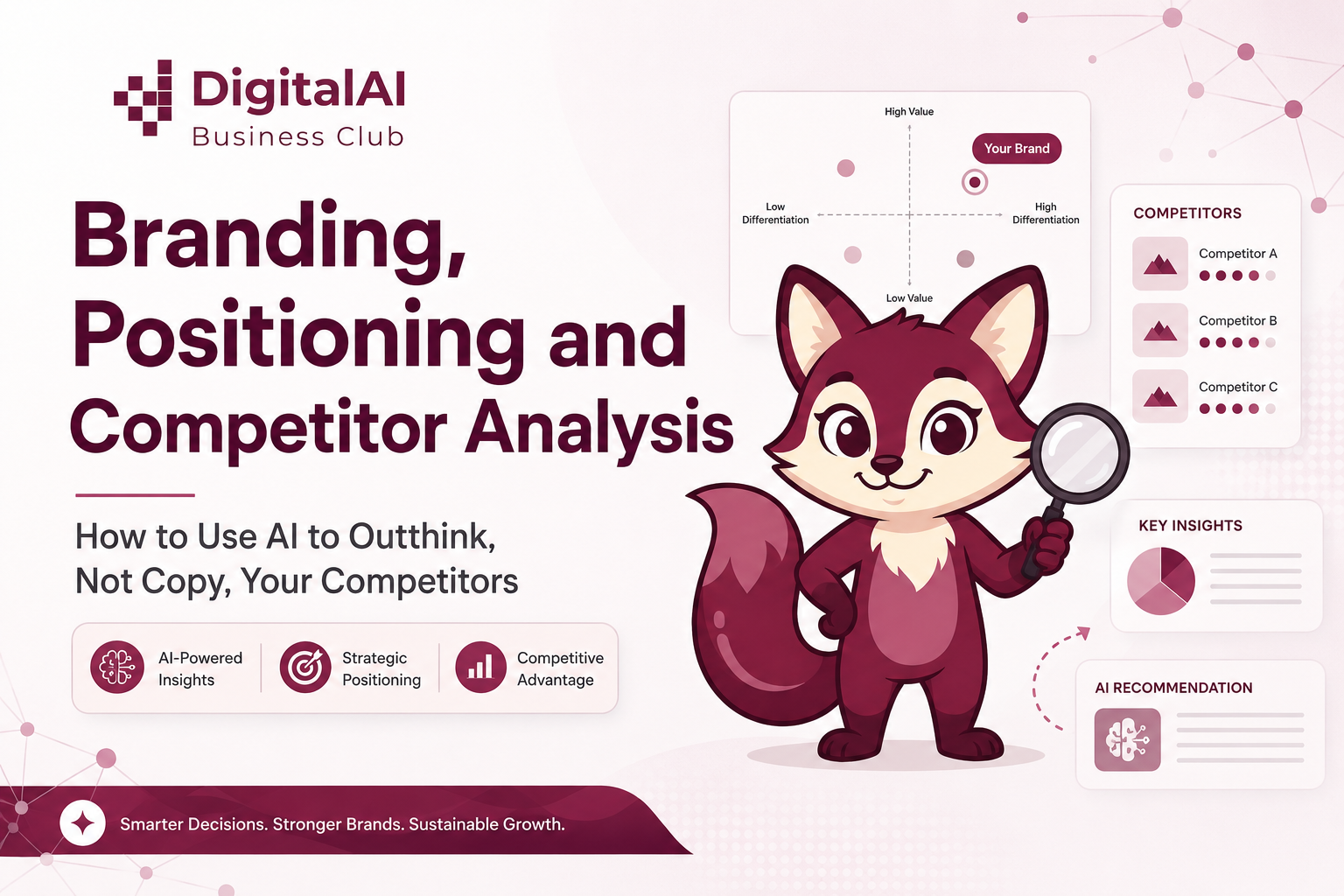
Branding, Positioning and Competitor Analysis: How to Use AI to Outthink, Not Copy, Your Competitors
AI can help you research the market faster. Strategy helps you choose the space your brand should own in the customer’s mind.
Quick Answer
AI can help businesses analyse competitors by reviewing websites, offers, pricing, content, reviews, testimonials, and brand messages. But the goal is not to copy competitors. The real goal is to identify market gaps, reframe competitor strengths, and create a clearer brand position that customers can remember.
Many business owners look at competitors for one reason:
“What are they doing, and how can we do the same?”
That is understandable. Competitor research feels practical. You look at their website, pricing, social media, content, offers, testimonials, and product features. Then you try to improve your own version.
But this is also where many brands become invisible.
They copy the language of the market. They follow the same content angles. They make similar promises. They compete on similar features. Then they wonder why customers only compare price.
The real purpose of competitor analysis is not to copy your competitors.
The real purpose is to understand the battlefield clearly, then choose a position your brand can own in the customer’s mind.
This is where branding, positioning, and AI become powerful.
1. Branding Is Not Just Your Logo
Many people still think branding means logo, colour, font, design, or slogan.
Those things matter, but they are not the full brand.
Your brand is the meaning people attach to your business. It is the feeling, expectation, trust, and memory that customers carry after interacting with you.
A business may say it is professional, innovative, caring, premium or different. But the market decides whether that is true.
If your customer experience is slow, confusing, generic, or inconsistent, that becomes your brand.
A logo can make you look polished. But positioning makes you remembered.
2. What the Book Positioning Teaches Us
The classic marketing book Positioning: The Battle for Your Mind by Al Ries and Jack Trout introduced a powerful idea: marketing is not only a battle of products. It is a battle for the customer’s mind.
Customers are overloaded with information. They do not have time to study every brand deeply. So they simplify.
They remember categories, leaders, contrasts, simple ideas, and brands that stand for something clear.
That is why positioning is not about saying everything you can do.
Positioning is about choosing the one clear space you want to occupy in the mind of your ideal customer.
For SMEs, coaches, consultants, trainers, agencies, and professional service providers, this is especially important.
You may not have the biggest budget. You may not have the largest team. You may not have the most famous brand.
But you can still win if you own a sharper position.
3. Why Competitor Analysis Often Leads to Weak Strategy
Traditional competitor analysis often produces a long spreadsheet. You compare pricing, features, products, services, website messages, social media platforms, content frequency, customer reviews, strengths, weaknesses, opportunities and threats.
This is useful, but it is not enough.
The danger is that after completing the analysis, many businesses ask the wrong question:
“How do we match them?”
That question leads to copying.
A better question is:
“What are they over-claiming, under-serving, ignoring, or making too complicated?”
That question leads to positioning.
Your goal is not to become a slightly better copy of your competitor. Your goal is to become the obvious choice for a specific customer, problem, belief, or outcome.
4. How AI Changes Competitor Analysis
AI can help business owners conduct competitor research much faster.
Instead of manually reading ten websites, collecting screenshots, studying social media posts, analysing customer reviews, and summarising offers, AI can help structure the information.
You can use AI to analyse competitor websites, landing pages, social media posts, blog articles, testimonials, reviews, pricing pages, lead magnets, sales pages, ad messages, webinar topics, product descriptions, brand tone, customer complaints and content positioning.
But AI should not replace your strategy.
AI helps you collect and summarise the market. You still need to decide what your brand should stand for.
Think of AI as your research assistant, not your positioning strategist.
5. The AI Positioning Advantage Framework
Here is a practical framework businesses can use:
Research: Use AI to study competitors’ websites, offers, pricing, content, reviews, testimonials, and messaging.
Compare: Organise findings into SWOT, feature comparison, scoring card, review tracker, and content analysis.
Reframe: Look at competitor strengths and identify how those strengths may also create weaknesses or gaps.
Position: Choose a clear space your brand can own in the customer’s mind.
Guide: Turn your final positioning into a brand guide, message pillars, tone of voice, and sales language.
Communicate: Apply the positioning across your website, social media, sales deck, proposals, workshops, and content.
6. Step 1: Research the Market
Ask AI to analyse your competitors across key areas:
- Who are they targeting?
- What problem do they claim to solve?
- What is their main offer?
- What promise do they make?
- What proof do they show?
- What tone of voice do they use?
- What content topics do they repeat?
- What objections do they address?
- What do customers praise?
- What do customers complain about?
At this stage, your goal is not to judge. Your goal is to observe. You are building a clear picture of the market conversation.
7. Step 2: Build a Competitor SWOT
Next, organise the findings into SWOT:
- Strengths: What are competitors doing well?
- Weaknesses: Where are they underperforming?
- Opportunities: What market needs are growing?
- Threats: What risks or vulnerabilities may affect them?
But remember: SWOT is only diagnosis.
It tells you what is happening. It does not automatically tell you what position to choose.
8. Step 3: Create a Positioning Map
A positioning map helps you see where competitors sit in the customer’s mind. Choose two important buying factors.
| Positioning Axis 1 | Positioning Axis 2 |
|---|---|
| Premium vs Affordable | Strategic vs Tactical |
| Human-led vs Tool-led | Enterprise-focused vs SME-focused |
| Fast Automation vs Guided Transformation | Generic AI vs Business-specific AI |
| Done-for-you vs Learn-to-do | Technical Expert vs Business Advisor |
Then plot your competitors. This helps you see the empty space.
For example, in the AI training market, many providers may position themselves around tools, automation, prompting, productivity, technical skills, and software demos.
That creates an opportunity for a different position:
AI strategy for business growth. AI implementation for SMEs. AI for decision-making, not just content creation. AI transformation before automation.
This is how you stop competing in a crowded space. You do not shout louder. You stand somewhere clearer.
9. Step 4: Reframe Competitor Strengths
This is where positioning becomes powerful.
Do not only look at competitor weaknesses. Look at their strengths and ask:
“How can this strength also become a weakness?”
| Competitor Strength | Possible Reframe | Your Positioning Opportunity |
|---|---|---|
| Large company | May feel slow, generic, or impersonal | Personalised, agile, founder-led support |
| Low-cost provider | May lack strategic guidance | Business-outcome-driven advisory |
| Tool expert | May focus too much on software, not business results | AI strategy before automation |
| Many features | May feel complex and overwhelming | Simple, guided, practical implementation |
| Fast automation agency | May automate before clarifying strategy | Diagnose first, automate second |
This is not about attacking competitors. It is about reframing the market.
Instead of saying, “We also provide AI training,” you can say:
“Most AI training teaches tools. We help business owners turn AI into decisions, systems, productivity, customer growth, and revenue opportunities.”
That is a positioning shift.
10. Step 5: Define Your Positioning Statement
Use this simple structure:
Example:
A strong positioning statement should be clear, specific, memorable, customer-focused, different from competitors, difficult to copy, and connected to a real customer problem.
Avoid vague statements like “we provide innovative solutions,” “we help businesses grow,” or “we are your trusted partner.” These sound professional, but they do not create a strong position.
A strong position creates contrast.
11. Step 6: Turn Positioning into a Brand Guide
Once your positioning is clear, you can use AI to build a practical brand guide.
Your brand guide should include brand promise, target audience, customer pain points, desired transformation, market belief, core message, message pillars, tone of voice, proof points, content themes, taglines, website headline, sales page angle, LinkedIn positioning, FAQ responses, objection handling, and competitor response.
This is where AI becomes useful again. Once you have made the strategic decision, AI can help turn it into communication assets.
12. Useful AI Skills for Branding and Competitor Analysis
Instead of repeating the same prompts every time, you can create reusable AI skills.
Skill 1: Competitor Intelligence Scanner
Purpose: Analyse competitor websites, offers, content, reviews, and brand messaging.
Output: Target audience, core offer, main promise, pricing model, proof points, tone of voice, strengths, weaknesses, content themes, customer complaints, and possible positioning gaps.
Skill 2: SWOT-to-Positioning Strategist
Purpose: Turn SWOT findings into strategic positioning options.
Output: Market gaps, competitor vulnerabilities, underserved audience segments, reframe opportunities, positioning angles, and strategic direction.
Skill 3: Brand Positioning Map Generator
Purpose: Suggest useful 2×2 positioning maps.
Output: Recommended positioning axes, competitor placement, your brand placement, white-space opportunities, and strategic interpretation.
Skill 4: Anti-Copy Positioning Coach
Purpose: Help businesses differentiate without copying competitors.
Output: How to reframe competitor strengths, what not to copy, alternative positioning ideas, and a sharper market point of view.
Skill 5: Brand Guide Builder
Purpose: Turn positioning into a usable brand communication guide.
Output: Brand promise, tone of voice, messaging pillars, tagline options, website headline, social media themes, sales message, CTA suggestions, and objection-handling language.
Skill 6: Competitor Battle Card Creator
Purpose: Help sales, marketing, and founders respond when prospects compare competitors.
Output: Competitor strengths, competitor weaknesses, how we win, what to say in sales conversations, what not to say, proof points, case study angles, and objection responses.
13. Practical Google Sheet Workflow
A simple Google Sheet competitor analysis workflow can include these tabs:
| Sheet Tab | Purpose |
|---|---|
| Competitor List | Track competitor name, website, offer, target market, pricing, and key message. |
| SWOT Analysis | Identify strengths, weaknesses, opportunities, and threats for each competitor. |
| Feature Comparison | Compare important buying factors, not just product features. |
| Content Marketing Review | Track blog topics, social media themes, lead magnets, email strategy, and visibility. |
| Review Tracker | Collect customer praise, complaints, repeated words, and emotional signals. |
| Positioning Map | Plot competitors using two strategic axes. |
| Brand Gap Analysis | Identify what competitors are not addressing. |
| Positioning Options | Generate three to five possible positions for your brand. |
| Final Brand Position | Choose one clear positioning statement. |
| Brand Guide | Translate the final position into messaging, content, sales, and visual direction. |
This turns competitor analysis from a static research document into a strategic decision tool.
14. The Strategic Mistake: Competing on Features Alone
Many businesses compare competitors feature by feature. This can be useful, but it is dangerous if it becomes the main strategy.
Feature comparison usually leads to more features, more discounts, more bundles, more claims, and more confusion.
But customers do not always choose the business with the longest feature list.
They choose the business that feels most relevant to their problem: a consultant who understands their situation, a trainer who makes the topic practical, a software provider that reduces complexity, a service provider that gives confidence, or a community that helps them take action.
Positioning is not only about what you offer. It is about what the customer believes you are best suited to solve.
15. Example: AI Training Market
Let’s say you are in the AI training market.
Many competitors may say: learn ChatGPT, master AI tools, automate your business, use prompts to save time, create content faster, or build AI agents.
These are valid, but they are becoming common.
A stronger positioning angle could be:
AI strategy before automation.
This creates a different market frame.
It says: do not chase tools, do not automate broken processes, do not train everyone the same way, do not use AI without business direction, and do not measure AI success only by time saved.
Instead: start with business goals, identify productivity leaks, map customer journey gaps, train teams by role, build AI habits into daily work, and connect AI usage to revenue, customer experience, and decision quality.
Now the brand is not competing as another AI tool trainer. It is positioned as a strategic guide for AI adoption.
That is a stronger and more defensible space.
16. Better Prompts for AI Competitor Analysis
Prompt 1: Competitor Website Analysis
Prompt 2: SWOT Analysis
Prompt 3: Positioning Gap Finder
Prompt 4: Reframe Competitor Strengths
Prompt 5: Positioning Statement
Prompt 6: Brand Guide
17. Final Thought: Do Not Compete Louder. Compete Clearer.
Competitor analysis should not make you more reactive. It should make you more strategic.
AI gives business owners a faster way to understand the market. It can scan competitors, summarise messages, organise SWOT, analyse reviews, and identify repeated patterns.
But AI is only useful when guided by strategic thinking.
The goal is not to copy what competitors are doing.
The goal is to see the market clearly, understand what customers already believe, identify the empty space, and choose a position that your brand can own.
In the age of AI, information is easier to get. But clear positioning is still rare.
The businesses that win will not be the ones producing the most content or chasing the most tools.
They will be the ones who know exactly what they stand for, who they serve, what problem they solve, and why they are the obvious choice.
Turn AI Confusion into Business Clarity
Join DigitalAI Business Club and learn practical AI strategy workflows for business growth, competitor analysis, content, productivity, and customer acquisition.
Explore DigitalAI Business ClubFrequently Asked Questions
How can AI help with competitor analysis?
AI can help analyse competitor websites, offers, pricing, content, reviews, testimonials, and brand messages. It helps summarise market patterns faster so business owners can make clearer strategic decisions.
What is the difference between branding and positioning?
Branding is the overall perception people have of your business. Positioning is the specific space you want to occupy in the customer’s mind compared with competitors.
Should I copy my competitors if they are successful?
No. Competitor analysis should help you understand the market, not copy it. The stronger strategy is to identify what competitors are not addressing and create a clearer position around that gap.
What comes after SWOT analysis?
After SWOT, create a positioning map, identify white-space opportunities, reframe competitor strengths, and define a clear positioning statement.
Can AI create a brand guide?
Yes. Once your positioning is clear, AI can help create your brand promise, tone of voice, message pillars, content themes, tagline options, website headline, sales message, and CTA.