
The Real Impact of AI on Job Functions — Through Kai-Fu Lee’s Lens
AI is not eliminating work in one dramatic sweep. It is reshaping the nature of work—role by role, decision by decision. Renowned AI expert Kai-Fu Lee offers a practical way to understand this shift—not by job titles, but by what humans actually contribute inside a role.
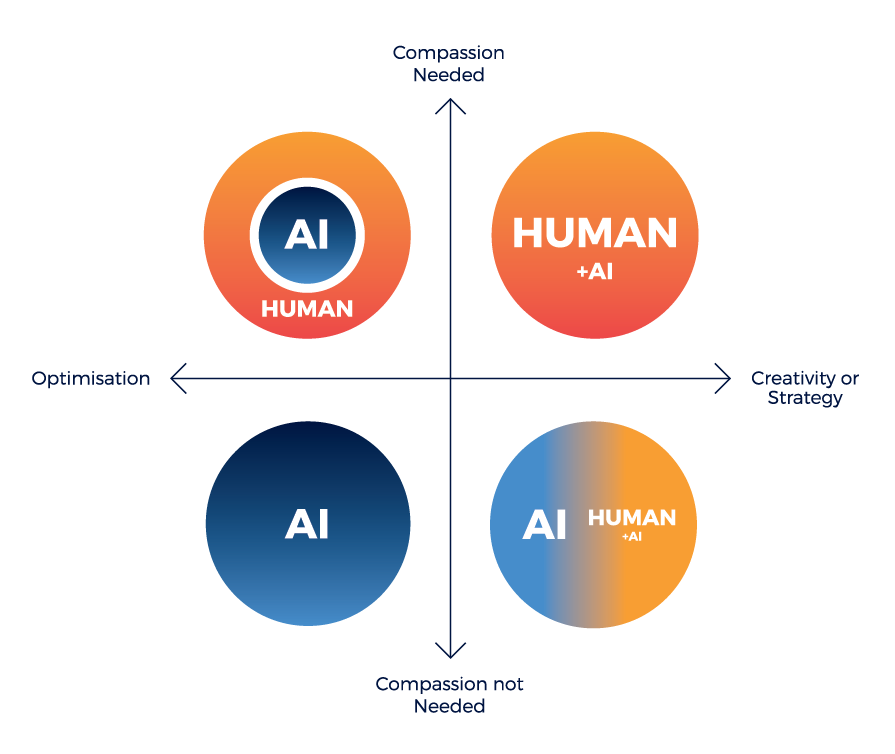
Across industries, AI tends to affect roles differently depending on two forces:
- How human-centric the work is (trust, empathy, relationship, judgment)
- How standardised or optimisable the work has become (repeatable steps, rules, predictable outputs)
From this perspective, we can see four patterns emerging.
1) Roles with Strong Human Touch — Assisted, Not Replaced
Some jobs are deeply social and relationship-driven, yet still involve routine coordination or optimisation. These roles won’t be replaced—but they will be augmented.
Examples:
- Teachers
- General practitioners
- Wedding planners
- Tour guides
AI can streamline scheduling, documentation, planning, and analysis—while the human stays at the centre. AI works in the background; people deliver the trust.
2) Roles Anchored in Compassion and Strategic Creativity — The Most Resilient
Other roles depend heavily on human judgment, emotional intelligence, and strategy. AI may support with insights, but it cannot lead the work.
Examples:
- PR directors
- Psychiatrists
- Social workers
- Criminal defense attorneys
- High-end concierge services
These roles require context, ethics, persuasion, and trust. As AI advances, these roles don’t disappear— they often become more valuable.
3) Roles Built on Repetition and Standardisation — Under the Greatest Pressure
Some jobs consist mainly of predictable, rules-based tasks with limited human interaction. These functions are most exposed because machines excel at pattern recognition, consistency, and speed.
Examples:
- Customer service representatives
- Tax preparers
- Claims adjusters
- Radiologists
This doesn’t mean people vanish overnight. But the job content shifts toward oversight, exception handling, and higher-level decision support.
4) Creative but Isolated Roles — Gradual, Subtle Disruption
There are roles that involve creativity, but minimal social interaction. AI can generate drafts, concepts, and analysis—raising the bar for differentiation.
Examples:
- Graphic designers
- Columnists
- Analysts
- Researchers
- Artists
The disruption here is slower, but persistent. The advantage shifts from “output” to taste, judgment, and originality.
What This Means for Leaders and Professionals
The real lesson isn’t fear—it’s clarity. AI doesn’t replace people. It replaces predictability.
- The more a role requires context, the more human value increases.
- The more a role requires ethics and trade-offs, the more human judgment matters.
- The more a role requires empathy and trust, the more AI becomes a support layer—not a replacement.
That’s why AI adoption is not a technical decision—it’s a leadership decision. Leaders must decide what should be automated, what must remain human, and where judgment—not efficiency—is the advantage.

Jane helps business owners, leaders, and professionals cut through AI hype and turn AI into clear, executable business strategy — improving productivity, strengthening decision-making, and future-proofing organisations before automation.